In Spain, a match starts well before kick-off. In fact, for most of us, it starts in the kitchen. Long before even setting foot in the stadium, people are already preparing what has become a fundamental tradition for football fans across the country: a baguette with the fillings of their choice, known as a bocadillo. Whether the filling is a typical Spanish omelette (tortilla de patatas), calamari (calamares), Iberian ham (jamón ibérico), or something a bit more inventive – I personally go for bacon, eggs and cheese – the concept remains the same. To call it “just a sandwich” misses the point entirely. The bocadillo is ritual, identity and fuel all at once, a culinary shorthand for the matchday experience.
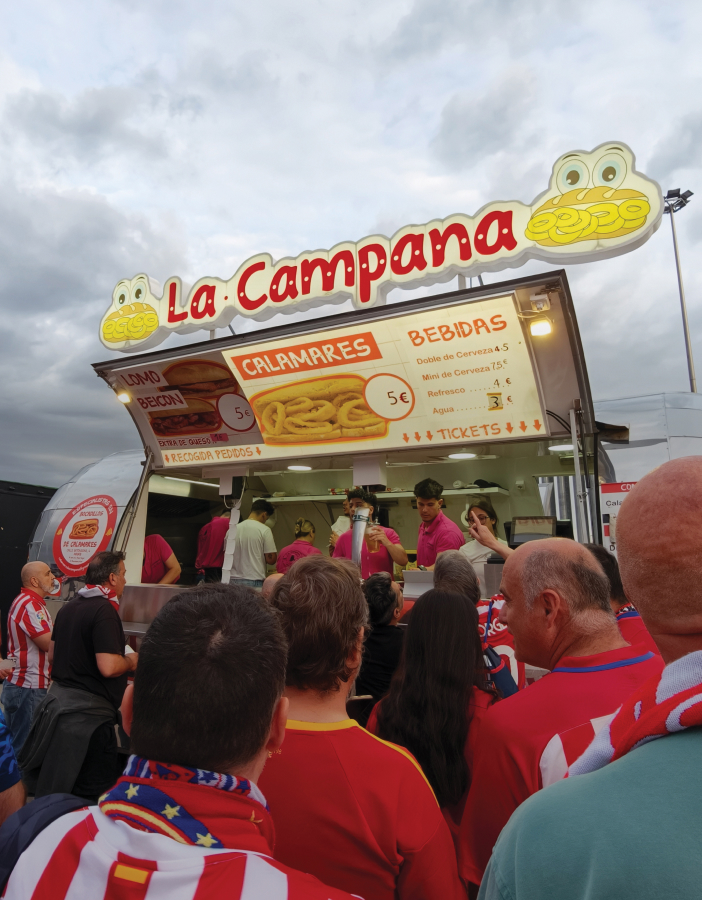
Of course, there are always those who don’t have the time or the skills in the kitchen, but that’s where the bars and kiosks around the stadium come to the rescue. Whether it’s your favourite go-to place, that one bar you have to visit as part of your pre-match ritual or a new one you want to try on the day, the options are endless and the bocadillos flow non-stop. Orders are shouted across counters, while a steady stream of beer is constantly being poured. There’s little variation in presentation, but that’s exactly the point: that consistency is comfort. You know what you’re getting, and it’s exactly what you want.
At the Metropolitano, my home stadium, a host of new food trucks have popped up outside the ground over the years, offering everything from burgers to pizzas to burritos – but to me there’s nothing quite like bringing my precious bocadillo, wrapped safely in its protective silver-foil armour in a plastic bag, and getting that familiar sense of warmth in my stomach.
“This isn't just a sandwich; the bocadillo is symbolic for so many Spanish football fans”
During the match itself, the bocadillo serves a practical purpose. Football rarely gives you a breather, especially in a Champions League quarter-final second leg against one of your biggest rivals. So, as half-time rolls around at the Metropolitano, against a backdrop of nerves and high stakes, the bocadillo becomes another essential part of the choreography. The unwrapping of the foil, the crumble of the bread, the momentary silence that follows 45 intense minutes of singing and suffering. Some fans religiously discuss what’s in today’s bocadillo with neighbours they only ever see and speak to at the stadium. Then, as quickly as the time it takes to open the plastic bag and peel away the foil, the moment is over and the players are back on the pitch. Refuelled fans resume their vertical position once again, and the nerve-racking ordeal of watching our team clinch their spot among Europe’s top four continues.
Against Barcelona in the quarter-finals, I left the stadium with a smile on my face, but there has been many a time when the result didn’t go quite how I imagined in my kitchen just a few hours earlier. And I’ve definitely caught myself dreaming of the bocadillos we’ll make before the final in Budapest…
This isn’t just a sandwich; the bocadillo is symbolic for so many Spanish football fans. It represents a version of football that scarcely exists any more, it resists the overcomplications we’re bombarded with at the stadium. No QR codes, no elaborate menus, no attempt to reinvent the experience. Just bread, filling and the shared anticipation of what’s to come.
In Spain, a match starts well before kick-off. In fact, for most of us, it starts in the kitchen. Long before even setting foot in the stadium, people are already preparing what has become a fundamental tradition for football fans across the country: a baguette with the fillings of their choice, known as a bocadillo. Whether the filling is a typical Spanish omelette (tortilla de patatas), calamari (calamares), Iberian ham (jamón ibérico), or something a bit more inventive – I personally go for bacon, eggs and cheese – the concept remains the same. To call it “just a sandwich” misses the point entirely. The bocadillo is ritual, identity and fuel all at once, a culinary shorthand for the matchday experience.
Of course, there are always those who don’t have the time or the skills in the kitchen, but that’s where the bars and kiosks around the stadium come to the rescue. Whether it’s your favourite go-to place, that one bar you have to visit as part of your pre-match ritual or a new one you want to try on the day, the options are endless and the bocadillos flow non-stop. Orders are shouted across counters, while a steady stream of beer is constantly being poured. There’s little variation in presentation, but that’s exactly the point: that consistency is comfort. You know what you’re getting, and it’s exactly what you want.
At the Metropolitano, my home stadium, a host of new food trucks have popped up outside the ground over the years, offering everything from burgers to pizzas to burritos – but to me there’s nothing quite like bringing my precious bocadillo, wrapped safely in its protective silver-foil armour in a plastic bag, and getting that familiar sense of warmth in my stomach.
“This isn't just a sandwich; the bocadillo is symbolic for so many Spanish football fans”
During the match itself, the bocadillo serves a practical purpose. Football rarely gives you a breather, especially in a Champions League quarter-final second leg against one of your biggest rivals. So, as half-time rolls around at the Metropolitano, against a backdrop of nerves and high stakes, the bocadillo becomes another essential part of the choreography. The unwrapping of the foil, the crumble of the bread, the momentary silence that follows 45 intense minutes of singing and suffering. Some fans religiously discuss what’s in today’s bocadillo with neighbours they only ever see and speak to at the stadium. Then, as quickly as the time it takes to open the plastic bag and peel away the foil, the moment is over and the players are back on the pitch. Refuelled fans resume their vertical position once again, and the nerve-racking ordeal of watching our team clinch their spot among Europe’s top four continues.
Against Barcelona in the quarter-finals, I left the stadium with a smile on my face, but there has been many a time when the result didn’t go quite how I imagined in my kitchen just a few hours earlier. And I’ve definitely caught myself dreaming of the bocadillos we’ll make before the final in Budapest…
This isn’t just a sandwich; the bocadillo is symbolic for so many Spanish football fans. It represents a version of football that scarcely exists any more, it resists the overcomplications we’re bombarded with at the stadium. No QR codes, no elaborate menus, no attempt to reinvent the experience. Just bread, filling and the shared anticipation of what’s to come.
In Spain, a match starts well before kick-off. In fact, for most of us, it starts in the kitchen. Long before even setting foot in the stadium, people are already preparing what has become a fundamental tradition for football fans across the country: a baguette with the fillings of their choice, known as a bocadillo. Whether the filling is a typical Spanish omelette (tortilla de patatas), calamari (calamares), Iberian ham (jamón ibérico), or something a bit more inventive – I personally go for bacon, eggs and cheese – the concept remains the same. To call it “just a sandwich” misses the point entirely. The bocadillo is ritual, identity and fuel all at once, a culinary shorthand for the matchday experience.
Of course, there are always those who don’t have the time or the skills in the kitchen, but that’s where the bars and kiosks around the stadium come to the rescue. Whether it’s your favourite go-to place, that one bar you have to visit as part of your pre-match ritual or a new one you want to try on the day, the options are endless and the bocadillos flow non-stop. Orders are shouted across counters, while a steady stream of beer is constantly being poured. There’s little variation in presentation, but that’s exactly the point: that consistency is comfort. You know what you’re getting, and it’s exactly what you want.
At the Metropolitano, my home stadium, a host of new food trucks have popped up outside the ground over the years, offering everything from burgers to pizzas to burritos – but to me there’s nothing quite like bringing my precious bocadillo, wrapped safely in its protective silver-foil armour in a plastic bag, and getting that familiar sense of warmth in my stomach.
“This isn't just a sandwich; the bocadillo is symbolic for so many Spanish football fans”
During the match itself, the bocadillo serves a practical purpose. Football rarely gives you a breather, especially in a Champions League quarter-final second leg against one of your biggest rivals. So, as half-time rolls around at the Metropolitano, against a backdrop of nerves and high stakes, the bocadillo becomes another essential part of the choreography. The unwrapping of the foil, the crumble of the bread, the momentary silence that follows 45 intense minutes of singing and suffering. Some fans religiously discuss what’s in today’s bocadillo with neighbours they only ever see and speak to at the stadium. Then, as quickly as the time it takes to open the plastic bag and peel away the foil, the moment is over and the players are back on the pitch. Refuelled fans resume their vertical position once again, and the nerve-racking ordeal of watching our team clinch their spot among Europe’s top four continues.
Against Barcelona in the quarter-finals, I left the stadium with a smile on my face, but there has been many a time when the result didn’t go quite how I imagined in my kitchen just a few hours earlier. And I’ve definitely caught myself dreaming of the bocadillos we’ll make before the final in Budapest…
This isn’t just a sandwich; the bocadillo is symbolic for so many Spanish football fans. It represents a version of football that scarcely exists any more, it resists the overcomplications we’re bombarded with at the stadium. No QR codes, no elaborate menus, no attempt to reinvent the experience. Just bread, filling and the shared anticipation of what’s to come.


In Spain, a match starts well before kick-off. In fact, for most of us, it starts in the kitchen. Long before even setting foot in the stadium, people are already preparing what has become a fundamental tradition for football fans across the country: a baguette with the fillings of their choice, known as a bocadillo. Whether the filling is a typical Spanish omelette (tortilla de patatas), calamari (calamares), Iberian ham (jamón ibérico), or something a bit more inventive – I personally go for bacon, eggs and cheese – the concept remains the same. To call it “just a sandwich” misses the point entirely. The bocadillo is ritual, identity and fuel all at once, a culinary shorthand for the matchday experience.
Of course, there are always those who don’t have the time or the skills in the kitchen, but that’s where the bars and kiosks around the stadium come to the rescue. Whether it’s your favourite go-to place, that one bar you have to visit as part of your pre-match ritual or a new one you want to try on the day, the options are endless and the bocadillos flow non-stop. Orders are shouted across counters, while a steady stream of beer is constantly being poured. There’s little variation in presentation, but that’s exactly the point: that consistency is comfort. You know what you’re getting, and it’s exactly what you want.
At the Metropolitano, my home stadium, a host of new food trucks have popped up outside the ground over the years, offering everything from burgers to pizzas to burritos – but to me there’s nothing quite like bringing my precious bocadillo, wrapped safely in its protective silver-foil armour in a plastic bag, and getting that familiar sense of warmth in my stomach.
“This isn't just a sandwich; the bocadillo is symbolic for so many Spanish football fans”
During the match itself, the bocadillo serves a practical purpose. Football rarely gives you a breather, especially in a Champions League quarter-final second leg against one of your biggest rivals. So, as half-time rolls around at the Metropolitano, against a backdrop of nerves and high stakes, the bocadillo becomes another essential part of the choreography. The unwrapping of the foil, the crumble of the bread, the momentary silence that follows 45 intense minutes of singing and suffering. Some fans religiously discuss what’s in today’s bocadillo with neighbours they only ever see and speak to at the stadium. Then, as quickly as the time it takes to open the plastic bag and peel away the foil, the moment is over and the players are back on the pitch. Refuelled fans resume their vertical position once again, and the nerve-racking ordeal of watching our team clinch their spot among Europe’s top four continues.
Against Barcelona in the quarter-finals, I left the stadium with a smile on my face, but there has been many a time when the result didn’t go quite how I imagined in my kitchen just a few hours earlier. And I’ve definitely caught myself dreaming of the bocadillos we’ll make before the final in Budapest…
This isn’t just a sandwich; the bocadillo is symbolic for so many Spanish football fans. It represents a version of football that scarcely exists any more, it resists the overcomplications we’re bombarded with at the stadium. No QR codes, no elaborate menus, no attempt to reinvent the experience. Just bread, filling and the shared anticipation of what’s to come.
In Spain, a match starts well before kick-off. In fact, for most of us, it starts in the kitchen. Long before even setting foot in the stadium, people are already preparing what has become a fundamental tradition for football fans across the country: a baguette with the fillings of their choice, known as a bocadillo. Whether the filling is a typical Spanish omelette (tortilla de patatas), calamari (calamares), Iberian ham (jamón ibérico), or something a bit more inventive – I personally go for bacon, eggs and cheese – the concept remains the same. To call it “just a sandwich” misses the point entirely. The bocadillo is ritual, identity and fuel all at once, a culinary shorthand for the matchday experience.
Of course, there are always those who don’t have the time or the skills in the kitchen, but that’s where the bars and kiosks around the stadium come to the rescue. Whether it’s your favourite go-to place, that one bar you have to visit as part of your pre-match ritual or a new one you want to try on the day, the options are endless and the bocadillos flow non-stop. Orders are shouted across counters, while a steady stream of beer is constantly being poured. There’s little variation in presentation, but that’s exactly the point: that consistency is comfort. You know what you’re getting, and it’s exactly what you want.
At the Metropolitano, my home stadium, a host of new food trucks have popped up outside the ground over the years, offering everything from burgers to pizzas to burritos – but to me there’s nothing quite like bringing my precious bocadillo, wrapped safely in its protective silver-foil armour in a plastic bag, and getting that familiar sense of warmth in my stomach.
“This isn't just a sandwich; the bocadillo is symbolic for so many Spanish football fans”
During the match itself, the bocadillo serves a practical purpose. Football rarely gives you a breather, especially in a Champions League quarter-final second leg against one of your biggest rivals. So, as half-time rolls around at the Metropolitano, against a backdrop of nerves and high stakes, the bocadillo becomes another essential part of the choreography. The unwrapping of the foil, the crumble of the bread, the momentary silence that follows 45 intense minutes of singing and suffering. Some fans religiously discuss what’s in today’s bocadillo with neighbours they only ever see and speak to at the stadium. Then, as quickly as the time it takes to open the plastic bag and peel away the foil, the moment is over and the players are back on the pitch. Refuelled fans resume their vertical position once again, and the nerve-racking ordeal of watching our team clinch their spot among Europe’s top four continues.
Against Barcelona in the quarter-finals, I left the stadium with a smile on my face, but there has been many a time when the result didn’t go quite how I imagined in my kitchen just a few hours earlier. And I’ve definitely caught myself dreaming of the bocadillos we’ll make before the final in Budapest…
This isn’t just a sandwich; the bocadillo is symbolic for so many Spanish football fans. It represents a version of football that scarcely exists any more, it resists the overcomplications we’re bombarded with at the stadium. No QR codes, no elaborate menus, no attempt to reinvent the experience. Just bread, filling and the shared anticipation of what’s to come.
In Spain, a match starts well before kick-off. In fact, for most of us, it starts in the kitchen. Long before even setting foot in the stadium, people are already preparing what has become a fundamental tradition for football fans across the country: a baguette with the fillings of their choice, known as a bocadillo. Whether the filling is a typical Spanish omelette (tortilla de patatas), calamari (calamares), Iberian ham (jamón ibérico), or something a bit more inventive – I personally go for bacon, eggs and cheese – the concept remains the same. To call it “just a sandwich” misses the point entirely. The bocadillo is ritual, identity and fuel all at once, a culinary shorthand for the matchday experience.
Of course, there are always those who don’t have the time or the skills in the kitchen, but that’s where the bars and kiosks around the stadium come to the rescue. Whether it’s your favourite go-to place, that one bar you have to visit as part of your pre-match ritual or a new one you want to try on the day, the options are endless and the bocadillos flow non-stop. Orders are shouted across counters, while a steady stream of beer is constantly being poured. There’s little variation in presentation, but that’s exactly the point: that consistency is comfort. You know what you’re getting, and it’s exactly what you want.
At the Metropolitano, my home stadium, a host of new food trucks have popped up outside the ground over the years, offering everything from burgers to pizzas to burritos – but to me there’s nothing quite like bringing my precious bocadillo, wrapped safely in its protective silver-foil armour in a plastic bag, and getting that familiar sense of warmth in my stomach.
“This isn't just a sandwich; the bocadillo is symbolic for so many Spanish football fans”
During the match itself, the bocadillo serves a practical purpose. Football rarely gives you a breather, especially in a Champions League quarter-final second leg against one of your biggest rivals. So, as half-time rolls around at the Metropolitano, against a backdrop of nerves and high stakes, the bocadillo becomes another essential part of the choreography. The unwrapping of the foil, the crumble of the bread, the momentary silence that follows 45 intense minutes of singing and suffering. Some fans religiously discuss what’s in today’s bocadillo with neighbours they only ever see and speak to at the stadium. Then, as quickly as the time it takes to open the plastic bag and peel away the foil, the moment is over and the players are back on the pitch. Refuelled fans resume their vertical position once again, and the nerve-racking ordeal of watching our team clinch their spot among Europe’s top four continues.
Against Barcelona in the quarter-finals, I left the stadium with a smile on my face, but there has been many a time when the result didn’t go quite how I imagined in my kitchen just a few hours earlier. And I’ve definitely caught myself dreaming of the bocadillos we’ll make before the final in Budapest…
This isn’t just a sandwich; the bocadillo is symbolic for so many Spanish football fans. It represents a version of football that scarcely exists any more, it resists the overcomplications we’re bombarded with at the stadium. No QR codes, no elaborate menus, no attempt to reinvent the experience. Just bread, filling and the shared anticipation of what’s to come.