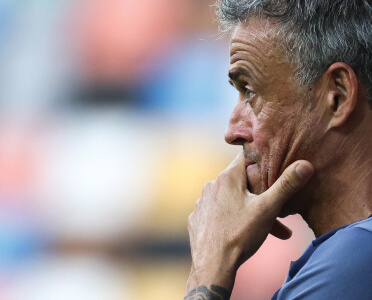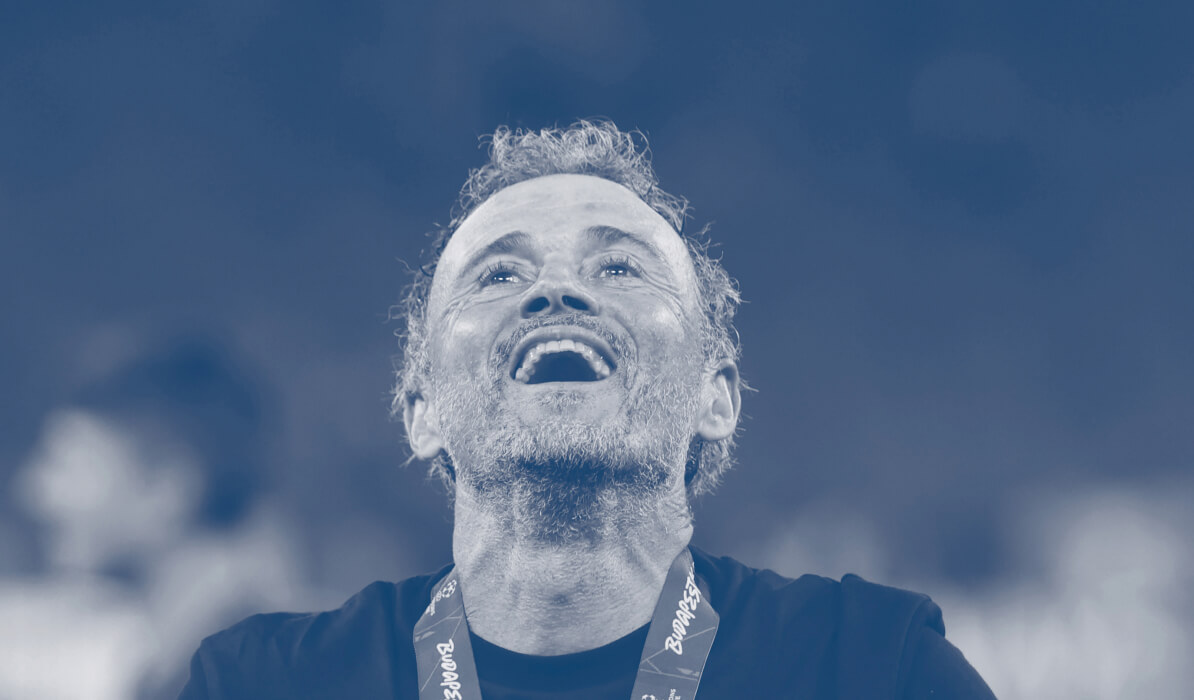
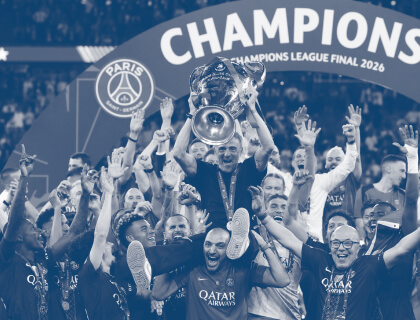
Luis Enrique Martinez is undoubtedly elevating himself, and this era of Paris Saint-Germain football, onto the all-time pantheon of European greatness. Not simply for a relentless commitment to winning and trophy-lifting but for the Paris brand of football and how enamoured neutrals are with how the Spaniard’s team plays. All of which takes a huge amount of skill but even more hard work, a point he emphasises in this chat.
The 56-year-old has intense energy levels and applies them to daily preparation, on the training pitches and in video analysis, meaning that a coach must re-charge his batteries with diligence whenever the opportunity presents itself.
On the evidence of this meeting, his rivals, both domestically and in the Champions League, should be aware that Luis Enrique is buzzing again: bouncing into the interview room full of jokes, smiles, generosity of attitude and giving all of us present an idea of what it must be like to be on the end of his teaching skills every day on Paris’ Poissy training ground.
During our conversation it’s obvious he has squeezed every last drop of fun, relaxation and energy from the summer. Fit, tanned and crackling with energy he happily admits that re-conquering Europe plus tilting at a venerated Real Madrid Champions League record continue to drive his voracious ambition and enthusiasm. Read for yourself…
A coach doesn’t completely disconnect. You have meetings, you need to organise the next season. We have to make a lot of decisions over the summer. You disconnect because you don’t go to your workplace, but you are always connected to the club. I didn’t stay in Paris; I went away with my family for seven weeks, which is an unusual amount of time to rest in football. It did me good. You try to disconnect as much as possible, but you are always connected because everyone talks to you about the season, people congratulate you for the titles you won. It sounds beautiful, but it shows how a coach never disconnects.
I didn’t watch any of the matches that started after 10pm because resting was my priority. But the next morning I always checked out the results and watched the highlights. I followed the World Cup like any other football fan, especially my national team.
Aberdeen is very close to your heart, just as Gijón is very close to mine. I consider myself an ambassador for Gijón, although I haven’t lived there in over 30 years because of my work. But I’m from Gijón, I’m proud of that, and I’ve always been a Sporting [de Gijón] fan. To be honoured while still alive, and to be able to dedicate it to my parents for all their effort, to my wife, to my family, to my people and in my country, for someone from Gijón, was amazing. It was a very special day, one of the best days of my life. It was so emotional that I struggled to speak; there was a moment when I thought I wasn’t going to be able to, and you know I’m very used to talking. It’s a day I will never forget.
You know me, Graham. I’m not a genius and I don’t want to be. I’m a person who dedicates all the time in the world to trying to compete in the best way. I believe I was born to compete, because that’s where I feel most comfortable. Whether it’s playing Parchís, tennis, padel or football or training, that’s what I love. Then, I have a constant obsession with trying to improve performances, my connection with the players, with the team, the demands placed on me, having empathy with the players, and getting more out of them. But I like to do it by convincing them, not just because I’m the coach and I tell you to do something.
I try to understand the game and explain it to the players in the simplest way possible. That’s what motivates me to keep improving. When people tell me that I’ve won a lot of titles it’s irrelevant; it belongs to the past, it’s history. We have to keep winning. And continuing to win is very difficult because at this level there are many teams with the same aspirations as us.
That’s my motivation, but I’m not a genius, and neither are my staff. We’re just people who love to improve, people who are constantly worried about whether what we’re doing is working, which is very difficult in today’s football world. Even if we’ve won. We’re constantly evaluating what we do. A result doesn’t hide opportunities to improve, and that’s what keeps me going as a coach. I’m an energetic person. I like to communicate and be close to the players because it’s a way for me to feel connected. I can no longer score goals or make passes, but I can help make game situations more understandable and choose the right players for what we want to carry out. That’s what I like.

You have a lot of individual conversations with the players, [to talk about] what we’re looking for and how we are going to look for it. We have an established team, that have been in place for three seasons, especially over the last two seasons, with practically the same players. A few join, a few others leave, and we have to look for something to give us a boost, individually and personally.
We need to create the feeling that, if we want to continue winning, we have to improve on what we did last season – because, most likely, doing the same thing as last season will not be enough to win this Champions League and this league title. So, that is the objective. We are going to try to continue along the same path because we like to play good football, because we believe that playing good football gives you a greater chance of winning trophies and matches, and because it is a style that our supporters enjoy. Although, obviously, what the fans like is winning. If you can win while playing entertaining football, even better, and that is our objective.
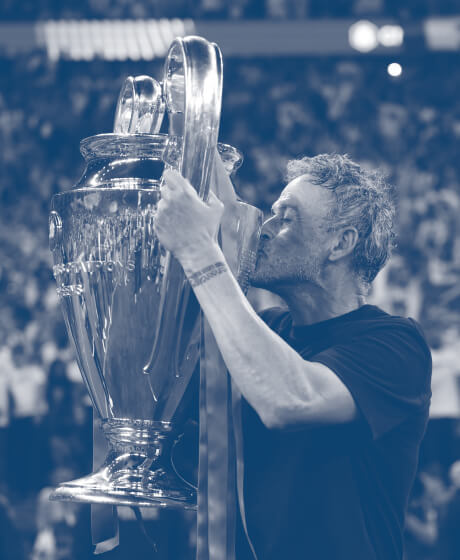
But it all comes from the same foundation. If it has been successful, I leave the past behind, I focus on renewing that desire to win again. It is difficult to keep winning. Right now, we have a unique challenge – something that is practically unprecedented in the history of European football, which is to draw level with Real Madrid if we can win a third consecutive Champions League. Wow! That is something on a whole other level. No one in history has won three in a row, only Real Madrid [in the Champions League era]. We can equal them. But I don’t think there is any team in Europe more motivated than us.
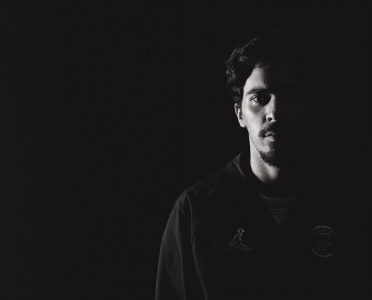
He’s one of the smartest players in any team. He bases his game on his team-mates. Watch him play – usually people only pay attention to the ball – but if you watch Fabián you’ll see him positioning his team-mates. He’ll be telling them where the ball needs to end up. He’s a vital player for us. If you look at the makeup of our squad, we don’t pick players because they’re strong, tall and quick. No – we try to get players who adapt to the cognitive approach of our brand of football. Fabián ranks number one in this regard. Fabi is always thinking. He’s there if we need him to drop back to receive a pass or close down space in between the lines. He’s one of the smartest players when he goes without the ball into space. He looks like he might be slow, but it’s totally the opposite – he’s really quick in his head. His technical quality is top-notch. He adapts exactly to what we want from him and that’s why he’s a nailed-on starter. He’s won everything – I don’t think there’s a trophy he hasn’t won. He could win the Ballon d’Or.
World football has evolved in terms of Spain’s image, be it for coaches, players and others related to the world of football, such as coaching staff and fitness staff. In the Premier League, there are five or maybe six Spanish coaches at the best teams. There was also Pep Guardiola in the past, Rafa Benítez too. Pep came in and won everything. Spanish football is at the top of world football in every regard, be it players, coaches or directors. What’s more, I think our game stands for a fun way of playing football, in that we seek out the ball, having it is our priority and we adapt through possession to being solid defensively. It represents our culture really well, the Hispanic idea of playing football. It’s a great moment for Spanish football and we should be proud of that.
I’ll never forget the day that [Paris sporting director] Luis Campos came to my house, and it took only 15 minutes to realise we were on the same page. There’s no doubt that the project here is the one I’ve been the most into as a coach. I hope that I’m here for many more years. It’s fantastic to start every season with the support of the club, the fans and the board. I expect to give my all. It’ll be really hard to keep on winning, but we won’t leave anything to chance.
Luis Enrique Martinez is undoubtedly elevating himself, and this era of Paris Saint-Germain football, onto the all-time pantheon of European greatness. Not simply for a relentless commitment to winning and trophy-lifting but for the Paris brand of football and how enamoured neutrals are with how the Spaniard’s team plays. All of which takes a huge amount of skill but even more hard work, a point he emphasises in this chat.
The 56-year-old has intense energy levels and applies them to daily preparation, on the training pitches and in video analysis, meaning that a coach must re-charge his batteries with diligence whenever the opportunity presents itself.
On the evidence of this meeting, his rivals, both domestically and in the Champions League, should be aware that Luis Enrique is buzzing again: bouncing into the interview room full of jokes, smiles, generosity of attitude and giving all of us present an idea of what it must be like to be on the end of his teaching skills every day on Paris’ Poissy training ground.
During our conversation it’s obvious he has squeezed every last drop of fun, relaxation and energy from the summer. Fit, tanned and crackling with energy he happily admits that re-conquering Europe plus tilting at a venerated Real Madrid Champions League record continue to drive his voracious ambition and enthusiasm. Read for yourself…
A coach doesn’t completely disconnect. You have meetings, you need to organise the next season. We have to make a lot of decisions over the summer. You disconnect because you don’t go to your workplace, but you are always connected to the club. I didn’t stay in Paris; I went away with my family for seven weeks, which is an unusual amount of time to rest in football. It did me good. You try to disconnect as much as possible, but you are always connected because everyone talks to you about the season, people congratulate you for the titles you won. It sounds beautiful, but it shows how a coach never disconnects.


I didn’t watch any of the matches that started after 10pm because resting was my priority. But the next morning I always checked out the results and watched the highlights. I followed the World Cup like any other football fan, especially my national team.
Aberdeen is very close to your heart, just as Gijón is very close to mine. I consider myself an ambassador for Gijón, although I haven’t lived there in over 30 years because of my work. But I’m from Gijón, I’m proud of that, and I’ve always been a Sporting [de Gijón] fan. To be honoured while still alive, and to be able to dedicate it to my parents for all their effort, to my wife, to my family, to my people and in my country, for someone from Gijón, was amazing. It was a very special day, one of the best days of my life. It was so emotional that I struggled to speak; there was a moment when I thought I wasn’t going to be able to, and you know I’m very used to talking. It’s a day I will never forget.
You know me, Graham. I’m not a genius and I don’t want to be. I’m a person who dedicates all the time in the world to trying to compete in the best way. I believe I was born to compete, because that’s where I feel most comfortable. Whether it’s playing Parchís, tennis, padel or football or training, that’s what I love. Then, I have a constant obsession with trying to improve performances, my connection with the players, with the team, the demands placed on me, having empathy with the players, and getting more out of them. But I like to do it by convincing them, not just because I’m the coach and I tell you to do something.
I try to understand the game and explain it to the players in the simplest way possible. That’s what motivates me to keep improving. When people tell me that I’ve won a lot of titles it’s irrelevant; it belongs to the past, it’s history. We have to keep winning. And continuing to win is very difficult because at this level there are many teams with the same aspirations as us.
That’s my motivation, but I’m not a genius, and neither are my staff. We’re just people who love to improve, people who are constantly worried about whether what we’re doing is working, which is very difficult in today’s football world. Even if we’ve won. We’re constantly evaluating what we do. A result doesn’t hide opportunities to improve, and that’s what keeps me going as a coach. I’m an energetic person. I like to communicate and be close to the players because it’s a way for me to feel connected. I can no longer score goals or make passes, but I can help make game situations more understandable and choose the right players for what we want to carry out. That’s what I like.
You have a lot of individual conversations with the players, [to talk about] what we’re looking for and how we are going to look for it. We have an established team, that have been in place for three seasons, especially over the last two seasons, with practically the same players. A few join, a few others leave, and we have to look for something to give us a boost, individually and personally.
We need to create the feeling that, if we want to continue winning, we have to improve on what we did last season – because, most likely, doing the same thing as last season will not be enough to win this Champions League and this league title. So, that is the objective. We are going to try to continue along the same path because we like to play good football, because we believe that playing good football gives you a greater chance of winning trophies and matches, and because it is a style that our supporters enjoy. Although, obviously, what the fans like is winning. If you can win while playing entertaining football, even better, and that is our objective.
But it all comes from the same foundation. If it has been successful, I leave the past behind, I focus on renewing that desire to win again. It is difficult to keep winning. Right now, we have a unique challenge – something that is practically unprecedented in the history of European football, which is to draw level with Real Madrid if we can win a third consecutive Champions League. Wow! That is something on a whole other level. No one in history has won three in a row, only Real Madrid [in the Champions League era]. We can equal them. But I don’t think there is any team in Europe more motivated than us.
He’s one of the smartest players in any team. He bases his game on his team-mates. Watch him play – usually people only pay attention to the ball – but if you watch Fabián you’ll see him positioning his team-mates. He’ll be telling them where the ball needs to end up. He’s a vital player for us. If you look at the makeup of our squad, we don’t pick players because they’re strong, tall and quick. No – we try to get players who adapt to the cognitive approach of our brand of football. Fabián ranks number one in this regard. Fabi is always thinking. He’s there if we need him to drop back to receive a pass or close down space in between the lines. He’s one of the smartest players when he goes without the ball into space. He looks like he might be slow, but it’s totally the opposite – he’s really quick in his head. His technical quality is top-notch. He adapts exactly to what we want from him and that’s why he’s a nailed-on starter. He’s won everything – I don’t think there’s a trophy he hasn’t won. He could win the Ballon d’Or.
World football has evolved in terms of Spain’s image, be it for coaches, players and others related to the world of football, such as coaching staff and fitness staff. In the Premier League, there are five or maybe six Spanish coaches at the best teams. There was also Pep Guardiola in the past, Rafa Benítez too. Pep came in and won everything. Spanish football is at the top of world football in every regard, be it players, coaches or directors. What’s more, I think our game stands for a fun way of playing football, in that we seek out the ball, having it is our priority and we adapt through possession to being solid defensively. It represents our culture really well, the Hispanic idea of playing football. It’s a great moment for Spanish football and we should be proud of that.
I’ll never forget the day that [Paris sporting director] Luis Campos came to my house, and it took only 15 minutes to realise we were on the same page. There’s no doubt that the project here is the one I’ve been the most into as a coach. I hope that I’m here for many more years. It’s fantastic to start every season with the support of the club, the fans and the board. I expect to give my all. It’ll be really hard to keep on winning, but we won’t leave anything to chance.
Luis Enrique Martinez is undoubtedly elevating himself, and this era of Paris Saint-Germain football, onto the all-time pantheon of European greatness. Not simply for a relentless commitment to winning and trophy-lifting but for the Paris brand of football and how enamoured neutrals are with how the Spaniard’s team plays. All of which takes a huge amount of skill but even more hard work, a point he emphasises in this chat.
The 56-year-old has intense energy levels and applies them to daily preparation, on the training pitches and in video analysis, meaning that a coach must re-charge his batteries with diligence whenever the opportunity presents itself.
On the evidence of this meeting, his rivals, both domestically and in the Champions League, should be aware that Luis Enrique is buzzing again: bouncing into the interview room full of jokes, smiles, generosity of attitude and giving all of us present an idea of what it must be like to be on the end of his teaching skills every day on Paris’ Poissy training ground.
During our conversation it’s obvious he has squeezed every last drop of fun, relaxation and energy from the summer. Fit, tanned and crackling with energy he happily admits that re-conquering Europe plus tilting at a venerated Real Madrid Champions League record continue to drive his voracious ambition and enthusiasm. Read for yourself…
A coach doesn’t completely disconnect. You have meetings, you need to organise the next season. We have to make a lot of decisions over the summer. You disconnect because you don’t go to your workplace, but you are always connected to the club. I didn’t stay in Paris; I went away with my family for seven weeks, which is an unusual amount of time to rest in football. It did me good. You try to disconnect as much as possible, but you are always connected because everyone talks to you about the season, people congratulate you for the titles you won. It sounds beautiful, but it shows how a coach never disconnects.
I didn’t watch any of the matches that started after 10pm because resting was my priority. But the next morning I always checked out the results and watched the highlights. I followed the World Cup like any other football fan, especially my national team.
Aberdeen is very close to your heart, just as Gijón is very close to mine. I consider myself an ambassador for Gijón, although I haven’t lived there in over 30 years because of my work. But I’m from Gijón, I’m proud of that, and I’ve always been a Sporting [de Gijón] fan. To be honoured while still alive, and to be able to dedicate it to my parents for all their effort, to my wife, to my family, to my people and in my country, for someone from Gijón, was amazing. It was a very special day, one of the best days of my life. It was so emotional that I struggled to speak; there was a moment when I thought I wasn’t going to be able to, and you know I’m very used to talking. It’s a day I will never forget.
You know me, Graham. I’m not a genius and I don’t want to be. I’m a person who dedicates all the time in the world to trying to compete in the best way. I believe I was born to compete, because that’s where I feel most comfortable. Whether it’s playing Parchís, tennis, padel or football or training, that’s what I love. Then, I have a constant obsession with trying to improve performances, my connection with the players, with the team, the demands placed on me, having empathy with the players, and getting more out of them. But I like to do it by convincing them, not just because I’m the coach and I tell you to do something.
I try to understand the game and explain it to the players in the simplest way possible. That’s what motivates me to keep improving. When people tell me that I’ve won a lot of titles it’s irrelevant; it belongs to the past, it’s history. We have to keep winning. And continuing to win is very difficult because at this level there are many teams with the same aspirations as us.
That’s my motivation, but I’m not a genius, and neither are my staff. We’re just people who love to improve, people who are constantly worried about whether what we’re doing is working, which is very difficult in today’s football world. Even if we’ve won. We’re constantly evaluating what we do. A result doesn’t hide opportunities to improve, and that’s what keeps me going as a coach. I’m an energetic person. I like to communicate and be close to the players because it’s a way for me to feel connected. I can no longer score goals or make passes, but I can help make game situations more understandable and choose the right players for what we want to carry out. That’s what I like.
You have a lot of individual conversations with the players, [to talk about] what we’re looking for and how we are going to look for it. We have an established team, that have been in place for three seasons, especially over the last two seasons, with practically the same players. A few join, a few others leave, and we have to look for something to give us a boost, individually and personally.
We need to create the feeling that, if we want to continue winning, we have to improve on what we did last season – because, most likely, doing the same thing as last season will not be enough to win this Champions League and this league title. So, that is the objective. We are going to try to continue along the same path because we like to play good football, because we believe that playing good football gives you a greater chance of winning trophies and matches, and because it is a style that our supporters enjoy. Although, obviously, what the fans like is winning. If you can win while playing entertaining football, even better, and that is our objective.
But it all comes from the same foundation. If it has been successful, I leave the past behind, I focus on renewing that desire to win again. It is difficult to keep winning. Right now, we have a unique challenge – something that is practically unprecedented in the history of European football, which is to draw level with Real Madrid if we can win a third consecutive Champions League. Wow! That is something on a whole other level. No one in history has won three in a row, only Real Madrid [in the Champions League era]. We can equal them. But I don’t think there is any team in Europe more motivated than us.
He’s one of the smartest players in any team. He bases his game on his team-mates. Watch him play – usually people only pay attention to the ball – but if you watch Fabián you’ll see him positioning his team-mates. He’ll be telling them where the ball needs to end up. He’s a vital player for us. If you look at the makeup of our squad, we don’t pick players because they’re strong, tall and quick. No – we try to get players who adapt to the cognitive approach of our brand of football. Fabián ranks number one in this regard. Fabi is always thinking. He’s there if we need him to drop back to receive a pass or close down space in between the lines. He’s one of the smartest players when he goes without the ball into space. He looks like he might be slow, but it’s totally the opposite – he’s really quick in his head. His technical quality is top-notch. He adapts exactly to what we want from him and that’s why he’s a nailed-on starter. He’s won everything – I don’t think there’s a trophy he hasn’t won. He could win the Ballon d’Or.
World football has evolved in terms of Spain’s image, be it for coaches, players and others related to the world of football, such as coaching staff and fitness staff. In the Premier League, there are five or maybe six Spanish coaches at the best teams. There was also Pep Guardiola in the past, Rafa Benítez too. Pep came in and won everything. Spanish football is at the top of world football in every regard, be it players, coaches or directors. What’s more, I think our game stands for a fun way of playing football, in that we seek out the ball, having it is our priority and we adapt through possession to being solid defensively. It represents our culture really well, the Hispanic idea of playing football. It’s a great moment for Spanish football and we should be proud of that.
I’ll never forget the day that [Paris sporting director] Luis Campos came to my house, and it took only 15 minutes to realise we were on the same page. There’s no doubt that the project here is the one I’ve been the most into as a coach. I hope that I’m here for many more years. It’s fantastic to start every season with the support of the club, the fans and the board. I expect to give my all. It’ll be really hard to keep on winning, but we won’t leave anything to chance.