Art and craft
The heartbeat that gets Paris racing, the metronome that sets their pace – Portuguese midfielder Vitinha has taken his side to the very top and tells Champions Journal he has no intention of stopping there
WORDS Chris Burke | PHOTOGRAPHY Kristy Sparow

Cover Stories
Say what you will about Thomas Frank, but the former Tottenham Hotspur coach certainly lives up to his name. And among the Dane’s various nuggets of honesty during his brief time in north London, his reaction to a 5-3 loss away to Paris Saint-Germain last November was especially frank. “They have one Ballon d’Or winner and I think the next one is playing in midfield,” he cooed. “Vitinha… Wow, what a player!”
Paris team-mate Ousmane Dembélé currently holds the Ballon d’Or title, but no player is more fundamentally plugged into the European champions’ slick machine than the 26-year-old furiously pulling the levers and pressing the buttons in midfield. Or, to borrow from the lexicon of French football – where the metaphors tend to lean more musical than mechanical – Vitinha is their “métronome”, their “chef d’orchestre” (orchestra conductor), their “maestro”.
Art and craft. Class and graft. However you spin it, the Portuguese international makes Luis Enrique’s side tick. Just take a look at the passing stats in this season’s Champions League. Heading into the semi-finals, Vitinha topped the list for completed passes with an astonishing 1,376 from 14 games, averaging out at nearly 100 every match. No one else had even broken the 1,000-pass barrier. And while we’re admiring the numbers, note too that he sat joint-seventh for ball recoveries, with no midfielders placed higher.
How did we get here? Rewind five years and Vitinha had just completed a season-long loan at Wolverhampton Wanderers and was finding his feet back at Porto, the Premier League club having declined the Dragões’ €20m asking price. Today, having bossed last year’s Champions League final against Inter Milan, he is valued at more than five times that figure.
Recall too that it was far from smooth sailing in his debut campaign with Paris after joining in 2022. Despite initially settling well under then coach Christophe Galtier, his form dipped in the second half of the season – and he was not alone, Vitinha and Co getting knocked out of the Champions League in the round of 16, losing to arch-rivals Marseille in the French Cup and winning the league by a single point compared to their usual dominant fashion. Now, three years later, he takes to the pitch as a man ranked third in the 2025 Ballon d’Or vote – and tipped to go higher.
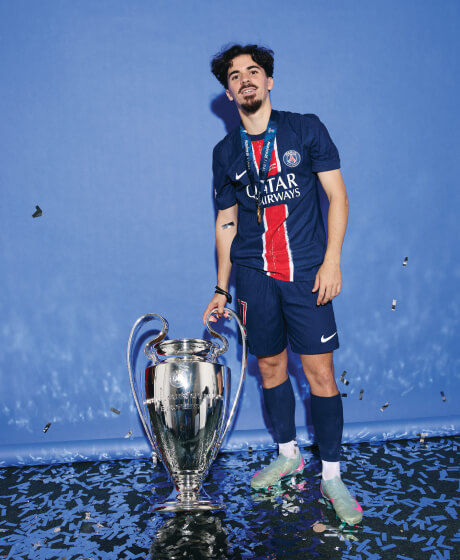
“Obviously, it would be such a mistake if I hadn’t grown and improved in many ways and become a better person and player over the course of these four years,” he tells Champions Journal. “The truth is that I can feel it. If you ask me to reflect on the Vitinha of 2022 compared to now, I feel that I’ve developed in both respects and I’m happy about that. It’s true that it’s very important, and I keep close to my heart the trophies I’ve won with the club, but even more important than that is what I’ve become and what I’m still becoming, because it’s a process. I feel very happy with everything I’ve become here at Paris Saint-Germain.”
What he’s become is the keystone of the French club’s fluid playing style, a deep-lying playmaker resistant to the press with his nimble footwork and quicker to break through opposition lines than his predecessor Marco Verratti. Flick. Flick. Turn. Run. Pass. Think you have him cornered in a midfield overload and he’ll finesse a way out. Seconds later, he’s found a structural flaw in your defence, a Paris player is bearing down on goal and your keeper had better be ready.
Take, for example, his driving role in Paris’ third goal in Munich last May. Vitinha picked up possession midway inside his own half and, despite a quartet of Inter players closing in, his first thought was to turn, carry the ball forward and attack. He slid a pass to Dembélé and kept going, accepting Dembélé’s back-heel in his stride. Suddenly the pitch opened up, giving Vitinha the time and space to release Désiré Doué to find the net. 3-0 and game over.
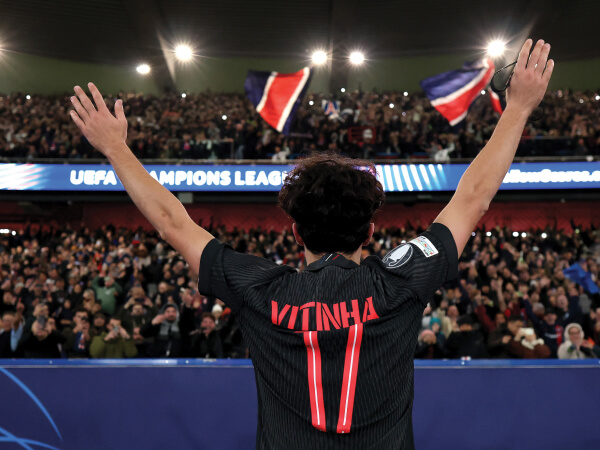
“I keep close to my heart the trophies I’ve won with the club, but even more important is what I’ve become and what I’m still becoming”
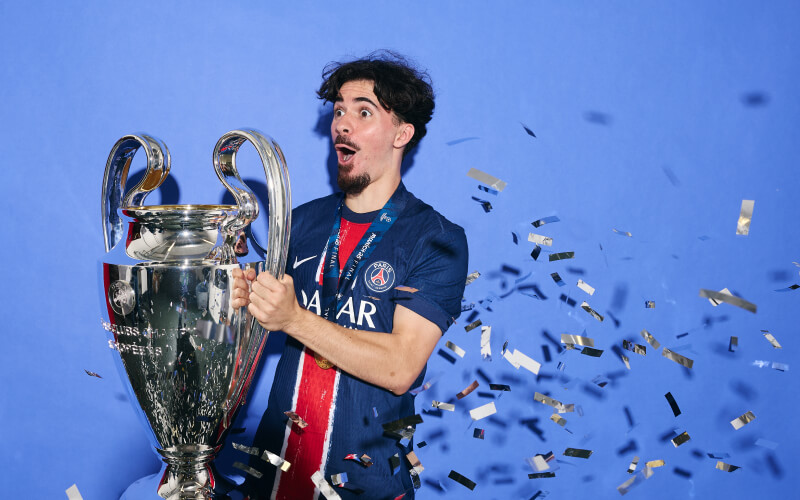
This season, Vitinha’s willingness to take risks has translated into a personal-record goal tally in the Champions League. After mustering just four across his first three European campaigns with Paris, including two on their run to the trophy last term, he ended the quarter-finals with six to his name already – the most ever by a midfielder at the club.
If they don’t already, Vitinha’s team-mates may as well synchronise their watches to his. Try to convince him of his importance, though, and he recoils. He sees himself as a cog in the machine. Or a note in the symphony. Whichever metaphorical tradition you prefer.
“It feels good, but I wouldn’t say it’s such a huge responsibility because I’m not alone. I do [set the pace], yes, but so do the goalkeeper, the full-backs, the centre-backs, the other midfielders, the forwards and even the subs coming on during the game. I don’t feel like the team won’t be able to play if I’m missing. We’re a team in the proper sense of the word and we’ve already proved that several times. Whenever a player is missing, the team keeps moving forward, playing the same way and winning.”
If that sounds a little like the Borg from the Star Trek universe, another relentless collective, fear not. Vitinha is at least able to see the self-belief that his dexterous technique and game smarts inevitably spread around the team. Wherever they are, however daunting the challenge, their No17 can calm nerves just by doing what he does. “I try to pass on confidence, to make it something infectious,” he says. “For my team-mates, that’s something I like to do: namely, to influence the team and... not convince but to contribute to playing better. To bring everyone together around the same playing vision.”
Even in that statement, of course, the humility finds a way to poke through. It’s what made Vitinha an unfair target during the transition from one vision of player recruitment at the Parc des Princes to another, and it’s what makes him the perfect avatar for the club’s present identity – a dizzying blend of youthful energy and egoless commitment to the cause, balanced on the precipice between innovation and order.
For Portuguese fans of an older generation, Vitinha’s modesty might also stir memories of his father, Vítor Manuel, who enjoyed a respectable top-flight career with the likes of CD Aves, Campomaiorense and Farense. Known for his level head and good humour, his dad seems to have successfully passed those qualities on, albeit much to Vitinha’s occasional frustration.
“I would agree that we’re similar in these respects,” he explains. “We’re similar in many ways. It’s too much. I sometimes get angry with him, and he gets angry with me, because we’re too similar, because when you see yourself in another person, it can be annoying. But I see myself when I look at him, and I think he feels the same.”
Among those who know, they even have a similar playing style – head up and surveying the scene like a bird of prey. “That’s what I’ve always heard as well, since I started in the Porto academy. I take it as a compliment,” says Vitinha. “He’s inspired me a lot, and we also play in the same position. He was very intelligent in the way he saw the game. I personally didn’t see him play much, but I’ve heard about him and seen footage. I played alongside him with former players when he was a bit older, and you could tell he was a clever player. Apparently, he was quicker than me and had better heading skills, but I have other attributes.”
The duo briefly overlapped at CD Aves in 2006/07, Vítor Manuel’s last as a professional and his son’s first as an academy prospect before he later joined Porto at the age of 11. Perhaps unsurprisingly, now that Vitinha is a Portugal regular with World Cup and European Championship experience under his belt, his dad feels less of a need to share his own expertise. “Growing up, he would pass on much more advice to me,” says Vitinha. “It’s not that he no longer wants to do that, but he’s learned that there’s a time to give advice. And if I’m in the heat of things or if I don’t want to listen... Nowadays I’m the one asking for advice. When things are quieter, I discuss the game with him.”
For more day-to-day interactions, another prominent mentor has taken up the baton. It was Luis Enrique’s arrival as Paris coach in July 2023 that truly transformed Vitinha’s role at the club, the former Barcelona boss introducing the all-for-one mentality and possession-based style that conquered Europe last season. Deploying Vitinha at the base of midfield and encouraging him to work on his defensive qualities, Luis Enrique unlocked his full potential as a tempo-setting instigator aligned with his manager’s vision. Indeed, no player has contested more minutes on the pitch than Vitinha since the Spaniard took the reins.
Naturally, the trust goes both ways. “Of course, because when you have a coach who not only delivers results but also convinces you to follow his playing philosophy, through the way he works on a daily basis, the way we train together day in and day out, it seems very unlikely you won’t like him,” says Vitinha. “Beyond his technical and tactical quality as a coach, he’s also a fantastic person. We don’t only talk about football, and that’s a good thing too. He’s a very natural and normal person who is very honest with you.
“In our jobs as managers and players, when you feel that the feedback is genuine and reflects what he thinks and feels, and what he wants from you, that’s something really important. Aside from that, everything’s been working well – with the team, for me on a personal level, and for him as a manager. I feel perfectly comfortable in my role, and not in my comfort zone, as we often step out of our comfort zone, which is good.”
This season, Vitinha’s willingness to take risks has translated into a personal-record goal tally in the Champions League. After mustering just four across his first three European campaigns with Paris, including two on their run to the trophy last term, he ended the quarter-finals with six to his name already – the most ever by a midfielder at the club. And almost all of them were worthy of a highlights package, given his penchant for having a crack from distance. “I don’t find myself in the box very often, so I’m usually outside the box when I score.”
Timing his ventures to the edge of the area and “shooting instinctively” brought Vitinha eye-catching strikes against Leverkusen, Newcastle United and Chelsea, the first two all power and placement and the third a delicate lob that put his side in charge of their round of 16 tie against the Blues. “It’s the type of goal you don’t see every day and it’s nice to see,” he says, watching it back again. “It’s a special delight when you score a goal like that.”
His true masterpiece, however, was a hat-trick in that league phase game against Spurs, kicked off by a first-touch thunderbolt from long range that clattered in off the crossbar – “I didn’t do that on purpose, but it made the goal even sweeter.” Next came only the third left-footed goal of his career, a sweeping effort low into the far corner. “The assist came from the left to the right, and I moved the ball to my left foot, which I never use to shoot because it doesn’t work, but this time it did, so it was perfect.”
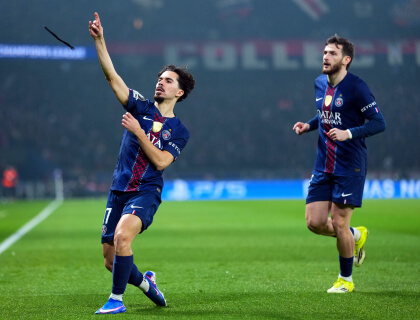
Rounding off with a penalty, Vitinha completed his first treble as a professional and raced away to greet the Paris fans with his trademark celebration – the headband that keeps his thick mop of hair in place twirled around his right index finger. Sitting on the opposition bench, Thomas Frank had seen enough to then head off and tell it straight to the press, declaring Vitinha a global superstar in the making. And, frankly, who could blame him?
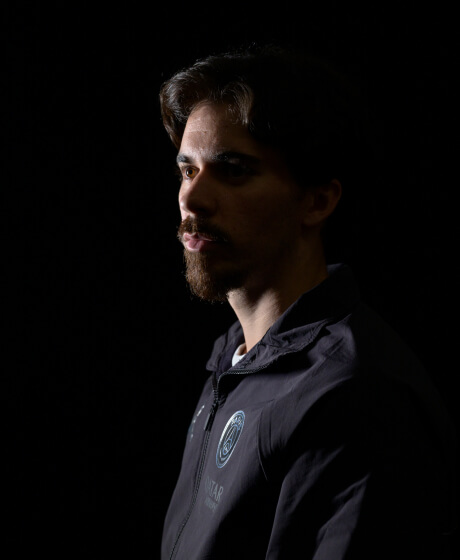
Paris team-mate Ousmane Dembélé currently holds the Ballon d’Or title, but no player is more fundamentally plugged into the European champions’ slick machine than the 26-year-old furiously pulling the levers and pressing the buttons in midfield. Or, to borrow from the lexicon of French football – where the metaphors tend to lean more musical than mechanical – Vitinha is their “métronome”, their “chef d’orchestre” (orchestra conductor), their “maestro”.
Art and craft. Class and graft. However you spin it, the Portuguese international makes Luis Enrique’s side tick. Just take a look at the passing stats in this season’s Champions League. Heading into the semi-finals, Vitinha topped the list for completed passes with an astonishing 1,376 from 14 games, averaging out at nearly 100 every match. No one else had even broken the 1,000-pass barrier. And while we’re admiring the numbers, note too that he sat joint-seventh for ball recoveries, with no midfielders placed higher.
How did we get here? Rewind five years and Vitinha had just completed a season-long loan at Wolverhampton Wanderers and was finding his feet back at Porto, the Premier League club having declined the Dragões’ €20m asking price. Today, having bossed last year’s Champions League final against Inter Milan, he is valued at more than five times that figure.
Recall too that it was far from smooth sailing in his debut campaign with Paris after joining in 2022. Despite initially settling well under then coach Christophe Galtier, his form dipped in the second half of the season – and he was not alone, Vitinha and Co getting knocked out of the Champions League in the round of 16, losing to arch-rivals Marseille in the French Cup and winning the league by a single point compared to their usual dominant fashion. Now, three years later, he takes to the pitch as a man ranked third in the 2025 Ballon d’Or vote – and tipped to go higher.
“Obviously, it would be such a mistake if I hadn’t grown and improved in many ways and become a better person and player over the course of these four years,” he tells Champions Journal. “The truth is that I can feel it. If you ask me to reflect on the Vitinha of 2022 compared to now, I feel that I’ve developed in both respects and I’m happy about that. It’s true that it’s very important, and I keep close to my heart the trophies I’ve won with the club, but even more important than that is what I’ve become and what I’m still becoming, because it’s a process. I feel very happy with everything I’ve become here at Paris Saint-Germain.”
What he’s become is the keystone of the French club’s fluid playing style, a deep-lying playmaker resistant to the press with his nimble footwork and quicker to break through opposition lines than his predecessor Marco Verratti. Flick. Flick. Turn. Run. Pass. Think you have him cornered in a midfield overload and he’ll finesse a way out. Seconds later, he’s found a structural flaw in your defence, a Paris player is bearing down on goal and your keeper had better be ready.
Take, for example, his driving role in Paris’ third goal in Munich last May. Vitinha picked up possession midway inside his own half and, despite a quartet of Inter players closing in, his first thought was to turn, carry the ball forward and attack. He slid a pass to Dembélé and kept going, accepting Dembélé’s back-heel in his stride. Suddenly the pitch opened up, giving Vitinha the time and space to release Désiré Doué to find the net. 3-0 and game over.
Read the full story
Sign up now to get access to this and every premium feature on Champions Journal. You will also get access to member-only competitions and offers. And you get all of that completely free!
“I keep close to my heart the trophies I’ve won with the club, but even more important is what I’ve become and what I’m still becoming”
This season, Vitinha’s willingness to take risks has translated into a personal-record goal tally in the Champions League. After mustering just four across his first three European campaigns with Paris, including two on their run to the trophy last term, he ended the quarter-finals with six to his name already – the most ever by a midfielder at the club.
For more day-to-day interactions, another prominent mentor has taken up the baton. It was Luis Enrique’s arrival as Paris coach in July 2023 that truly transformed Vitinha’s role at the club, the former Barcelona boss introducing the all-for-one mentality and possession-based style that conquered Europe last season. Deploying Vitinha at the base of midfield and encouraging him to work on his defensive qualities, Luis Enrique unlocked his full potential as a tempo-setting instigator aligned with his manager’s vision. Indeed, no player has contested more minutes on the pitch than Vitinha since the Spaniard took the reins.
Naturally, the trust goes both ways. “Of course, because when you have a coach who not only delivers results but also convinces you to follow his playing philosophy, through the way he works on a daily basis, the way we train together day in and day out, it seems very unlikely you won’t like him,” says Vitinha. “Beyond his technical and tactical quality as a coach, he’s also a fantastic person. We don’t only talk about football, and that’s a good thing too. He’s a very natural and normal person who is very honest with you.
“In our jobs as managers and players, when you feel that the feedback is genuine and reflects what he thinks and feels, and what he wants from you, that’s something really important. Aside from that, everything’s been working well – with the team, for me on a personal level, and for him as a manager. I feel perfectly comfortable in my role, and not in my comfort zone, as we often step out of our comfort zone, which is good.”
This season, Vitinha’s willingness to take risks has translated into a personal-record goal tally in the Champions League. After mustering just four across his first three European campaigns with Paris, including two on their run to the trophy last term, he ended the quarter-finals with six to his name already – the most ever by a midfielder at the club. And almost all of them were worthy of a highlights package, given his penchant for having a crack from distance. “I don’t find myself in the box very often, so I’m usually outside the box when I score.”
Timing his ventures to the edge of the area and “shooting instinctively” brought Vitinha eye-catching strikes against Leverkusen, Newcastle United and Chelsea, the first two all power and placement and the third a delicate lob that put his side in charge of their round of 16 tie against the Blues. “It’s the type of goal you don’t see every day and it’s nice to see,” he says, watching it back again. “It’s a special delight when you score a goal like that.”
His true masterpiece, however, was a hat-trick in that league phase game against Spurs, kicked off by a first-touch thunderbolt from long range that clattered in off the crossbar – “I didn’t do that on purpose, but it made the goal even sweeter.” Next came only the third left-footed goal of his career, a sweeping effort low into the far corner. “The assist came from the left to the right, and I moved the ball to my left foot, which I never use to shoot because it doesn’t work, but this time it did, so it was perfect.”
Rounding off with a penalty, Vitinha completed his first treble as a professional and raced away to greet the Paris fans with his trademark celebration – the headband that keeps his thick mop of hair in place twirled around his right index finger. Sitting on the opposition bench, Thomas Frank had seen enough to then head off and tell it straight to the press, declaring Vitinha a global superstar in the making. And, frankly, who could blame him?
Paris team-mate Ousmane Dembélé currently holds the Ballon d’Or title, but no player is more fundamentally plugged into the European champions’ slick machine than the 26-year-old furiously pulling the levers and pressing the buttons in midfield. Or, to borrow from the lexicon of French football – where the metaphors tend to lean more musical than mechanical – Vitinha is their “métronome”, their “chef d’orchestre” (orchestra conductor), their “maestro”.
Art and craft. Class and graft. However you spin it, the Portuguese international makes Luis Enrique’s side tick. Just take a look at the passing stats in this season’s Champions League. Heading into the semi-finals, Vitinha topped the list for completed passes with an astonishing 1,376 from 14 games, averaging out at nearly 100 every match. No one else had even broken the 1,000-pass barrier. And while we’re admiring the numbers, note too that he sat joint-seventh for ball recoveries, with no midfielders placed higher.
How did we get here? Rewind five years and Vitinha had just completed a season-long loan at Wolverhampton Wanderers and was finding his feet back at Porto, the Premier League club having declined the Dragões’ €20m asking price. Today, having bossed last year’s Champions League final against Inter Milan, he is valued at more than five times that figure.
Recall too that it was far from smooth sailing in his debut campaign with Paris after joining in 2022. Despite initially settling well under then coach Christophe Galtier, his form dipped in the second half of the season – and he was not alone, Vitinha and Co getting knocked out of the Champions League in the round of 16, losing to arch-rivals Marseille in the French Cup and winning the league by a single point compared to their usual dominant fashion. Now, three years later, he takes to the pitch as a man ranked third in the 2025 Ballon d’Or vote – and tipped to go higher.
“Obviously, it would be such a mistake if I hadn’t grown and improved in many ways and become a better person and player over the course of these four years,” he tells Champions Journal. “The truth is that I can feel it. If you ask me to reflect on the Vitinha of 2022 compared to now, I feel that I’ve developed in both respects and I’m happy about that. It’s true that it’s very important, and I keep close to my heart the trophies I’ve won with the club, but even more important than that is what I’ve become and what I’m still becoming, because it’s a process. I feel very happy with everything I’ve become here at Paris Saint-Germain.”
What he’s become is the keystone of the French club’s fluid playing style, a deep-lying playmaker resistant to the press with his nimble footwork and quicker to break through opposition lines than his predecessor Marco Verratti. Flick. Flick. Turn. Run. Pass. Think you have him cornered in a midfield overload and he’ll finesse a way out. Seconds later, he’s found a structural flaw in your defence, a Paris player is bearing down on goal and your keeper had better be ready.
Take, for example, his driving role in Paris’ third goal in Munich last May. Vitinha picked up possession midway inside his own half and, despite a quartet of Inter players closing in, his first thought was to turn, carry the ball forward and attack. He slid a pass to Dembélé and kept going, accepting Dembélé’s back-heel in his stride. Suddenly the pitch opened up, giving Vitinha the time and space to release Désiré Doué to find the net. 3-0 and game over.
“I keep close to my heart the trophies I’ve won with the club, but even more important is what I’ve become and what I’m still becoming”
This season, Vitinha’s willingness to take risks has translated into a personal-record goal tally in the Champions League. After mustering just four across his first three European campaigns with Paris, including two on their run to the trophy last term, he ended the quarter-finals with six to his name already – the most ever by a midfielder at the club.
For more day-to-day interactions, another prominent mentor has taken up the baton. It was Luis Enrique’s arrival as Paris coach in July 2023 that truly transformed Vitinha’s role at the club, the former Barcelona boss introducing the all-for-one mentality and possession-based style that conquered Europe last season. Deploying Vitinha at the base of midfield and encouraging him to work on his defensive qualities, Luis Enrique unlocked his full potential as a tempo-setting instigator aligned with his manager’s vision. Indeed, no player has contested more minutes on the pitch than Vitinha since the Spaniard took the reins.
Naturally, the trust goes both ways. “Of course, because when you have a coach who not only delivers results but also convinces you to follow his playing philosophy, through the way he works on a daily basis, the way we train together day in and day out, it seems very unlikely you won’t like him,” says Vitinha. “Beyond his technical and tactical quality as a coach, he’s also a fantastic person. We don’t only talk about football, and that’s a good thing too. He’s a very natural and normal person who is very honest with you.
“In our jobs as managers and players, when you feel that the feedback is genuine and reflects what he thinks and feels, and what he wants from you, that’s something really important. Aside from that, everything’s been working well – with the team, for me on a personal level, and for him as a manager. I feel perfectly comfortable in my role, and not in my comfort zone, as we often step out of our comfort zone, which is good.”
This season, Vitinha’s willingness to take risks has translated into a personal-record goal tally in the Champions League. After mustering just four across his first three European campaigns with Paris, including two on their run to the trophy last term, he ended the quarter-finals with six to his name already – the most ever by a midfielder at the club. And almost all of them were worthy of a highlights package, given his penchant for having a crack from distance. “I don’t find myself in the box very often, so I’m usually outside the box when I score.”
Timing his ventures to the edge of the area and “shooting instinctively” brought Vitinha eye-catching strikes against Leverkusen, Newcastle United and Chelsea, the first two all power and placement and the third a delicate lob that put his side in charge of their round of 16 tie against the Blues. “It’s the type of goal you don’t see every day and it’s nice to see,” he says, watching it back again. “It’s a special delight when you score a goal like that.”
His true masterpiece, however, was a hat-trick in that league phase game against Spurs, kicked off by a first-touch thunderbolt from long range that clattered in off the crossbar – “I didn’t do that on purpose, but it made the goal even sweeter.” Next came only the third left-footed goal of his career, a sweeping effort low into the far corner. “The assist came from the left to the right, and I moved the ball to my left foot, which I never use to shoot because it doesn’t work, but this time it did, so it was perfect.”
Rounding off with a penalty, Vitinha completed his first treble as a professional and raced away to greet the Paris fans with his trademark celebration – the headband that keeps his thick mop of hair in place twirled around his right index finger. Sitting on the opposition bench, Thomas Frank had seen enough to then head off and tell it straight to the press, declaring Vitinha a global superstar in the making. And, frankly, who could blame him?