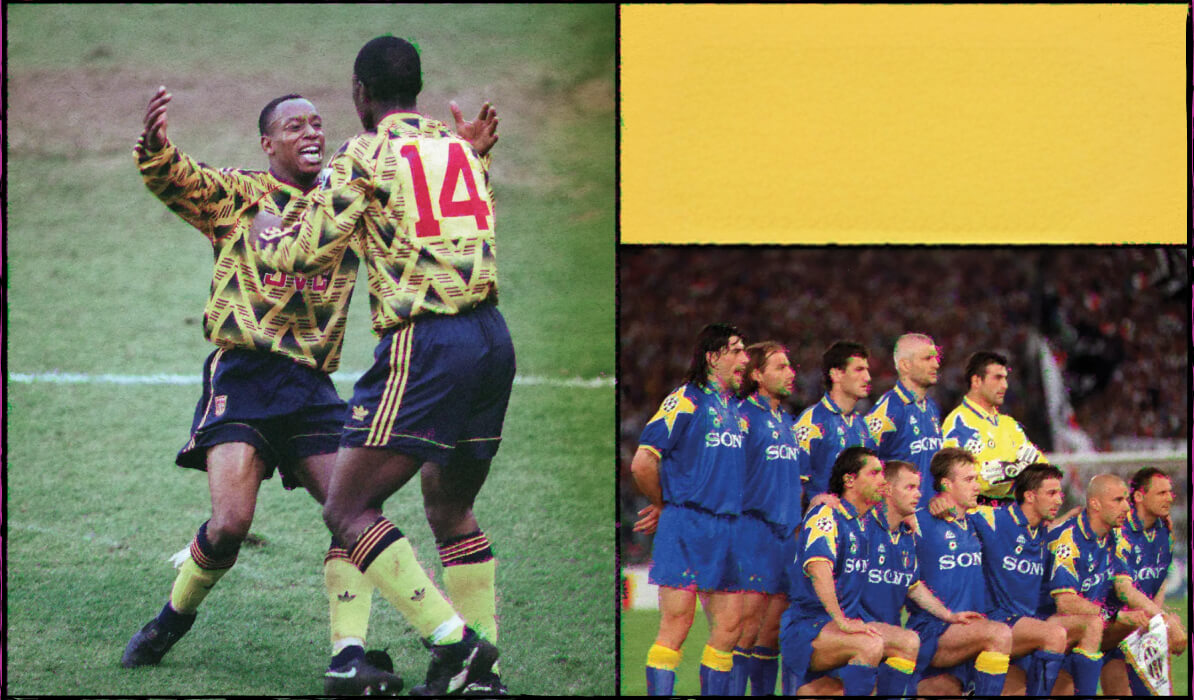
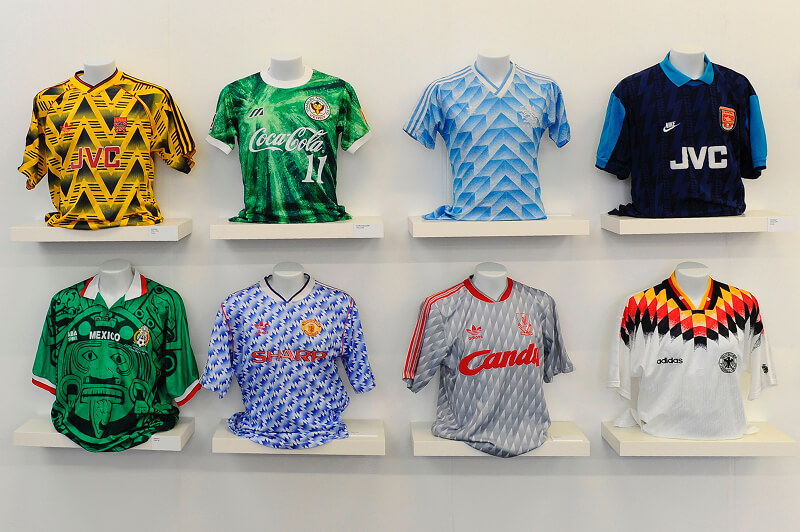
Boxy fit. Long, baggy sleeves. Garish geometric pattern. Heavy satin-esque material. There are a number of hallmarks that mean a 1990s football shirt is instantly recognisable – and despite the style being long out of fashion for modern football clubs, the ’90s is easily the decade that produced the most iconic shirts of the modern era. From Arsenal’s ‘bruised banana’ to Fiorentina’s Nintendo-sponsored purple, or the England men’s blue-patterned third kit, if you see a retro shirt on the street, it’s almost guaranteed to be from the 1990s.
Before the late 1980s, a football shirt wasn’t a fashion statement; it was a serious piece of sportswear and fans rarely thought of wearing one with a pair of jeans. But then the 1990s hit and sportswear as part of everyday clothing was everywhere. The decade kicked off with Italia ’90, a fascinating World Cup that lives long in the memory, not so much for the quality of its football (which was largely unremarkable) but for its fashion. To this day, “Italia ’90” remains a phrase that conjures up pure footballing chic, and shirts from that tournament are some of the most hunted by fashionable fans.
Outside of football, the ’90s is a decade that continues to influence modern fashion. Sure, this fascination isn’t new, with styles from the era dominating the high street for at least the last couple of years, but even in today’s hyper-speed world of cyclical trends, it’s had incredible staying power. That’s even ratcheted up a notch recently – this summer’s viral Instagram craze had people sharing photos of themselves from the decade, while this autumn will bring a major retrospective exhibition at Tate Britain, curated by former editor-in-chief of British Vogue Edward Enninful.
So why has this decade gripped our collective imagination so firmly? For one thing, it is very fertile ground for inspiration. “The ’90s spans a lot of different trends,” says Jacqui McAssey, senior lecturer at the Liverpool School of Art and Design, who I caught up with to talk about the era and its influence on modern fashion. “You have the early ’90s, which was rave culture. Within rave culture, you have that little psychedelic ’60s moment – Groove is in the Heart appears. And then it was the supermodel era – the voluptuous, womanly supermodel – before moving into grunge, an aesthetic that’s completely the opposite. In the ’90s as well, we got Britpop. You can imagine within that one decade how many things can be brought back.”
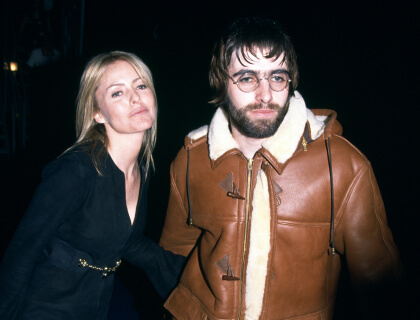
There is also a heaping dose of nostalgia that goes into our love of the ’90s, especially in the UK. “The UK in the ’90s holds this unique space at the moment,” McAssey points out. “You’ve got the introduction of the Premier League, you’ve got all the British music. Politically as well, when Tony Blair came in, there was an optimism which is very, very different to our landscape now. It’s pre-mobile phone; there’s definitely a fascination for Gen Z around what life was like before phones. It’s almost like a golden era, isn’t it?”
On the pitch, the 1990s was the decade when clubs introduced the idea of designing a shirt just for the Champions League, with Juventus being the first to do so and lifting the trophy in 1996 clad in blue and yellow with a star on the shoulder. That remains an absolute classic of the genre with its oversized fit, bright colours and punchy graphic flourish. But, interestingly, the most popular English kits of the 1990s often have nothing to do with footballing success. Instead, they tend to coincide with a lack of trophies in the cabinet, especially in Europe. The ’90s was a decade that didn’t produce an English winner of the Champions League until the very end, with Manchester United’s victory in 1998/99, yet English clubs’ kits from the decade are now among the most common football shirts being worn as streetwear.
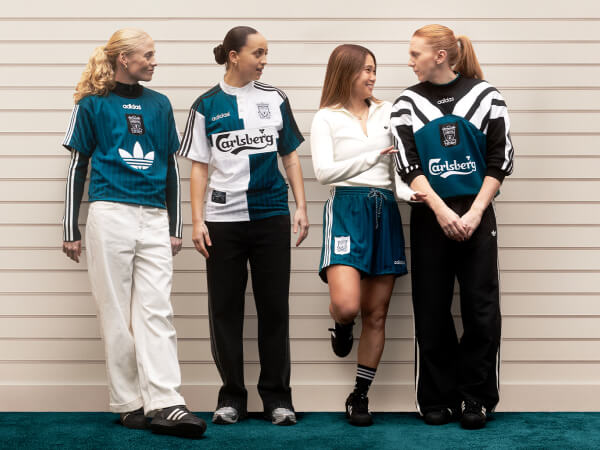
A hugely popular shirt of the era was Liverpool’s 1995/96 green, white and black away offering, which has recently been reissued as part of adidas’ Bringback collection, with the kit manufacturer rereleasing iconic kits from the past. But that shirt is not associated with triumphs on the pitch – as Reds fan McAssey points out, it’s what Liverpool wore when they lost the 1996 FA Cup final to Manchester United. “That shirt is from an era when we had some great players, but Man United were dominant,” she says. “So the fact that United beat us that season, a lot of older fans would be like, ‘No way would I wear that.’ But there’s a new generation who won’t remember that. It’s moved beyond just the football reference to the design and the aesthetic.”

That aesthetic is easier than ever to get your hands on, thanks to the massive increase in popularity of the resale market in the past few years. Vintage shirts are everywhere on second-hand shopping apps like Vinted and Depop, while specialist sportswear resellers like Classic Football Shirts can offer a huge mark-up on ’90s shirts because they know they’ll sell.
“The resale market is huge now,” says McAssey. “It’s so dominant. The clubs and the sports brands were like, ‘Well, we want a piece of that. They’re actually our shirts. Let’s just reissue them.’” For those who want to get their hands on a piece of ’90s football culture but don’t want to pay the price for an original – an original of the green Liverpool shirt goes for at least £250, for example – a reissue is ideal, no matter the associated on-pitch memories.
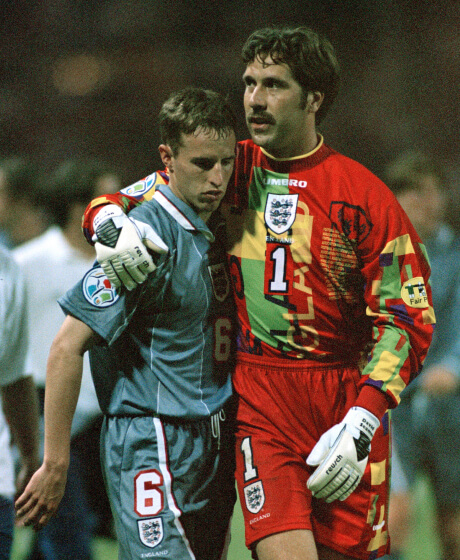
The boxy, loose fit of a ’90s shirt is probably the clearest distinguishing feature, but a close second would be the intricate patterns that popped up across the decade. Another shirt recently reissued by adidas is Manchester United’s 1990–92 away kit, featuring an arresting blue and white print. “I personally love the goalkeeper shirts,” says McAssey, drawn to their often extravagant colours and prints. “David Seaman’s EURO ’96 shirt is a standout. They could be quite garish, but I like the garish. They’re magnificent. I still really love them.”
After this summer’s World Cup combined with our nostalgia for a pre-internet era to once again put ’90s shirts front and centre, the fascination for the decade shows no sign of abating. “I think the ’90s trend will continue,” McAssey agrees. “We’ll just find other creative ways of wearing the shirts: what we put them with, how we style them, how we customise them.
I don’t think it’ll go away any time soon. It’s become part of the language of football and style.”
Boxy fit. Long, baggy sleeves. Garish geometric pattern. Heavy satin-esque material. There are a number of hallmarks that mean a 1990s football shirt is instantly recognisable – and despite the style being long out of fashion for modern football clubs, the ’90s is easily the decade that produced the most iconic shirts of the modern era. From Arsenal’s ‘bruised banana’ to Fiorentina’s Nintendo-sponsored purple, or the England men’s blue-patterned third kit, if you see a retro shirt on the street, it’s almost guaranteed to be from the 1990s.
Before the late 1980s, a football shirt wasn’t a fashion statement; it was a serious piece of sportswear and fans rarely thought of wearing one with a pair of jeans. But then the 1990s hit and sportswear as part of everyday clothing was everywhere. The decade kicked off with Italia ’90, a fascinating World Cup that lives long in the memory, not so much for the quality of its football (which was largely unremarkable) but for its fashion. To this day, “Italia ’90” remains a phrase that conjures up pure footballing chic, and shirts from that tournament are some of the most hunted by fashionable fans.
Outside of football, the ’90s is a decade that continues to influence modern fashion. Sure, this fascination isn’t new, with styles from the era dominating the high street for at least the last couple of years, but even in today’s hyper-speed world of cyclical trends, it’s had incredible staying power. That’s even ratcheted up a notch recently – this summer’s viral Instagram craze had people sharing photos of themselves from the decade, while this autumn will bring a major retrospective exhibition at Tate Britain, curated by former editor-in-chief of British Vogue Edward Enninful.
So why has this decade gripped our collective imagination so firmly? For one thing, it is very fertile ground for inspiration. “The ’90s spans a lot of different trends,” says Jacqui McAssey, senior lecturer at the Liverpool School of Art and Design, who I caught up with to talk about the era and its influence on modern fashion. “You have the early ’90s, which was rave culture. Within rave culture, you have that little psychedelic ’60s moment – Groove is in the Heart appears. And then it was the supermodel era – the voluptuous, womanly supermodel – before moving into grunge, an aesthetic that’s completely the opposite. In the ’90s as well, we got Britpop. You can imagine within that one decade how many things can be brought back.”


There is also a heaping dose of nostalgia that goes into our love of the ’90s, especially in the UK. “The UK in the ’90s holds this unique space at the moment,” McAssey points out. “You’ve got the introduction of the Premier League, you’ve got all the British music. Politically as well, when Tony Blair came in, there was an optimism which is very, very different to our landscape now. It’s pre-mobile phone; there’s definitely a fascination for Gen Z around what life was like before phones. It’s almost like a golden era, isn’t it?”
On the pitch, the 1990s was the decade when clubs introduced the idea of designing a shirt just for the Champions League, with Juventus being the first to do so and lifting the trophy in 1996 clad in blue and yellow with a star on the shoulder. That remains an absolute classic of the genre with its oversized fit, bright colours and punchy graphic flourish. But, interestingly, the most popular English kits of the 1990s often have nothing to do with footballing success. Instead, they tend to coincide with a lack of trophies in the cabinet, especially in Europe. The ’90s was a decade that didn’t produce an English winner of the Champions League until the very end, with Manchester United’s victory in 1998/99, yet English clubs’ kits from the decade are now among the most common football shirts being worn as streetwear.
A hugely popular shirt of the era was Liverpool’s 1995/96 green, white and black away offering, which has recently been reissued as part of adidas’ Bringback collection, with the kit manufacturer rereleasing iconic kits from the past. But that shirt is not associated with triumphs on the pitch – as Reds fan McAssey points out, it’s what Liverpool wore when they lost the 1996 FA Cup final to Manchester United. “That shirt is from an era when we had some great players, but Man United were dominant,” she says. “So the fact that United beat us that season, a lot of older fans would be like, ‘No way would I wear that.’ But there’s a new generation who won’t remember that. It’s moved beyond just the football reference to the design and the aesthetic.”
That aesthetic is easier than ever to get your hands on, thanks to the massive increase in popularity of the resale market in the past few years. Vintage shirts are everywhere on second-hand shopping apps like Vinted and Depop, while specialist sportswear resellers like Classic Football Shirts can offer a huge mark-up on ’90s shirts because they know they’ll sell.
“The resale market is huge now,” says McAssey. “It’s so dominant. The clubs and the sports brands were like, ‘Well, we want a piece of that. They’re actually our shirts. Let’s just reissue them.’” For those who want to get their hands on a piece of ’90s football culture but don’t want to pay the price for an original – an original of the green Liverpool shirt goes for at least £250, for example – a reissue is ideal, no matter the associated on-pitch memories.
The boxy, loose fit of a ’90s shirt is probably the clearest distinguishing feature, but a close second would be the intricate patterns that popped up across the decade. Another shirt recently reissued by adidas is Manchester United’s 1990–92 away kit, featuring an arresting blue and white print. “I personally love the goalkeeper shirts,” says McAssey, drawn to their often extravagant colours and prints. “David Seaman’s EURO ’96 shirt is a standout. They could be quite garish, but I like the garish. They’re magnificent. I still really love them.”
After this summer’s World Cup combined with our nostalgia for a pre-internet era to once again put ’90s shirts front and centre, the fascination for the decade shows no sign of abating. “I think the ’90s trend will continue,” McAssey agrees. “We’ll just find other creative ways of wearing the shirts: what we put them with, how we style them, how we customise them.
I don’t think it’ll go away any time soon. It’s become part of the language of football and style.”
Boxy fit. Long, baggy sleeves. Garish geometric pattern. Heavy satin-esque material. There are a number of hallmarks that mean a 1990s football shirt is instantly recognisable – and despite the style being long out of fashion for modern football clubs, the ’90s is easily the decade that produced the most iconic shirts of the modern era. From Arsenal’s ‘bruised banana’ to Fiorentina’s Nintendo-sponsored purple, or the England men’s blue-patterned third kit, if you see a retro shirt on the street, it’s almost guaranteed to be from the 1990s.
Before the late 1980s, a football shirt wasn’t a fashion statement; it was a serious piece of sportswear and fans rarely thought of wearing one with a pair of jeans. But then the 1990s hit and sportswear as part of everyday clothing was everywhere. The decade kicked off with Italia ’90, a fascinating World Cup that lives long in the memory, not so much for the quality of its football (which was largely unremarkable) but for its fashion. To this day, “Italia ’90” remains a phrase that conjures up pure footballing chic, and shirts from that tournament are some of the most hunted by fashionable fans.
Outside of football, the ’90s is a decade that continues to influence modern fashion. Sure, this fascination isn’t new, with styles from the era dominating the high street for at least the last couple of years, but even in today’s hyper-speed world of cyclical trends, it’s had incredible staying power. That’s even ratcheted up a notch recently – this summer’s viral Instagram craze had people sharing photos of themselves from the decade, while this autumn will bring a major retrospective exhibition at Tate Britain, curated by former editor-in-chief of British Vogue Edward Enninful.
So why has this decade gripped our collective imagination so firmly? For one thing, it is very fertile ground for inspiration. “The ’90s spans a lot of different trends,” says Jacqui McAssey, senior lecturer at the Liverpool School of Art and Design, who I caught up with to talk about the era and its influence on modern fashion. “You have the early ’90s, which was rave culture. Within rave culture, you have that little psychedelic ’60s moment – Groove is in the Heart appears. And then it was the supermodel era – the voluptuous, womanly supermodel – before moving into grunge, an aesthetic that’s completely the opposite. In the ’90s as well, we got Britpop. You can imagine within that one decade how many things can be brought back.”
There is also a heaping dose of nostalgia that goes into our love of the ’90s, especially in the UK. “The UK in the ’90s holds this unique space at the moment,” McAssey points out. “You’ve got the introduction of the Premier League, you’ve got all the British music. Politically as well, when Tony Blair came in, there was an optimism which is very, very different to our landscape now. It’s pre-mobile phone; there’s definitely a fascination for Gen Z around what life was like before phones. It’s almost like a golden era, isn’t it?”
On the pitch, the 1990s was the decade when clubs introduced the idea of designing a shirt just for the Champions League, with Juventus being the first to do so and lifting the trophy in 1996 clad in blue and yellow with a star on the shoulder. That remains an absolute classic of the genre with its oversized fit, bright colours and punchy graphic flourish. But, interestingly, the most popular English kits of the 1990s often have nothing to do with footballing success. Instead, they tend to coincide with a lack of trophies in the cabinet, especially in Europe. The ’90s was a decade that didn’t produce an English winner of the Champions League until the very end, with Manchester United’s victory in 1998/99, yet English clubs’ kits from the decade are now among the most common football shirts being worn as streetwear.
A hugely popular shirt of the era was Liverpool’s 1995/96 green, white and black away offering, which has recently been reissued as part of adidas’ Bringback collection, with the kit manufacturer rereleasing iconic kits from the past. But that shirt is not associated with triumphs on the pitch – as Reds fan McAssey points out, it’s what Liverpool wore when they lost the 1996 FA Cup final to Manchester United. “That shirt is from an era when we had some great players, but Man United were dominant,” she says. “So the fact that United beat us that season, a lot of older fans would be like, ‘No way would I wear that.’ But there’s a new generation who won’t remember that. It’s moved beyond just the football reference to the design and the aesthetic.”
That aesthetic is easier than ever to get your hands on, thanks to the massive increase in popularity of the resale market in the past few years. Vintage shirts are everywhere on second-hand shopping apps like Vinted and Depop, while specialist sportswear resellers like Classic Football Shirts can offer a huge mark-up on ’90s shirts because they know they’ll sell.
“The resale market is huge now,” says McAssey. “It’s so dominant. The clubs and the sports brands were like, ‘Well, we want a piece of that. They’re actually our shirts. Let’s just reissue them.’” For those who want to get their hands on a piece of ’90s football culture but don’t want to pay the price for an original – an original of the green Liverpool shirt goes for at least £250, for example – a reissue is ideal, no matter the associated on-pitch memories.
The boxy, loose fit of a ’90s shirt is probably the clearest distinguishing feature, but a close second would be the intricate patterns that popped up across the decade. Another shirt recently reissued by adidas is Manchester United’s 1990–92 away kit, featuring an arresting blue and white print. “I personally love the goalkeeper shirts,” says McAssey, drawn to their often extravagant colours and prints. “David Seaman’s EURO ’96 shirt is a standout. They could be quite garish, but I like the garish. They’re magnificent. I still really love them.”
After this summer’s World Cup combined with our nostalgia for a pre-internet era to once again put ’90s shirts front and centre, the fascination for the decade shows no sign of abating. “I think the ’90s trend will continue,” McAssey agrees. “We’ll just find other creative ways of wearing the shirts: what we put them with, how we style them, how we customise them.
I don’t think it’ll go away any time soon. It’s become part of the language of football and style.”