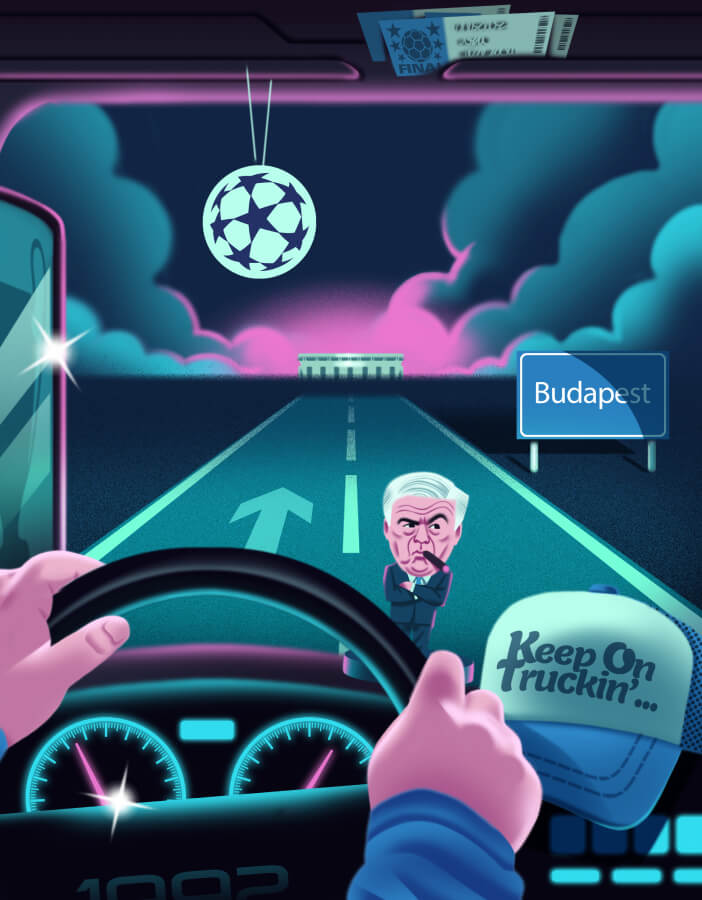
It is that time of year, with spring in the air and the knockout phase under way, when references to the “road to the final” recur with increasing frequency. For most football followers, that can mean only one thing: the pathway, and accompanying obstacles, awaiting a team aiming to reach the final of a competition – Budapest on 30 May, in the case of this season’s Champions League.
For Miguel Fonseca, though, the phrase “road to the final” holds a different, considerably more literal meaning. After all, the 53-year-old from southern Portugal is a lorry driver. For more than a decade, he has travelled the length and breadth of Europe in a 17-metre heavy goods vehicle, ferrying Champions League signage and other logistical equipment to different stadiums as one of UEFA’s team of drivers. Literally putting the show on the road. And yes – let’s get those football-related puns out of the way now – parking the bus every night too.
Of his various “roads to the final”, he has no fonder memory than his journey to Kyiv for the 2018 showpiece between Real Madrid and Liverpool, a drive from UEFA’s HQ in Nyon, Switzerland, through Germany, Czechia and Slovakia before he entered Ukraine. It took him five days. There was an 11-hour wait just to get over the border into Ukraine – and lengthy waits at frontier crossings are, it turns out, an occupational hazard for lorry drivers.
Miguel enjoys being behind the wheel and that particular trek, deep into the east of Europe, has stayed with him. “I like to drive long distances and I really enjoyed going to Kyiv because it was something new for me, with beautiful views of the mountains and the countryside.”
For every Champions League final, five or six lorries depart from Belgium and Switzerland for the venue, each carrying around 12 tonnes’ worth of equipment. Miguel has been in charge of that valuable cargo several times now.
One of the pleasures of my many years working as a UEFA reporter has been the conversations behind the scenes with the unsung heroes of a European football night and Miguel offers a case in point – somebody you say hello to in the stadium before a game and then bump into at breakfast the next morning. His stories of life on the road have always struck me as intriguing. “When you’re driving, you’re always on your own,” he explains. “And then when I stop to rest at night, I like to cook. I have a stove, a fridge, everything, and I make my own food. The truck is very comfortable. It has a bed too so it’s a bit like camping when the weather is fine.
It is that time of year, with spring in the air and the knockout phase under way, when references to the “road to the final” recur with increasing frequency. For most football followers, that can mean only one thing: the pathway, and accompanying obstacles, awaiting a team aiming to reach the final of a competition – Budapest on 30 May, in the case of this season’s Champions League.
For Miguel Fonseca, though, the phrase “road to the final” holds a different, considerably more literal meaning. After all, the 53-year-old from southern Portugal is a lorry driver. For more than a decade, he has travelled the length and breadth of Europe in a 17-metre heavy goods vehicle, ferrying Champions League signage and other logistical equipment to different stadiums as one of UEFA’s team of drivers. Literally putting the show on the road. And yes – let’s get those football-related puns out of the way now – parking the bus every night too.
Of his various “roads to the final”, he has no fonder memory than his journey to Kyiv for the 2018 showpiece between Real Madrid and Liverpool, a drive from UEFA’s HQ in Nyon, Switzerland, through Germany, Czechia and Slovakia before he entered Ukraine. It took him five days. There was an 11-hour wait just to get over the border into Ukraine – and lengthy waits at frontier crossings are, it turns out, an occupational hazard for lorry drivers.
Miguel enjoys being behind the wheel and that particular trek, deep into the east of Europe, has stayed with him. “I like to drive long distances and I really enjoyed going to Kyiv because it was something new for me, with beautiful views of the mountains and the countryside.”
For every Champions League final, five or six lorries depart from Belgium and Switzerland for the venue, each carrying around 12 tonnes’ worth of equipment. Miguel has been in charge of that valuable cargo several times now.
One of the pleasures of my many years working as a UEFA reporter has been the conversations behind the scenes with the unsung heroes of a European football night and Miguel offers a case in point – somebody you say hello to in the stadium before a game and then bump into at breakfast the next morning. His stories of life on the road have always struck me as intriguing. “When you’re driving, you’re always on your own,” he explains. “And then when I stop to rest at night, I like to cook. I have a stove, a fridge, everything, and I make my own food. The truck is very comfortable. It has a bed too so it’s a bit like camping when the weather is fine.
“Sometimes you talk with people, and if there’s another Portuguese driver parked there, you’ll chat. Most of the time, though, it’s a bit lonely unless you’re driving with other colleagues.”
Under the competition’s previous group stage format, drivers like Miguel would have two venues each season. At the start of the campaign, they would collect a lorry filled with signage at the central warehouse in Belgium, and drive it between their two stadiums. One year, that meant Miguel shuttling between Seville in Spain and Malmö in Sweden – a six-day journey each time, factoring in the time restrictions on drivers (such as the legal requirement to stop and take a break after every four and a half hours on the road).
Since the advent of the new Champions League format, each of the 36 league phase teams now have their own designated truck, holding around ten tonnes of branding material, which stays close to the stadium between games, with drivers like Miguel flying in. Yet one thing remains the same, as Miguel explains. “You’re not allowed to arrive at the stadium until matchday minus three.” That is when the lorry is emptied and the stadium dressed in its Champions League livery – a process managed by his mate Toni, the signage manager. At that point, Miguel’s job changes from driver to logistics team member, helping put up the signage (both in the stands and behind the scenes in the press conference room and interview areas). After the game, he is back in the next morning, packing it all away.
The days are long and, as a result, Miguel doesn’t watch every game in which he is involved. Indeed, at some of the Champions League and Europa League finals he has worked, he has been asleep in his hotel bed when the game kicked off. After all, his job begins after the final whistle has blown and he must help his colleagues clear the stadium. “I’ll rest until the manager gives me a call because I know I’ll be working until four in the morning or later.” And that’s before he even contemplates climbing back into his cabin to embark on the long road home.
It is that time of year, with spring in the air and the knockout phase under way, when references to the “road to the final” recur with increasing frequency. For most football followers, that can mean only one thing: the pathway, and accompanying obstacles, awaiting a team aiming to reach the final of a competition – Budapest on 30 May, in the case of this season’s Champions League.
For Miguel Fonseca, though, the phrase “road to the final” holds a different, considerably more literal meaning. After all, the 53-year-old from southern Portugal is a lorry driver. For more than a decade, he has travelled the length and breadth of Europe in a 17-metre heavy goods vehicle, ferrying Champions League signage and other logistical equipment to different stadiums as one of UEFA’s team of drivers. Literally putting the show on the road. And yes – let’s get those football-related puns out of the way now – parking the bus every night too.
Of his various “roads to the final”, he has no fonder memory than his journey to Kyiv for the 2018 showpiece between Real Madrid and Liverpool, a drive from UEFA’s HQ in Nyon, Switzerland, through Germany, Czechia and Slovakia before he entered Ukraine. It took him five days. There was an 11-hour wait just to get over the border into Ukraine – and lengthy waits at frontier crossings are, it turns out, an occupational hazard for lorry drivers.
Miguel enjoys being behind the wheel and that particular trek, deep into the east of Europe, has stayed with him. “I like to drive long distances and I really enjoyed going to Kyiv because it was something new for me, with beautiful views of the mountains and the countryside.”
For every Champions League final, five or six lorries depart from Belgium and Switzerland for the venue, each carrying around 12 tonnes’ worth of equipment. Miguel has been in charge of that valuable cargo several times now.
One of the pleasures of my many years working as a UEFA reporter has been the conversations behind the scenes with the unsung heroes of a European football night and Miguel offers a case in point – somebody you say hello to in the stadium before a game and then bump into at breakfast the next morning. His stories of life on the road have always struck me as intriguing. “When you’re driving, you’re always on your own,” he explains. “And then when I stop to rest at night, I like to cook. I have a stove, a fridge, everything, and I make my own food. The truck is very comfortable. It has a bed too so it’s a bit like camping when the weather is fine.


It is that time of year, with spring in the air and the knockout phase under way, when references to the “road to the final” recur with increasing frequency. For most football followers, that can mean only one thing: the pathway, and accompanying obstacles, awaiting a team aiming to reach the final of a competition – Budapest on 30 May, in the case of this season’s Champions League.
For Miguel Fonseca, though, the phrase “road to the final” holds a different, considerably more literal meaning. After all, the 53-year-old from southern Portugal is a lorry driver. For more than a decade, he has travelled the length and breadth of Europe in a 17-metre heavy goods vehicle, ferrying Champions League signage and other logistical equipment to different stadiums as one of UEFA’s team of drivers. Literally putting the show on the road. And yes – let’s get those football-related puns out of the way now – parking the bus every night too.
Of his various “roads to the final”, he has no fonder memory than his journey to Kyiv for the 2018 showpiece between Real Madrid and Liverpool, a drive from UEFA’s HQ in Nyon, Switzerland, through Germany, Czechia and Slovakia before he entered Ukraine. It took him five days. There was an 11-hour wait just to get over the border into Ukraine – and lengthy waits at frontier crossings are, it turns out, an occupational hazard for lorry drivers.
Miguel enjoys being behind the wheel and that particular trek, deep into the east of Europe, has stayed with him. “I like to drive long distances and I really enjoyed going to Kyiv because it was something new for me, with beautiful views of the mountains and the countryside.”
For every Champions League final, five or six lorries depart from Belgium and Switzerland for the venue, each carrying around 12 tonnes’ worth of equipment. Miguel has been in charge of that valuable cargo several times now.
One of the pleasures of my many years working as a UEFA reporter has been the conversations behind the scenes with the unsung heroes of a European football night and Miguel offers a case in point – somebody you say hello to in the stadium before a game and then bump into at breakfast the next morning. His stories of life on the road have always struck me as intriguing. “When you’re driving, you’re always on your own,” he explains. “And then when I stop to rest at night, I like to cook. I have a stove, a fridge, everything, and I make my own food. The truck is very comfortable. It has a bed too so it’s a bit like camping when the weather is fine.
It is that time of year, with spring in the air and the knockout phase under way, when references to the “road to the final” recur with increasing frequency. For most football followers, that can mean only one thing: the pathway, and accompanying obstacles, awaiting a team aiming to reach the final of a competition – Budapest on 30 May, in the case of this season’s Champions League.
For Miguel Fonseca, though, the phrase “road to the final” holds a different, considerably more literal meaning. After all, the 53-year-old from southern Portugal is a lorry driver. For more than a decade, he has travelled the length and breadth of Europe in a 17-metre heavy goods vehicle, ferrying Champions League signage and other logistical equipment to different stadiums as one of UEFA’s team of drivers. Literally putting the show on the road. And yes – let’s get those football-related puns out of the way now – parking the bus every night too.
Of his various “roads to the final”, he has no fonder memory than his journey to Kyiv for the 2018 showpiece between Real Madrid and Liverpool, a drive from UEFA’s HQ in Nyon, Switzerland, through Germany, Czechia and Slovakia before he entered Ukraine. It took him five days. There was an 11-hour wait just to get over the border into Ukraine – and lengthy waits at frontier crossings are, it turns out, an occupational hazard for lorry drivers.
Miguel enjoys being behind the wheel and that particular trek, deep into the east of Europe, has stayed with him. “I like to drive long distances and I really enjoyed going to Kyiv because it was something new for me, with beautiful views of the mountains and the countryside.”
For every Champions League final, five or six lorries depart from Belgium and Switzerland for the venue, each carrying around 12 tonnes’ worth of equipment. Miguel has been in charge of that valuable cargo several times now.
One of the pleasures of my many years working as a UEFA reporter has been the conversations behind the scenes with the unsung heroes of a European football night and Miguel offers a case in point – somebody you say hello to in the stadium before a game and then bump into at breakfast the next morning. His stories of life on the road have always struck me as intriguing. “When you’re driving, you’re always on your own,” he explains. “And then when I stop to rest at night, I like to cook. I have a stove, a fridge, everything, and I make my own food. The truck is very comfortable. It has a bed too so it’s a bit like camping when the weather is fine.
“Sometimes you talk with people, and if there’s another Portuguese driver parked there, you’ll chat. Most of the time, though, it’s a bit lonely unless you’re driving with other colleagues.”
Under the competition’s previous group stage format, drivers like Miguel would have two venues each season. At the start of the campaign, they would collect a lorry filled with signage at the central warehouse in Belgium, and drive it between their two stadiums. One year, that meant Miguel shuttling between Seville in Spain and Malmö in Sweden – a six-day journey each time, factoring in the time restrictions on drivers (such as the legal requirement to stop and take a break after every four and a half hours on the road).
Since the advent of the new Champions League format, each of the 36 league phase teams now have their own designated truck, holding around ten tonnes of branding material, which stays close to the stadium between games, with drivers like Miguel flying in. Yet one thing remains the same, as Miguel explains. “You’re not allowed to arrive at the stadium until matchday minus three.” That is when the lorry is emptied and the stadium dressed in its Champions League livery – a process managed by his mate Toni, the signage manager. At that point, Miguel’s job changes from driver to logistics team member, helping put up the signage (both in the stands and behind the scenes in the press conference room and interview areas). After the game, he is back in the next morning, packing it all away.
The days are long and, as a result, Miguel doesn’t watch every game in which he is involved. Indeed, at some of the Champions League and Europa League finals he has worked, he has been asleep in his hotel bed when the game kicked off. After all, his job begins after the final whistle has blown and he must help his colleagues clear the stadium. “I’ll rest until the manager gives me a call because I know I’ll be working until four in the morning or later.” And that’s before he even contemplates climbing back into his cabin to embark on the long road home.
It is that time of year, with spring in the air and the knockout phase under way, when references to the “road to the final” recur with increasing frequency. For most football followers, that can mean only one thing: the pathway, and accompanying obstacles, awaiting a team aiming to reach the final of a competition – Budapest on 30 May, in the case of this season’s Champions League.
For Miguel Fonseca, though, the phrase “road to the final” holds a different, considerably more literal meaning. After all, the 53-year-old from southern Portugal is a lorry driver. For more than a decade, he has travelled the length and breadth of Europe in a 17-metre heavy goods vehicle, ferrying Champions League signage and other logistical equipment to different stadiums as one of UEFA’s team of drivers. Literally putting the show on the road. And yes – let’s get those football-related puns out of the way now – parking the bus every night too.
Of his various “roads to the final”, he has no fonder memory than his journey to Kyiv for the 2018 showpiece between Real Madrid and Liverpool, a drive from UEFA’s HQ in Nyon, Switzerland, through Germany, Czechia and Slovakia before he entered Ukraine. It took him five days. There was an 11-hour wait just to get over the border into Ukraine – and lengthy waits at frontier crossings are, it turns out, an occupational hazard for lorry drivers.
Miguel enjoys being behind the wheel and that particular trek, deep into the east of Europe, has stayed with him. “I like to drive long distances and I really enjoyed going to Kyiv because it was something new for me, with beautiful views of the mountains and the countryside.”
For every Champions League final, five or six lorries depart from Belgium and Switzerland for the venue, each carrying around 12 tonnes’ worth of equipment. Miguel has been in charge of that valuable cargo several times now.
One of the pleasures of my many years working as a UEFA reporter has been the conversations behind the scenes with the unsung heroes of a European football night and Miguel offers a case in point – somebody you say hello to in the stadium before a game and then bump into at breakfast the next morning. His stories of life on the road have always struck me as intriguing. “When you’re driving, you’re always on your own,” he explains. “And then when I stop to rest at night, I like to cook. I have a stove, a fridge, everything, and I make my own food. The truck is very comfortable. It has a bed too so it’s a bit like camping when the weather is fine.