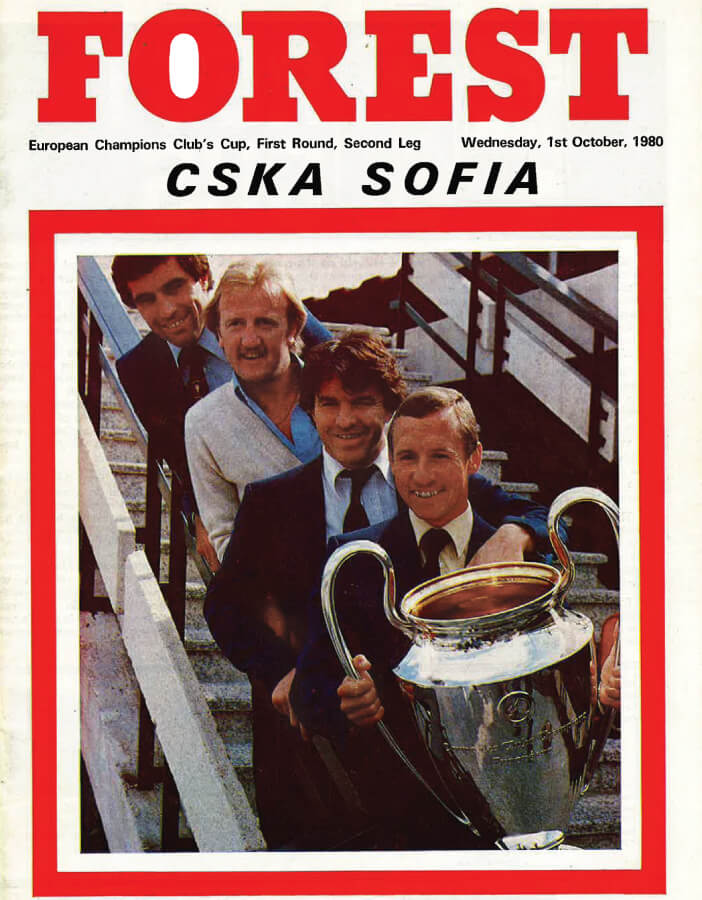
They say every picture tells a story and this one is no different, although in this case the story didn’t have the ending many had predicted. The photo on the cover of the programme for Nottingham Forest’s European Cup first round decider against CSKA Sofia on 1 October 1980 depicts captain John McGovern holding the trophy won in Madrid four months earlier, with team-mates John Robertson, Kenny Burns and Peter Shilton behind him on the steps at East Midlands Airport on their victorious return from Spain.
Forest were the kings of Europe after winning the second of their two straight European Cups, so no one expected Brian Clough’s side to exit the competition in the first round after this match. It signalled the beginning of the end for Forest’s great side, not to mention the relationship between Clough and his assistant Peter Taylor that was so fundamental to their success.
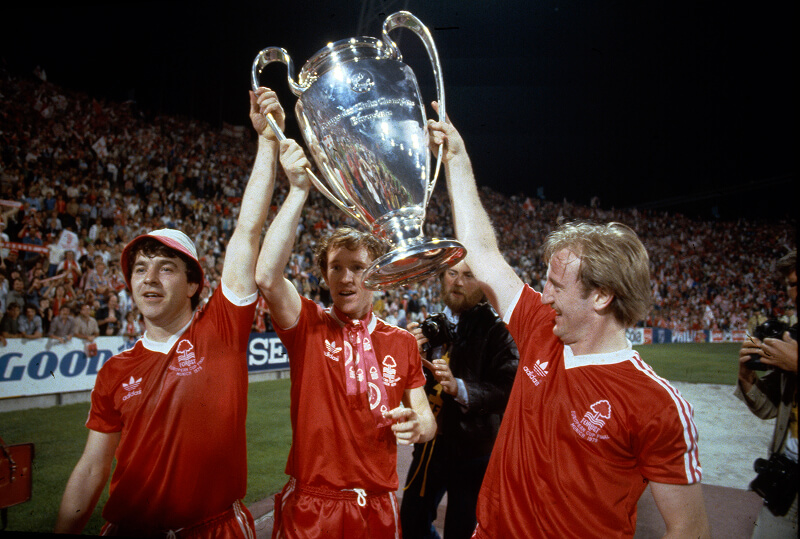
Trailing 1-0 from the first leg in Bulgaria, Forest were expected to turn the tie around at the City Ground. However, Ruzhdi Kerimov scored the only goal to send the Bulgarian champions through and bring Forest’s remarkable European Cup run to an end. In three seasons, Clough’s men had followed up promotion to the First Division by winning their first English title in 1977/78 and then successive European crowns, along with a UEFA Super Cup and two League Cups.
The player standing behind McGovern on the cover of that evening’s match programme was the fulcrum of Forest’s success during those golden years and a man fondly remembered when he passed away aged 72 this Christmas Day. For a winger, Robertson was never the quickest but, as Clough remarked, “Give him a ball and a yard of grass, and he was an artist, the Picasso of our game.” Robbo’s brushstrokes certainly illuminated those two European Cup finals. If crossing a ball was an art form, Robertson was its finest painter. His precise left-footed cross allowed Trevor Francis to score the decisive back-post header against Malmö in 1979, and a year later Robertson took centre stage himself, exchanging passes with a prostrate Garry Birtles before nonchalantly curling in the only goal of the game against Hamburg at the Bernabéu.
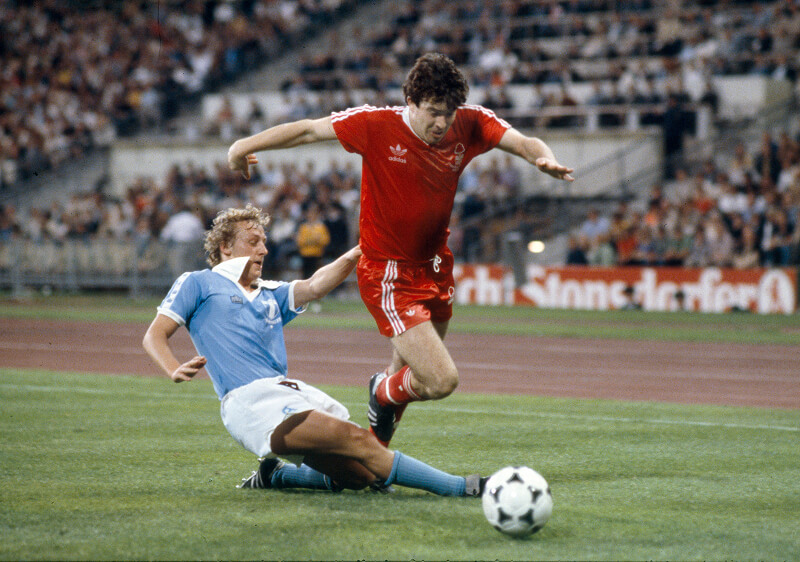
Robertson had showed great character in the build-up to the first leg of their 1978/79 semi-final after his older brother Hughie and sister-in-law Isobel were killed in a car accident, a car John had gifted his sibling after passing his driving test. It was a tragedy that would haunt him for the rest of his life, yet he still found the strength a couple of days after Hughie’s funeral not only to play but score with a diving header in a 3-3 draw against Köln.
Robertson was at the peak of his powers in those years, and with hindsight it’s still something of a mystery why he never won or was even shortlisted for the Ballon d’Or. Maybe it was because he played for one of Europe’s less fashionable clubs. However, before Clough arrived at the City Ground in January 1975, Robertson was an overweight and directionless central midfielder lacking in tactical discipline and physical endurance, to the point where Forest considered selling him to Partick Thistle. Luckily, Clough quickly worked out that his two-footed, chubby ugly duckling could be turned into an elegant white swan by deploying Robertson as a left-winger.
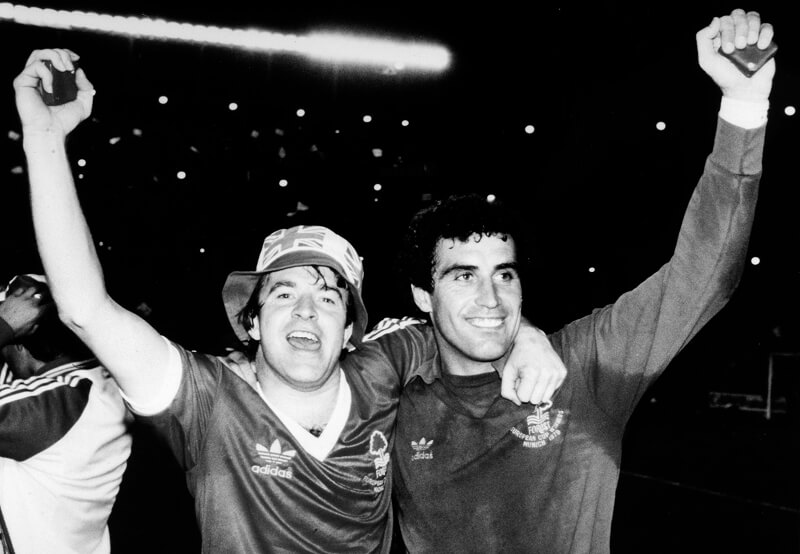
It turned out to be another masterstroke by Clough, who could have written the book on man management. Robertson flourished in his new role and later revealed Clough’s first bit of advice to him was: “Son, if you’re a central midfielder, I’m Frank Sinatra.” The maestro from Viewpark (the same area that gave fellow wing wizard Jimmy Johnstone to the world) went on to play 243 consecutive matches between December 1976 and December 1980, and – despite big-name buys such as England goalkeeper Shilton and Francis, Britain’s first £1m footballer – he was the magician who made Forest tick. “I knew he liked me, but I loved him,” Robertson later said of his manager. “I wouldn’t have had a career without him.”
If any one player personifies that Forest team’s story, it was Robertson, who went from being a Second Division outcast to the key player in two European Cup triumphs. Asked before the final in Madrid how Forest would get the better of Hamburg full-back Manny Kaltz, considered to be one of the best defenders in Europe, Clough said: “We’ve got a little fat guy who will turn him inside out.” Leaning forward for further emphasis, he added: “A very talented, highly skilled, unbelievable outside-left. He’ll turn him inside out.” As predictions go, it wasn’t bad, with Robertson cutting inside Kaltz after 20 minutes before beating keeper Rudi Kargus. He may have not won a Ballon d’Or, but as Clough himself might have said of his favourite player, Robertson was definitely in the top one.
They say every picture tells a story and this one is no different, although in this case the story didn’t have the ending many had predicted. The photo on the cover of the programme for Nottingham Forest’s European Cup first round decider against CSKA Sofia on 1 October 1980 depicts captain John McGovern holding the trophy won in Madrid four months earlier, with team-mates John Robertson, Kenny Burns and Peter Shilton behind him on the steps at East Midlands Airport on their victorious return from Spain.
Forest were the kings of Europe after winning the second of their two straight European Cups, so no one expected Brian Clough’s side to exit the competition in the first round after this match. It signalled the beginning of the end for Forest’s great side, not to mention the relationship between Clough and his assistant Peter Taylor that was so fundamental to their success.
Trailing 1-0 from the first leg in Bulgaria, Forest were expected to turn the tie around at the City Ground. However, Ruzhdi Kerimov scored the only goal to send the Bulgarian champions through and bring Forest’s remarkable European Cup run to an end. In three seasons, Clough’s men had followed up promotion to the First Division by winning their first English title in 1977/78 and then successive European crowns, along with a UEFA Super Cup and two League Cups.
The player standing behind McGovern on the cover of that evening’s match programme was the fulcrum of Forest’s success during those golden years and a man fondly remembered when he passed away aged 72 this Christmas Day. For a winger, Robertson was never the quickest but, as Clough remarked, “Give him a ball and a yard of grass, and he was an artist, the Picasso of our game.” Robbo’s brushstrokes certainly illuminated those two European Cup finals. If crossing a ball was an art form, Robertson was its finest painter. His precise left-footed cross allowed Trevor Francis to score the decisive back-post header against Malmö in 1979, and a year later Robertson took centre stage himself, exchanging passes with a prostrate Garry Birtles before nonchalantly curling in the only goal of the game against Hamburg at the Bernabéu.
Robertson had showed great character in the build-up to the first leg of their 1978/79 semi-final after his older brother Hughie and sister-in-law Isobel were killed in a car accident, a car John had gifted his sibling after passing his driving test. It was a tragedy that would haunt him for the rest of his life, yet he still found the strength a couple of days after Hughie’s funeral not only to play but score with a diving header in a 3-3 draw against Köln.
Robertson was at the peak of his powers in those years, and with hindsight it’s still something of a mystery why he never won or was even shortlisted for the Ballon d’Or. Maybe it was because he played for one of Europe’s less fashionable clubs. However, before Clough arrived at the City Ground in January 1975, Robertson was an overweight and directionless central midfielder lacking in tactical discipline and physical endurance, to the point where Forest considered selling him to Partick Thistle. Luckily, Clough quickly worked out that his two-footed, chubby ugly duckling could be turned into an elegant white swan by deploying Robertson as a left-winger.
It turned out to be another masterstroke by Clough, who could have written the book on man management. Robertson flourished in his new role and later revealed Clough’s first bit of advice to him was: “Son, if you’re a central midfielder, I’m Frank Sinatra.” The maestro from Viewpark (the same area that gave fellow wing wizard Jimmy Johnstone to the world) went on to play 243 consecutive matches between December 1976 and December 1980, and – despite big-name buys such as England goalkeeper Shilton and Francis, Britain’s first £1m footballer – he was the magician who made Forest tick. “I knew he liked me, but I loved him,” Robertson later said of his manager. “I wouldn’t have had a career without him.”
If any one player personifies that Forest team’s story, it was Robertson, who went from being a Second Division outcast to the key player in two European Cup triumphs. Asked before the final in Madrid how Forest would get the better of Hamburg full-back Manny Kaltz, considered to be one of the best defenders in Europe, Clough said: “We’ve got a little fat guy who will turn him inside out.” Leaning forward for further emphasis, he added: “A very talented, highly skilled, unbelievable outside-left. He’ll turn him inside out.” As predictions go, it wasn’t bad, with Robertson cutting inside Kaltz after 20 minutes before beating keeper Rudi Kargus. He may have not won a Ballon d’Or, but as Clough himself might have said of his favourite player, Robertson was definitely in the top one.
They say every picture tells a story and this one is no different, although in this case the story didn’t have the ending many had predicted. The photo on the cover of the programme for Nottingham Forest’s European Cup first round decider against CSKA Sofia on 1 October 1980 depicts captain John McGovern holding the trophy won in Madrid four months earlier, with team-mates John Robertson, Kenny Burns and Peter Shilton behind him on the steps at East Midlands Airport on their victorious return from Spain.
Forest were the kings of Europe after winning the second of their two straight European Cups, so no one expected Brian Clough’s side to exit the competition in the first round after this match. It signalled the beginning of the end for Forest’s great side, not to mention the relationship between Clough and his assistant Peter Taylor that was so fundamental to their success.
Trailing 1-0 from the first leg in Bulgaria, Forest were expected to turn the tie around at the City Ground. However, Ruzhdi Kerimov scored the only goal to send the Bulgarian champions through and bring Forest’s remarkable European Cup run to an end. In three seasons, Clough’s men had followed up promotion to the First Division by winning their first English title in 1977/78 and then successive European crowns, along with a UEFA Super Cup and two League Cups.
The player standing behind McGovern on the cover of that evening’s match programme was the fulcrum of Forest’s success during those golden years and a man fondly remembered when he passed away aged 72 this Christmas Day. For a winger, Robertson was never the quickest but, as Clough remarked, “Give him a ball and a yard of grass, and he was an artist, the Picasso of our game.” Robbo’s brushstrokes certainly illuminated those two European Cup finals. If crossing a ball was an art form, Robertson was its finest painter. His precise left-footed cross allowed Trevor Francis to score the decisive back-post header against Malmö in 1979, and a year later Robertson took centre stage himself, exchanging passes with a prostrate Garry Birtles before nonchalantly curling in the only goal of the game against Hamburg at the Bernabéu.
Robertson had showed great character in the build-up to the first leg of their 1978/79 semi-final after his older brother Hughie and sister-in-law Isobel were killed in a car accident, a car John had gifted his sibling after passing his driving test. It was a tragedy that would haunt him for the rest of his life, yet he still found the strength a couple of days after Hughie’s funeral not only to play but score with a diving header in a 3-3 draw against Köln.
Robertson was at the peak of his powers in those years, and with hindsight it’s still something of a mystery why he never won or was even shortlisted for the Ballon d’Or. Maybe it was because he played for one of Europe’s less fashionable clubs. However, before Clough arrived at the City Ground in January 1975, Robertson was an overweight and directionless central midfielder lacking in tactical discipline and physical endurance, to the point where Forest considered selling him to Partick Thistle. Luckily, Clough quickly worked out that his two-footed, chubby ugly duckling could be turned into an elegant white swan by deploying Robertson as a left-winger.
It turned out to be another masterstroke by Clough, who could have written the book on man management. Robertson flourished in his new role and later revealed Clough’s first bit of advice to him was: “Son, if you’re a central midfielder, I’m Frank Sinatra.” The maestro from Viewpark (the same area that gave fellow wing wizard Jimmy Johnstone to the world) went on to play 243 consecutive matches between December 1976 and December 1980, and – despite big-name buys such as England goalkeeper Shilton and Francis, Britain’s first £1m footballer – he was the magician who made Forest tick. “I knew he liked me, but I loved him,” Robertson later said of his manager. “I wouldn’t have had a career without him.”
If any one player personifies that Forest team’s story, it was Robertson, who went from being a Second Division outcast to the key player in two European Cup triumphs. Asked before the final in Madrid how Forest would get the better of Hamburg full-back Manny Kaltz, considered to be one of the best defenders in Europe, Clough said: “We’ve got a little fat guy who will turn him inside out.” Leaning forward for further emphasis, he added: “A very talented, highly skilled, unbelievable outside-left. He’ll turn him inside out.” As predictions go, it wasn’t bad, with Robertson cutting inside Kaltz after 20 minutes before beating keeper Rudi Kargus. He may have not won a Ballon d’Or, but as Clough himself might have said of his favourite player, Robertson was definitely in the top one.


They say every picture tells a story and this one is no different, although in this case the story didn’t have the ending many had predicted. The photo on the cover of the programme for Nottingham Forest’s European Cup first round decider against CSKA Sofia on 1 October 1980 depicts captain John McGovern holding the trophy won in Madrid four months earlier, with team-mates John Robertson, Kenny Burns and Peter Shilton behind him on the steps at East Midlands Airport on their victorious return from Spain.
Forest were the kings of Europe after winning the second of their two straight European Cups, so no one expected Brian Clough’s side to exit the competition in the first round after this match. It signalled the beginning of the end for Forest’s great side, not to mention the relationship between Clough and his assistant Peter Taylor that was so fundamental to their success.
Trailing 1-0 from the first leg in Bulgaria, Forest were expected to turn the tie around at the City Ground. However, Ruzhdi Kerimov scored the only goal to send the Bulgarian champions through and bring Forest’s remarkable European Cup run to an end. In three seasons, Clough’s men had followed up promotion to the First Division by winning their first English title in 1977/78 and then successive European crowns, along with a UEFA Super Cup and two League Cups.
The player standing behind McGovern on the cover of that evening’s match programme was the fulcrum of Forest’s success during those golden years and a man fondly remembered when he passed away aged 72 this Christmas Day. For a winger, Robertson was never the quickest but, as Clough remarked, “Give him a ball and a yard of grass, and he was an artist, the Picasso of our game.” Robbo’s brushstrokes certainly illuminated those two European Cup finals. If crossing a ball was an art form, Robertson was its finest painter. His precise left-footed cross allowed Trevor Francis to score the decisive back-post header against Malmö in 1979, and a year later Robertson took centre stage himself, exchanging passes with a prostrate Garry Birtles before nonchalantly curling in the only goal of the game against Hamburg at the Bernabéu.
Robertson had showed great character in the build-up to the first leg of their 1978/79 semi-final after his older brother Hughie and sister-in-law Isobel were killed in a car accident, a car John had gifted his sibling after passing his driving test. It was a tragedy that would haunt him for the rest of his life, yet he still found the strength a couple of days after Hughie’s funeral not only to play but score with a diving header in a 3-3 draw against Köln.
Robertson was at the peak of his powers in those years, and with hindsight it’s still something of a mystery why he never won or was even shortlisted for the Ballon d’Or. Maybe it was because he played for one of Europe’s less fashionable clubs. However, before Clough arrived at the City Ground in January 1975, Robertson was an overweight and directionless central midfielder lacking in tactical discipline and physical endurance, to the point where Forest considered selling him to Partick Thistle. Luckily, Clough quickly worked out that his two-footed, chubby ugly duckling could be turned into an elegant white swan by deploying Robertson as a left-winger.
It turned out to be another masterstroke by Clough, who could have written the book on man management. Robertson flourished in his new role and later revealed Clough’s first bit of advice to him was: “Son, if you’re a central midfielder, I’m Frank Sinatra.” The maestro from Viewpark (the same area that gave fellow wing wizard Jimmy Johnstone to the world) went on to play 243 consecutive matches between December 1976 and December 1980, and – despite big-name buys such as England goalkeeper Shilton and Francis, Britain’s first £1m footballer – he was the magician who made Forest tick. “I knew he liked me, but I loved him,” Robertson later said of his manager. “I wouldn’t have had a career without him.”
If any one player personifies that Forest team’s story, it was Robertson, who went from being a Second Division outcast to the key player in two European Cup triumphs. Asked before the final in Madrid how Forest would get the better of Hamburg full-back Manny Kaltz, considered to be one of the best defenders in Europe, Clough said: “We’ve got a little fat guy who will turn him inside out.” Leaning forward for further emphasis, he added: “A very talented, highly skilled, unbelievable outside-left. He’ll turn him inside out.” As predictions go, it wasn’t bad, with Robertson cutting inside Kaltz after 20 minutes before beating keeper Rudi Kargus. He may have not won a Ballon d’Or, but as Clough himself might have said of his favourite player, Robertson was definitely in the top one.
They say every picture tells a story and this one is no different, although in this case the story didn’t have the ending many had predicted. The photo on the cover of the programme for Nottingham Forest’s European Cup first round decider against CSKA Sofia on 1 October 1980 depicts captain John McGovern holding the trophy won in Madrid four months earlier, with team-mates John Robertson, Kenny Burns and Peter Shilton behind him on the steps at East Midlands Airport on their victorious return from Spain.
Forest were the kings of Europe after winning the second of their two straight European Cups, so no one expected Brian Clough’s side to exit the competition in the first round after this match. It signalled the beginning of the end for Forest’s great side, not to mention the relationship between Clough and his assistant Peter Taylor that was so fundamental to their success.
Trailing 1-0 from the first leg in Bulgaria, Forest were expected to turn the tie around at the City Ground. However, Ruzhdi Kerimov scored the only goal to send the Bulgarian champions through and bring Forest’s remarkable European Cup run to an end. In three seasons, Clough’s men had followed up promotion to the First Division by winning their first English title in 1977/78 and then successive European crowns, along with a UEFA Super Cup and two League Cups.
The player standing behind McGovern on the cover of that evening’s match programme was the fulcrum of Forest’s success during those golden years and a man fondly remembered when he passed away aged 72 this Christmas Day. For a winger, Robertson was never the quickest but, as Clough remarked, “Give him a ball and a yard of grass, and he was an artist, the Picasso of our game.” Robbo’s brushstrokes certainly illuminated those two European Cup finals. If crossing a ball was an art form, Robertson was its finest painter. His precise left-footed cross allowed Trevor Francis to score the decisive back-post header against Malmö in 1979, and a year later Robertson took centre stage himself, exchanging passes with a prostrate Garry Birtles before nonchalantly curling in the only goal of the game against Hamburg at the Bernabéu.
Robertson had showed great character in the build-up to the first leg of their 1978/79 semi-final after his older brother Hughie and sister-in-law Isobel were killed in a car accident, a car John had gifted his sibling after passing his driving test. It was a tragedy that would haunt him for the rest of his life, yet he still found the strength a couple of days after Hughie’s funeral not only to play but score with a diving header in a 3-3 draw against Köln.
Robertson was at the peak of his powers in those years, and with hindsight it’s still something of a mystery why he never won or was even shortlisted for the Ballon d’Or. Maybe it was because he played for one of Europe’s less fashionable clubs. However, before Clough arrived at the City Ground in January 1975, Robertson was an overweight and directionless central midfielder lacking in tactical discipline and physical endurance, to the point where Forest considered selling him to Partick Thistle. Luckily, Clough quickly worked out that his two-footed, chubby ugly duckling could be turned into an elegant white swan by deploying Robertson as a left-winger.
It turned out to be another masterstroke by Clough, who could have written the book on man management. Robertson flourished in his new role and later revealed Clough’s first bit of advice to him was: “Son, if you’re a central midfielder, I’m Frank Sinatra.” The maestro from Viewpark (the same area that gave fellow wing wizard Jimmy Johnstone to the world) went on to play 243 consecutive matches between December 1976 and December 1980, and – despite big-name buys such as England goalkeeper Shilton and Francis, Britain’s first £1m footballer – he was the magician who made Forest tick. “I knew he liked me, but I loved him,” Robertson later said of his manager. “I wouldn’t have had a career without him.”
If any one player personifies that Forest team’s story, it was Robertson, who went from being a Second Division outcast to the key player in two European Cup triumphs. Asked before the final in Madrid how Forest would get the better of Hamburg full-back Manny Kaltz, considered to be one of the best defenders in Europe, Clough said: “We’ve got a little fat guy who will turn him inside out.” Leaning forward for further emphasis, he added: “A very talented, highly skilled, unbelievable outside-left. He’ll turn him inside out.” As predictions go, it wasn’t bad, with Robertson cutting inside Kaltz after 20 minutes before beating keeper Rudi Kargus. He may have not won a Ballon d’Or, but as Clough himself might have said of his favourite player, Robertson was definitely in the top one.
They say every picture tells a story and this one is no different, although in this case the story didn’t have the ending many had predicted. The photo on the cover of the programme for Nottingham Forest’s European Cup first round decider against CSKA Sofia on 1 October 1980 depicts captain John McGovern holding the trophy won in Madrid four months earlier, with team-mates John Robertson, Kenny Burns and Peter Shilton behind him on the steps at East Midlands Airport on their victorious return from Spain.
Forest were the kings of Europe after winning the second of their two straight European Cups, so no one expected Brian Clough’s side to exit the competition in the first round after this match. It signalled the beginning of the end for Forest’s great side, not to mention the relationship between Clough and his assistant Peter Taylor that was so fundamental to their success.
Trailing 1-0 from the first leg in Bulgaria, Forest were expected to turn the tie around at the City Ground. However, Ruzhdi Kerimov scored the only goal to send the Bulgarian champions through and bring Forest’s remarkable European Cup run to an end. In three seasons, Clough’s men had followed up promotion to the First Division by winning their first English title in 1977/78 and then successive European crowns, along with a UEFA Super Cup and two League Cups.
The player standing behind McGovern on the cover of that evening’s match programme was the fulcrum of Forest’s success during those golden years and a man fondly remembered when he passed away aged 72 this Christmas Day. For a winger, Robertson was never the quickest but, as Clough remarked, “Give him a ball and a yard of grass, and he was an artist, the Picasso of our game.” Robbo’s brushstrokes certainly illuminated those two European Cup finals. If crossing a ball was an art form, Robertson was its finest painter. His precise left-footed cross allowed Trevor Francis to score the decisive back-post header against Malmö in 1979, and a year later Robertson took centre stage himself, exchanging passes with a prostrate Garry Birtles before nonchalantly curling in the only goal of the game against Hamburg at the Bernabéu.
Robertson had showed great character in the build-up to the first leg of their 1978/79 semi-final after his older brother Hughie and sister-in-law Isobel were killed in a car accident, a car John had gifted his sibling after passing his driving test. It was a tragedy that would haunt him for the rest of his life, yet he still found the strength a couple of days after Hughie’s funeral not only to play but score with a diving header in a 3-3 draw against Köln.
Robertson was at the peak of his powers in those years, and with hindsight it’s still something of a mystery why he never won or was even shortlisted for the Ballon d’Or. Maybe it was because he played for one of Europe’s less fashionable clubs. However, before Clough arrived at the City Ground in January 1975, Robertson was an overweight and directionless central midfielder lacking in tactical discipline and physical endurance, to the point where Forest considered selling him to Partick Thistle. Luckily, Clough quickly worked out that his two-footed, chubby ugly duckling could be turned into an elegant white swan by deploying Robertson as a left-winger.
It turned out to be another masterstroke by Clough, who could have written the book on man management. Robertson flourished in his new role and later revealed Clough’s first bit of advice to him was: “Son, if you’re a central midfielder, I’m Frank Sinatra.” The maestro from Viewpark (the same area that gave fellow wing wizard Jimmy Johnstone to the world) went on to play 243 consecutive matches between December 1976 and December 1980, and – despite big-name buys such as England goalkeeper Shilton and Francis, Britain’s first £1m footballer – he was the magician who made Forest tick. “I knew he liked me, but I loved him,” Robertson later said of his manager. “I wouldn’t have had a career without him.”
If any one player personifies that Forest team’s story, it was Robertson, who went from being a Second Division outcast to the key player in two European Cup triumphs. Asked before the final in Madrid how Forest would get the better of Hamburg full-back Manny Kaltz, considered to be one of the best defenders in Europe, Clough said: “We’ve got a little fat guy who will turn him inside out.” Leaning forward for further emphasis, he added: “A very talented, highly skilled, unbelievable outside-left. He’ll turn him inside out.” As predictions go, it wasn’t bad, with Robertson cutting inside Kaltz after 20 minutes before beating keeper Rudi Kargus. He may have not won a Ballon d’Or, but as Clough himself might have said of his favourite player, Robertson was definitely in the top one.







.webp)

