Grounds for celebration
Simon Hart visits an exhibition in Liverpool that explores the fascinating history of football architecture, from the packed terraces of the past to today’s multipurpose behemoths
WORDS Simon Hart
Culture
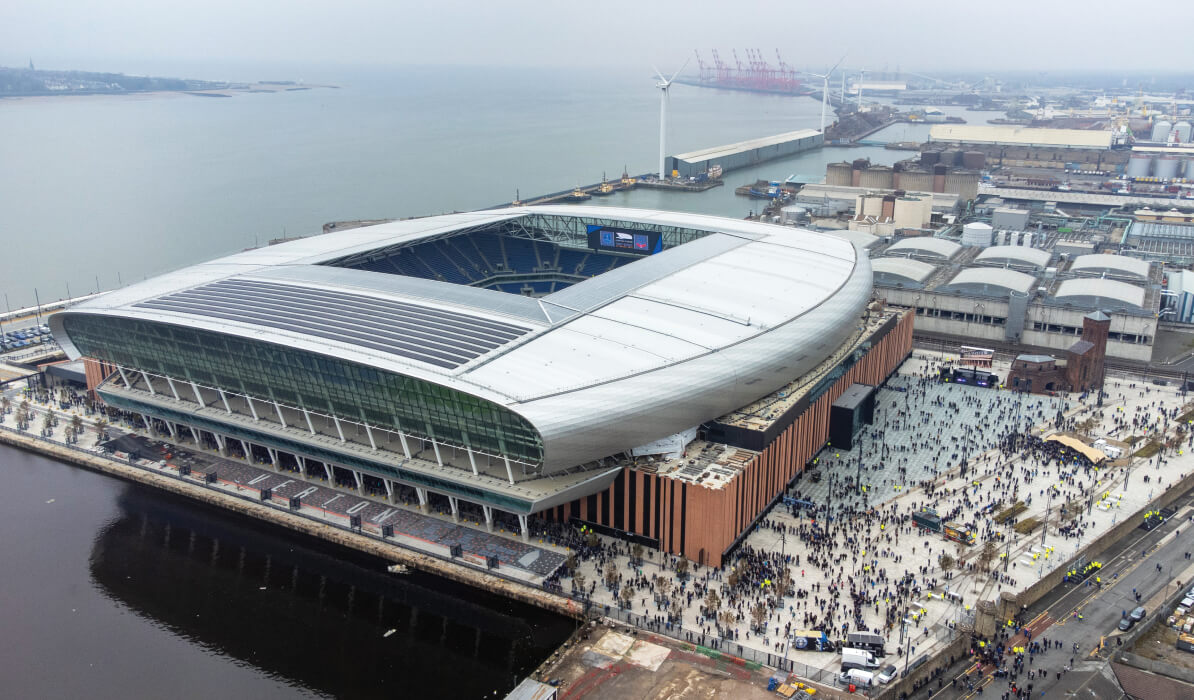
Time travel, whenever it comes, might just feel something like this. Less than an hour ago, I was at Everton’s Hill Dickinson Stadium, absorbing the spectacle of the newest venue on the English football landscape, its metallic roof gleaming beside the River Mersey.
Now here I am back in 1966, watching Pelé and Eusébio in World Cup action at Goodison Park, the old home of Everton’s men’s team – all brought to life in a wonderful, lush-coloured extract from Goal!, the official film of that tournament. It’s showing on a large screen at the entrance to Home Ground, an exhibition at Liverpool’s RIBA North gallery which, in the words of curator Pete Collard, aims to “to give people insight into the history of the game and the history of football architecture”.
The sight of Goodison’s old Archibald Leitch-designed stands acting as a backdrop to World Cup football is certainly a wonderful way to start. As Collard admits, Everton’s farewell to their home of 133 years – the setting (history buffs, take note) for the European Cup’s first-ever penalty shoot-out, back in 1970 – was the exhibition’s catalyst.
“It felt like a brilliant opportunity to celebrate what is the most significant piece of architecture being built in the northwest this year and probably in forthcoming years too,” Collard says of the new stadium, whose construction brings fresh life to a section of the city’s waterfront. “Given the old Everton stadium, Goodison Park, has a beautiful architectural story as well, it seemed like a very simple idea to acknowledge the closing of one and the opening of another in Liverpool. And obviously because Liverpool is such a brilliant football city, it wrote itself in many ways.”
This is an exhibition which takes you back in time, before pointing to the future as well. It begins with black-and-white footage of games played in the first years of the 20th century at Anfield, Turf Moor and Burnden Park – the respective homes of Liverpool, Burnley and Bolton Wanderers. Cue scratchy shots of long shorts, wooden fences and factory chimneys, evocative glimpses that invite reflection on football’s origins and how much it has evolved.
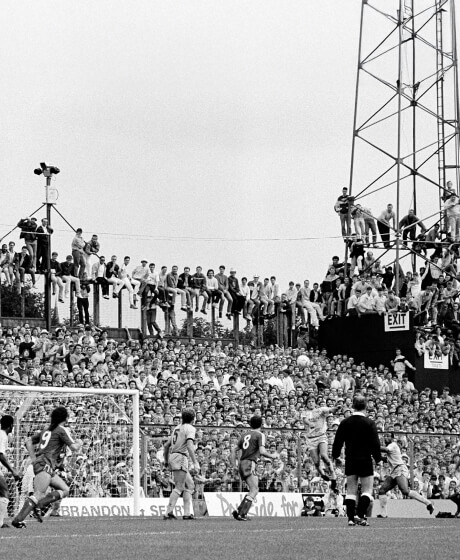
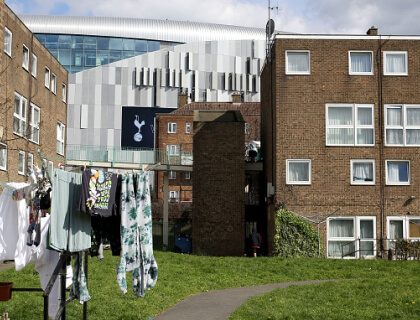
Those origins are explored beautifully by several aerial images of stadiums such as Goodison and Highbury set amid tight streets of terraced houses. These show, as Collard explains, “how close these clubs and the grounds were to the local residents and the supporters living around there. That’s the thing: you are embedded in in the community, you’re embedded in a particular part of the city.”
The exhibition’s gaze lands for a while on the earlier-mentioned Leitch, the Scottish pioneer it describes as “the foremost football stadium architect in Britain during the 20th century”. At one point in the late 1920s, no fewer than 16 of the 22 English top-flight clubs had a Leitch-designed stand, underlining his impact on the look and feel of the game. Rangers’ Ibrox Park and Portsmouth’s Fratton Park still have stands with his signature lattice-style steel balustrades which, along the front of the upper tier, also made Goodison so distinctive.
“He’s such an interesting figure because he had complete dominance over the field,” notes Collard. But while British football had “one guy designing everything, and doing it from a very pragmatic, economical engineering sort of perspective”, there was a different approach in some European cities in the 1930s. There, stadiums were being built with “a much bigger meaning beyond the game itself”.
“football stadiums can have a meaning beyond the activities that are happening there”
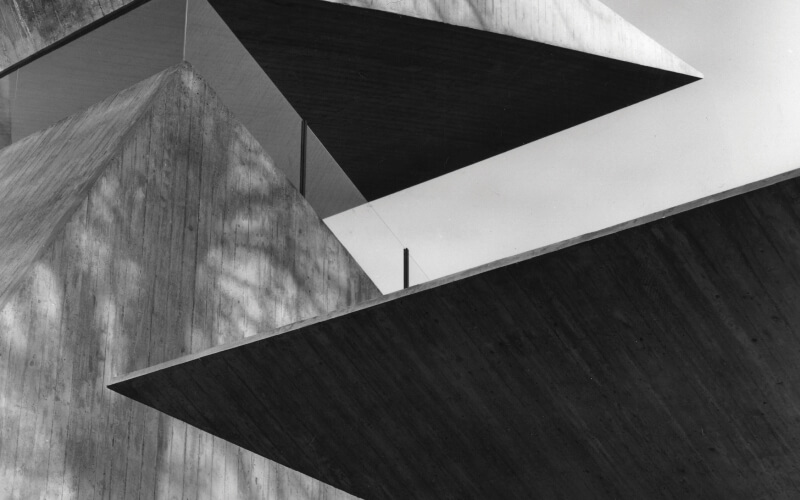
“These grounds are embedded in the community, embedded in a particular part of the city”
The exhibition identifies Florence’s Stadio Giovanni Berta – named after a fascist militant and later renamed the Stadio Artemio Franchi – and Vienna’s Praterstadion (today the Ernst-Happel-Stadion) as two notable examples of “the idea that football stadiums can have a meaning beyond the activities that are happening there”.
“I wanted to deliberately showcase how in Vienna and Florence, virtually at the same time, these stadiums were being built,” says Collard. “One by a left-wing city council, the other a right-wing city council – using big architecture, big ideas, bold visual motifs and so on to say very different things about the nature of sport, physical activity and how they wanted to influence the views of
the population.”
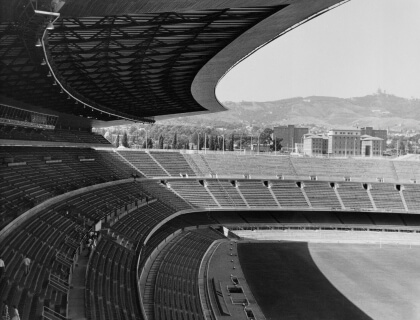
Along the same lines, the exhibition includes a black-and-white image of the Camp Nou in its original 1957 form, displaying it as a “bold modernist structure” which, Collard adds, “shows that the club is contemporary, is very forward-thinking, is very much of the moment. You know the Barcelona story and how it became this beacon of Catalan culture and a meeting place. We’ve talked about football stadiums as a place for people to meet and congregate, and in the case of Barcelona to share their political ideas.”
One of the most striking monochrome images is of the great oval-shaped bowl that was Chelsea’s Stamford Bridge home in 1920 (featured at the end of this piece). Here is the football ground in primitive form: there is a single grandstand, but the eye is drawn to three large banks of terracing on which tens of thousands
are crammed.
“It’s quite hard to bring atmosphere in, but photography particularly can really show what it’s like to be there,” Collard says (and the Estadio Azteca photo above illustrates this too). “The events on the pitch are just one part of the stadium experience. It’s being surrounded in a vast piece of architecture but with tens of thousands of people. With that Chelsea image, when I saw that, it was a real ‘Wow!’ moment. It shows the amount of people you could get on what was basically a raised bank of earth.”
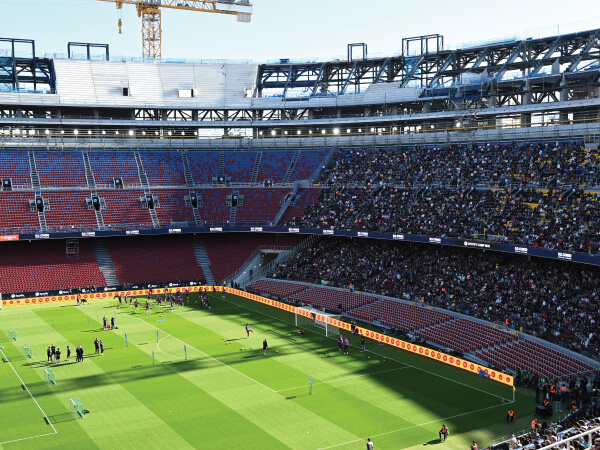
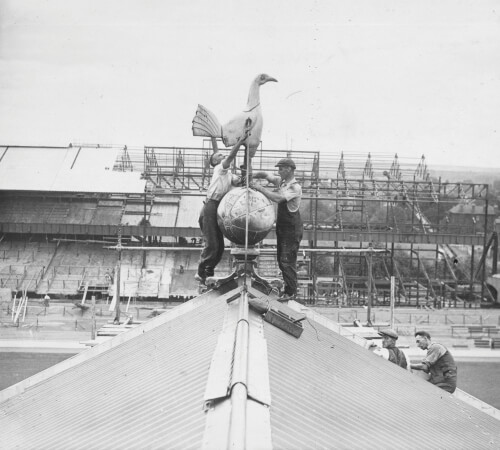
This prompts a then-and-now reflection, given how the original stadiums were not built solely for football. Indeed, Stamford Bridge’s original shape allowed space for running and cycle tracks around the perimeter of the pitch. As Collard points out, “The clubs or the ground owners would want to maximise revenue,” and the exhibition’s subsequent images of the new Tottenham Hotspur Stadium offer a present-day example of the same phenomenon, with the north London venue boasting a retractable pitch that can make way for an American football field beneath.
“It’s so true of today that it’s not enough just to have a wonderful stadium that has a great atmosphere and great sightlines and works for the football team. You have to have the potential to have a Bruce Springsteen or a Taylor Swift concert as well. I think flexibility and adaptability are really key to stadium design. That’s very challenging
for architects.”
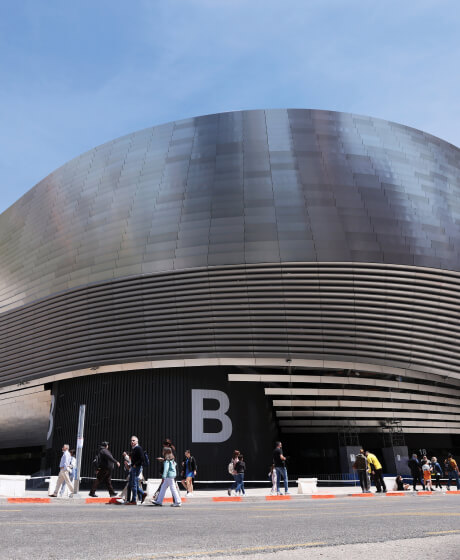
Among the outstanding modern designs featured are Real Madrid’s repurposed Santiago Bernabéu (top right) and Bayern’s Munich Football Arena (right) – the former wrapped in steel ribbon, the latter in 2,816 ethylene tetrafluoroethylene-foil air cushions that can be independently lit in different colours. (Yes, I was taking notes).
Collard cites the architects of Bayern’s stadium, Herzog & de Meuron, as “a very good example of a practice that has a strong interest in football. They designed the St. Jakob-Park stadium in Basel almost because they’re fans of the club. So there’s a bit of investment there. They’ve designed a few others – and if you look at their Munich and Bordeaux stadiums, they’re completely different.
“It’s about trying, in each case, to come up with a unique solution, with something which suits the landscape, the club, the city and so on. I think it’s quite hard for somebody to create a particular style or a particular genre – or at least it was in the 20th century. So [outside Britain], nobody like Leitch really came up. But I think Herzog & de Meuron are a very interesting example of a practice that really gets football, really engages with football.”
Fittingly, Home Ground ends at Anfield with a 1906 drawing of the original Kop stand, which is contrasted with a digital model of Everton’s new home. Collard selected it from a set of hand-drawn plans – some of which, thankfully, were retrieved from a skip outside the city council surveyor’s office a few years ago.
“It shows, I think, the evolution of football stadiums and how they went from being designed in such a basic form. That design for Anfield shows a Leitch design – a new grandstand and a new terrace. That’s perhaps the most famous stand in world football. Liverpool fans would obviously claim it as that, as it does have such a history within the story of football. And it is such a very basic piece of painting with pencil annotation.”
All things must start somewhere, even the grandest of football grounds. The Kop was once just “some lines on a piece of paper” – before the builders did their bit, and then generations of Liverpool players, managers and fans did the rest.
Now here I am back in 1966, watching Pelé and Eusébio in World Cup action at Goodison Park, the old home of Everton’s men’s team – all brought to life in a wonderful, lush-coloured extract from Goal!, the official film of that tournament. It’s showing on a large screen at the entrance to Home Ground, an exhibition at Liverpool’s RIBA North gallery which, in the words of curator Pete Collard, aims to “to give people insight into the history of the game and the history of football architecture”.
The sight of Goodison’s old Archibald Leitch-designed stands acting as a backdrop to World Cup football is certainly a wonderful way to start. As Collard admits, Everton’s farewell to their home of 133 years – the setting (history buffs, take note) for the European Cup’s first-ever penalty shoot-out, back in 1970 – was the exhibition’s catalyst.
“It felt like a brilliant opportunity to celebrate what is the most significant piece of architecture being built in the northwest this year and probably in forthcoming years too,” Collard says of the new stadium, whose construction brings fresh life to a section of the city’s waterfront. “Given the old Everton stadium, Goodison Park, has a beautiful architectural story as well, it seemed like a very simple idea to acknowledge the closing of one and the opening of another in Liverpool. And obviously because Liverpool is such a brilliant football city, it wrote itself in many ways.”
This is an exhibition which takes you back in time, before pointing to the future as well. It begins with black-and-white footage of games played in the first years of the 20th century at Anfield, Turf Moor and Burnden Park – the respective homes of Liverpool, Burnley and Bolton Wanderers. Cue scratchy shots of long shorts, wooden fences and factory chimneys, evocative glimpses that invite reflection on football’s origins and how much it has evolved.
Those origins are explored beautifully by several aerial images of stadiums such as Goodison and Highbury set amid tight streets of terraced houses. These show, as Collard explains, “how close these clubs and the grounds were to the local residents and the supporters living around there. That’s the thing: you are embedded in in the community, you’re embedded in a particular part of the city.”
The exhibition’s gaze lands for a while on the earlier-mentioned Leitch, the Scottish pioneer it describes as “the foremost football stadium architect in Britain during the 20th century”. At one point in the late 1920s, no fewer than 16 of the 22 English top-flight clubs had a Leitch-designed stand, underlining his impact on the look and feel of the game. Rangers’ Ibrox Park and Portsmouth’s Fratton Park still have stands with his signature lattice-style steel balustrades which, along the front of the upper tier, also made Goodison so distinctive.
“He’s such an interesting figure because he had complete dominance over the field,” notes Collard. But while British football had “one guy designing everything, and doing it from a very pragmatic, economical engineering sort of perspective”, there was a different approach in some European cities in the 1930s. There, stadiums were being built with “a much bigger meaning beyond the game itself”.
Read the full story
Sign up now to get access to this and every premium feature on Champions Journal. You will also get access to member-only competitions and offers. And you get all of that completely free!
“football stadiums can have a meaning beyond the activities that are happening there”
“These grounds are embedded in the community, embedded in a particular part of the city”
Among the outstanding modern designs featured are Real Madrid’s repurposed Santiago Bernabéu (top right) and Bayern’s Munich Football Arena (right) – the former wrapped in steel ribbon, the latter in 2,816 ethylene tetrafluoroethylene-foil air cushions that can be independently lit in different colours. (Yes, I was taking notes).
Collard cites the architects of Bayern’s stadium, Herzog & de Meuron, as “a very good example of a practice that has a strong interest in football. They designed the St. Jakob-Park stadium in Basel almost because they’re fans of the club. So there’s a bit of investment there. They’ve designed a few others – and if you look at their Munich and Bordeaux stadiums, they’re completely different.
“It’s about trying, in each case, to come up with a unique solution, with something which suits the landscape, the club, the city and so on. I think it’s quite hard for somebody to create a particular style or a particular genre – or at least it was in the 20th century. So [outside Britain], nobody like Leitch really came up. But I think Herzog & de Meuron are a very interesting example of a practice that really gets football, really engages with football.”
Fittingly, Home Ground ends at Anfield with a 1906 drawing of the original Kop stand, which is contrasted with a digital model of Everton’s new home. Collard selected it from a set of hand-drawn plans – some of which, thankfully, were retrieved from a skip outside the city council surveyor’s office a few years ago.
“It shows, I think, the evolution of football stadiums and how they went from being designed in such a basic form. That design for Anfield shows a Leitch design – a new grandstand and a new terrace. That’s perhaps the most famous stand in world football. Liverpool fans would obviously claim it as that, as it does have such a history within the story of football. And it is such a very basic piece of painting with pencil annotation.”
All things must start somewhere, even the grandest of football grounds. The Kop was once just “some lines on a piece of paper” – before the builders did their bit, and then generations of Liverpool players, managers and fans did the rest.
Now here I am back in 1966, watching Pelé and Eusébio in World Cup action at Goodison Park, the old home of Everton’s men’s team – all brought to life in a wonderful, lush-coloured extract from Goal!, the official film of that tournament. It’s showing on a large screen at the entrance to Home Ground, an exhibition at Liverpool’s RIBA North gallery which, in the words of curator Pete Collard, aims to “to give people insight into the history of the game and the history of football architecture”.
The sight of Goodison’s old Archibald Leitch-designed stands acting as a backdrop to World Cup football is certainly a wonderful way to start. As Collard admits, Everton’s farewell to their home of 133 years – the setting (history buffs, take note) for the European Cup’s first-ever penalty shoot-out, back in 1970 – was the exhibition’s catalyst.
“It felt like a brilliant opportunity to celebrate what is the most significant piece of architecture being built in the northwest this year and probably in forthcoming years too,” Collard says of the new stadium, whose construction brings fresh life to a section of the city’s waterfront. “Given the old Everton stadium, Goodison Park, has a beautiful architectural story as well, it seemed like a very simple idea to acknowledge the closing of one and the opening of another in Liverpool. And obviously because Liverpool is such a brilliant football city, it wrote itself in many ways.”
This is an exhibition which takes you back in time, before pointing to the future as well. It begins with black-and-white footage of games played in the first years of the 20th century at Anfield, Turf Moor and Burnden Park – the respective homes of Liverpool, Burnley and Bolton Wanderers. Cue scratchy shots of long shorts, wooden fences and factory chimneys, evocative glimpses that invite reflection on football’s origins and how much it has evolved.
Those origins are explored beautifully by several aerial images of stadiums such as Goodison and Highbury set amid tight streets of terraced houses. These show, as Collard explains, “how close these clubs and the grounds were to the local residents and the supporters living around there. That’s the thing: you are embedded in in the community, you’re embedded in a particular part of the city.”
The exhibition’s gaze lands for a while on the earlier-mentioned Leitch, the Scottish pioneer it describes as “the foremost football stadium architect in Britain during the 20th century”. At one point in the late 1920s, no fewer than 16 of the 22 English top-flight clubs had a Leitch-designed stand, underlining his impact on the look and feel of the game. Rangers’ Ibrox Park and Portsmouth’s Fratton Park still have stands with his signature lattice-style steel balustrades which, along the front of the upper tier, also made Goodison so distinctive.
“He’s such an interesting figure because he had complete dominance over the field,” notes Collard. But while British football had “one guy designing everything, and doing it from a very pragmatic, economical engineering sort of perspective”, there was a different approach in some European cities in the 1930s. There, stadiums were being built with “a much bigger meaning beyond the game itself”.
“football stadiums can have a meaning beyond the activities that are happening there”
“These grounds are embedded in the community, embedded in a particular part of the city”
Among the outstanding modern designs featured are Real Madrid’s repurposed Santiago Bernabéu (top right) and Bayern’s Munich Football Arena (right) – the former wrapped in steel ribbon, the latter in 2,816 ethylene tetrafluoroethylene-foil air cushions that can be independently lit in different colours. (Yes, I was taking notes).
Collard cites the architects of Bayern’s stadium, Herzog & de Meuron, as “a very good example of a practice that has a strong interest in football. They designed the St. Jakob-Park stadium in Basel almost because they’re fans of the club. So there’s a bit of investment there. They’ve designed a few others – and if you look at their Munich and Bordeaux stadiums, they’re completely different.
“It’s about trying, in each case, to come up with a unique solution, with something which suits the landscape, the club, the city and so on. I think it’s quite hard for somebody to create a particular style or a particular genre – or at least it was in the 20th century. So [outside Britain], nobody like Leitch really came up. But I think Herzog & de Meuron are a very interesting example of a practice that really gets football, really engages with football.”
Fittingly, Home Ground ends at Anfield with a 1906 drawing of the original Kop stand, which is contrasted with a digital model of Everton’s new home. Collard selected it from a set of hand-drawn plans – some of which, thankfully, were retrieved from a skip outside the city council surveyor’s office a few years ago.
“It shows, I think, the evolution of football stadiums and how they went from being designed in such a basic form. That design for Anfield shows a Leitch design – a new grandstand and a new terrace. That’s perhaps the most famous stand in world football. Liverpool fans would obviously claim it as that, as it does have such a history within the story of football. And it is such a very basic piece of painting with pencil annotation.”
All things must start somewhere, even the grandest of football grounds. The Kop was once just “some lines on a piece of paper” – before the builders did their bit, and then generations of Liverpool players, managers and fans did the rest.


.webp)