Nearly half a century ago, the landscape of European football changed with a series of enthralling European Cup quarter-finals that signalled Liverpool’s coming glory and deprived Bayern München of their crown. Here, we celebrate the last-eight showdowns in 1976/77 that redrew the landscape of the game, and the teams, players and coaches who made this era shine
WORDS Chris Burke, Simon Hart and Yuriy Korzachenko
History
Days after winning the 1976 European Cup final, Bayern München’s players lined up behind a long table at their Olympiastadion home. This was no open-top bus trophy parade. Instead, they stood before a table of their three European Cup trophies, the fruits of their recent supremacy. The German giants had just won the competition three years in a row, earning them the actual trophy itself, which stood taller than the replicas on either side. So why did the players look either glum or bored? Why were there so many empty seats in the stands? Just like Ajax before them between 1971 and 1973, this Bayern team had reached the end of the road. It was time for new challengers to rise, and in the quarter-finals the following season, the tectonic plates of European football shifted decisively. Three of the four ties featured the era’s most colourful, fascinating clubs, including a Liverpool side about to achieve a famous victory that would set them on their way to becoming the new continental kings.
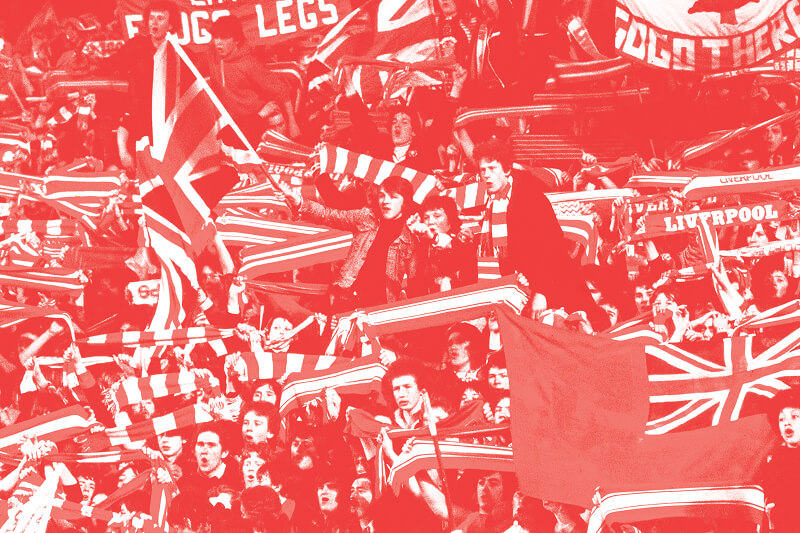
Liverpool fans during the quarter-final second leg against Saint-Étienne
The rising force
Liverpool’s first great European Cup comeback would help propel them all the way against opponents who’ve never been as far in the competition since
Bill Shankly had a theory about the old UEFA Cup. In his time as Liverpool manager, Shankly posited that it was the competition in which “you came across the sides who were on their way up”. Elton Welsby, then commentating on Merseyside football for Radio City, a Liverpool-based independent radio station, remembers hearing it from Shankly and wonders whether the Scot was being mischievous, given it was the one European trophy he brought to Anfield – the club’s first continental honour in 1973.
Yet the notion that Liverpool were the coming force certainly gained weight when Bob Paisley, Shankly’s successor, led them to a second UEFA Cup triumph in 1976. As Welsby recalls, it created “a great belief among the players that they would win the European Cup”.
That belief had its biggest test in March 1977 when Liverpool were drawn against Saint-Étienne in the quarter-finals. Liverpool had their UEFA Cups, but since reaching the semi-finals on their European Cup debut in 1964/65, they had got no further than the second round in two subsequent attempts in the senior competition. And now one of Europe’s outstanding teams of the ’70s – the previous season’s runners-up no less – stood in their way.
When Kermit the Frog sang “It’s not easy being green” during this decade, they were clearly not listening at the Stade Geoffroy-Guichard. Along with three straight league titles between 1974 and 1976, for a brief, sparkling moment, the French outsiders had threatened to paint the whole of Europe green.
The man behind St-Étienne’s continental heyday was coach Robert Herbin, instantly recognisable thanks to a wild curly mane of red hair. Quiet and enigmatic, Herbin was nicknamed the Sphinx due to his inscrutable manner. He was remarkably young – retiring as a player to take the reins aged 33 in 1972 – yet was undaunted by tough decisions, replacing many of his old team-mates with academy talents, including Dominique Rocheteau, the darling of French football, Dominique Bathenay and Jacques Santini.
With a colourful side also featuring midfield icon Jean-Michel Larqué and the Revelli brothers, Hervé and Patrick, Les Verts excelled in Europe with their hard-pressing football and reached the 1974/75 European Cup semi-finals, losing to Bayern. A year later, they saw off Rangers, Dynamo Kyiv and PSV Eindhoven to make it all the way to the final, where Bayern again lay in wait.
Backed by around 30,000 fans in Glasgow, St-Étienne came agonisingly close to victory, with Bathenay and Santini both striking the crossbar in the first half – and sparking the legend of “les poteaux carrés” (the square posts now on display in the club museum). Had the outdated Hampden Park goal frame been round, many insisted, those efforts would have bounced in and Les Verts would have triumphed, instead of losing to a Franz Roth free-kick. Having become the first French side to reach the European Cup final since Reims in 1959, they drew 100,000 people to the Champs-Élysées in Paris for a parade on their return.
This then was the challenge facing Liverpool and in the first leg in France, on 2 March, it grew even greater as St-Étienne gained a 1-0 advantage, Bathenay flicking in the winning goal on the volley following a corner in the 79th minute. A single-goal lead was not insubstantial given the fact St-Étienne had conceded just once in their previous nine European Cup games.
So to Anfield on 16 March. In the previous season’s UEFA Cup final first leg against Club Brugge, Ray Kennedy, Jimmy Case and Kevin Keegan had scored the second-half goals that overturned a 2-0 half-time deficit. Paisley’s men had since shrugged off a 1-0 first-leg loss when beating Trabzonspor 3-0 at home to set up the St-Étienne tie. What followed would prove another key step towards hardwiring European comebacks into Anfield’s muscle memory. “We didn’t expect to win,” remembers Chris Howard, one of the 55,043 fans present. Yet those home fans certainly hoped and they brought ferocious backing, according to Welsby. “It was a standing Kop to start with and that made a huge difference,” he recalls. “I think Anfield then was more intimidating.”
For Howard, the scene outside the ground before kick-off was memorable in itself. He describes the Liverpool team bus inching its way through a mass of bodies “ten deep” – and the reaction of Reds striker David Johnson, a friend of his. “Everybody was banging on the side of the coach, trying to wave at the players,” says Howard. “The bus stopped by us and Kevin Keegan was at the window seat, right by us. You had all these people jumping up and down shouting, but Johnno was next to him and he stood up, leaned over Keegan and started banging on the window at us.”
It was forward Keegan, in his final months as a Liverpool player before joining Hamburg, who ensured the match started with a bang. He had missed the first leg because of injury but made an immediate impact with a goal after one minute and 42 seconds. Steve Heighway played a short corner to Keegan and his cross from the left flew over the head of goalkeeper Ivan Curković and into the net.
There were spectators still flowing into the ground at that point. By the time the stadium had filled up, Ian McDermott, another Reds fan, found himself marvelling at the extra colour the visiting supporters brought to the occasion. “It was unusual to see such vivid green berets on their fans,” he recounts. “And their kit was a very modern, shiny green, which was unusual too. I also recall seeing their fans drinking red wine from actual wine glasses in the stands!”
Those travelling fans had an equalising goal to toast in the 51st minute as Bathenay unleashed his second of the tie – an exceptional swerving strike from 30 metres out. Liverpool now needed two more goals against opponents with five straight European Cup shutouts behind them. Yet midfielder Kennedy got the first within seven minutes via a first-time shot from the edge of the area that beat the dive of Curković. Then up stepped substitute David Fairclough – a player with a happy knack of scoring goals off the bench. In a time before electronic boards, his entrance was announced by a piece of white card with the number 12 inked on it in red.
Welsby remembers: “The crowd became the 12th man, if you like. Well, no, they didn’t. They became the 13th man because Fairclough became the 12th man. He was so direct and he was so quick.” As Paisley would attest later that night: “Dave has the pace, ability and skill I was looking for to take to the French defenders, who were tiring.”
The supersub replaced centre-forward John Toshack in the 72th minute and 12 minutes later delivered the tie’s deciding goal. The inception was straightforward enough as Kennedy, inside Liverpool’s half, lifted the ball over the St-Étienne back line for Fairclough to race onto, getting in front of centre-back Christian Lopez and shooting low past Curković.
“The whole ground was shaking,” says Welsby of the jubilant atmosphere inside Anfield. This was the night a chant was born as Liverpool’s fans responded to the visitors’ cries of “Allez, les Verts” with their own chorus of “Allez, les Rouges.” Yet, adds Ian McDermott, “‘We shall not be moved’ was probably the biggest and loudest and most prolonged chant that night after the winning goal.” They really meant it too. As history tells us, Liverpool would not be moved: their days as a European power had arrived. Ten weeks later, with their Rome triumph over Borussia Mönchengladbach, they lifted the European Cup for the first time.
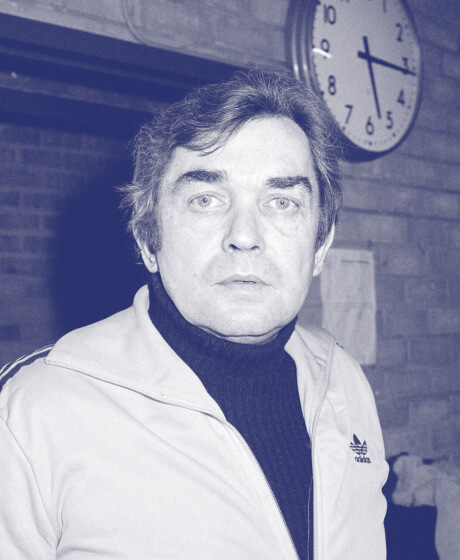
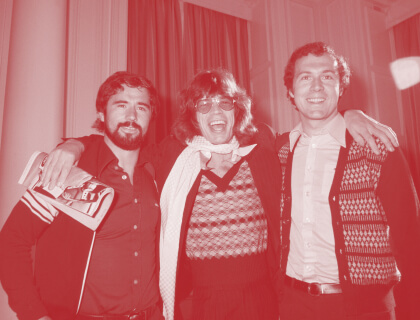
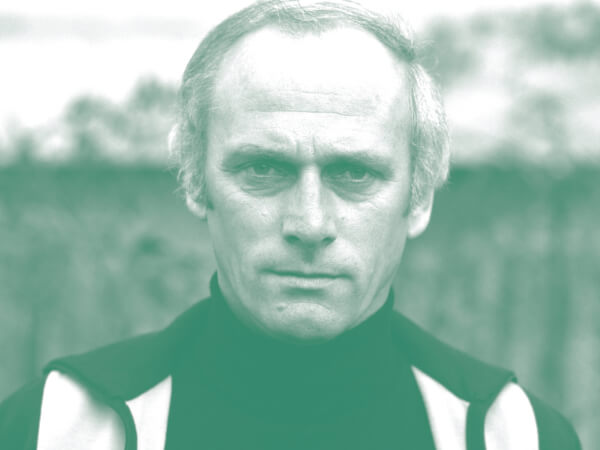
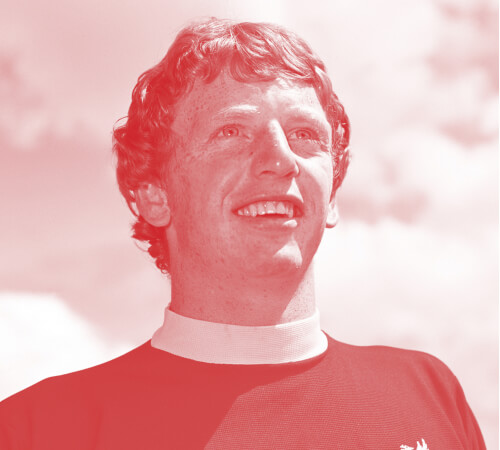
Ernst Happel of Club Brugge (above); Bayern legends Gerd Müller (left) and Franz Beckenbauer (right) pose with Mick Jagger (top right); Gladbach coach Udo Lattek (right)
Ernst Happel of Club Brugge (above); Bayern legends Gerd Müller (left) and Franz Beckenbauer (right) pose with Mick Jagger (top right); Gladbach coach Udo Lattek (right)
"It was unusual to see such vivid green berets on their fans,” he recounts. “And their kit was a very modern, shiny green, which was unusual too. I also recall seeing their fans drinking red wine from actual wine glasses in the stands!"
Holders lose their crown
Bayern’s three-year tenure as European champions masked growing frailties that Dynamo Kyiv and their pioneering coach were more than happy to pounce on
If there’s one piece of wisdom every football fan knows, it’s this: you can’t always get what you want. Mick Jagger could have sung it in person to the entire Bayern München squad when he walked into the wrong room at their Glasgow hotel ahead of the 1976 European Cup final. The Rolling Stones were staying a floor above the German side before their showdown with St-Étienne, keeping the players up with their partying at night and now intruding on a meeting. “Mick, you have to leave the room because I’m preparing the team,” said coach Dettmar Cramer, as if this were all completely normal.
Cramer had taken the reins from Udo Lattek in January 1975 and steered Bayern to their second and third European titles in that remarkable hat-trick run. But he had taken over a team past its peak, the core trio of goalkeeper Sepp Maier, iconic captain Franz Beckenbauer and goal machine Gerd Müller having all played together since 1964. Beckenbauer himself would leave for the New York Cosmos at the end of the 1976/77 campaign, as grimly aware as his colleagues that this once dominant side was lurching into decline.
Switching to a counterattacking style under Cramer, Bayern were unable to compete on all fronts, focusing their energies on European nights as they went five years without a Bundesliga title after 1973/74. Even their fans seemed weary, heavily outnumbered by the St-Étienne faithful for that Glasgow last hurrah. “For our supporters, it was starting to get a bit boring,” match winner Franz Roth later theorised, capturing the suspicion that the party was nearly over. By the time Dynamo Kyiv were done with them in the last eight the next season, it was.
The club from the Soviet Union had form, having beaten Bayern 3-0 on aggregate in the 1975 UEFA Super Cup, explosive forward Oleh Blokhin notching all the goals. That performance had helped Blokhin secure the Ballon d’Or that year, becoming the first Ukrainian to do so, though curiously he had to wait until the second leg of the quarter-final against Bayern to receive his prize – after Beckenbauer had been presented with the 1976 Ballon d’Or ahead of the first leg. This quirk of timing merely added to the sense of a prestige occasion.
Many had tried to downplay the 1975 Super Cup result as a one-off, but now Dynamo had the chance to set the record straight. Football had thrived in Ukraine since the late 1920s – 2027 will actually mark Dynamo’s 100th birthday – and it gave players and fans a rare source of entertainment under Soviet rule, not to mention a chance to thumb their nose at Moscow. Dynamo’s feats energised the locals, particularly when they beat Ferencváros 3-0 in the 1975 European Cup Winners’ Cup final to become the first Soviet club to lift a continental trophy. And they did it thanks to one of football’s most innovative coaches, a man bent on bringing scientific rigour into the game.
Valeriy Lobanovskyi was decades ahead of his time. Blessed with the mind of a mathematician, he had graduated as an engineer before applying similar principles to the teams in his charge, adopting the mantra: “You do not adapt the system to the players; you adapt the players to the system.” Behind the scenes, he brought in specialists from the Kyiv Institute of Physical Education, as well as experts from athletics, gymnastics and swimming, planning every training session and recovery programme down to the minute.
He also found ways to circumvent the oppressive nature of life in the Soviet Union. “Lobanovskyi used to send his assistant Mykhailo Oshemkov to Zakarpattia, one of the westernmost regions of the USSR,” says former midfielder Leonid Buryak, who would come to play a crucial role in the Bayern tie. “Oshemkov would spend around ten days there, picking up television broadcasts from Western countries showing European club matches. He would record and compile the footage so it could be analysed.”
Not that the players themselves felt they needed the help. “We had a team back then that didn’t care whether it was Bayern or anyone else,” adds Buryak. “We understood that there wasn’t a team in Europe – or even the world – that Dynamo Kyiv couldn’t compete with on equal terms.” And they soon proved that to everyone, though not without suffering a 1-0 loss in Munich in the first leg. The deficit could have been worse too, with Müller missing due to a back injury and his replacement Rainer Künkel nowhere near as clinical, despite notching the goal.
The return game was far from straightforward either, and Dynamo had to lift themselves after Blokhin won and spurned a penalty in the first half, changing his mind in the run-up and failing to beat Maier. “Everyone understood that receiving the Ballon d’Or trophy was a huge moment for Oleh,” explains Buryak. “It was a real celebration for him, and he desperately wanted to score. After he missed the penalty, we all supported him. But in the dressing room at half-time, Lobanovskyi simply asked him, ‘Who told you to take it?’ That was the end of the discussion.”
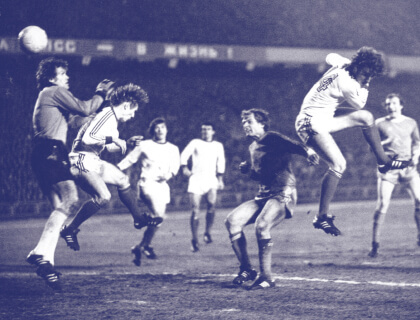
Backed by over 100,000 fans at Central Stadium, Dynamo had to wait until the 83rd minute to finally level the tie – via another penalty, no less. This time, Blokhin did not take it. “I remember Sepp Maier saying something to me in German,” recalls Buryak, who stepped up instead. “He was probably trying to get under my skin, but I simply turned away, placed the ball on the spot, took my run-up and scored.” The future Dynamo and Ukraine coach then delivered the free-kick for the winner five minutes later, a delicious floating ball into the area which Petro Slobodian reached before Maier to head in.
Not long after, the final whistle brought the curtain down on Bayern’s three-year European reign – and it would be a quarter of a century before their next continental conquest. For Dynamo, meanwhile, the result showed the world how seriously they deserved to be taken. “We were completely exhausted – physically and emotionally drained,” recounts Buryak. “Some players even almost fainted. Lobanovskyi tried not to look in their direction so they wouldn’t feel embarrassed afterwards.
“I spoke with Beckenbauer several times afterwards, and we looked back on those matches – including the fact that it was Dynamo Kyiv who denied Bayern a fourth consecutive European Cup title. I still remember Franz saying, ‘You can’t even imagine how much money you cost us back then.’ As for us, we received just 100 roubles each for the win.”
The real prize, of course, was the European Cup itself, but Dynamo’s pursuit was promptly halted in the next round, Buryak and Co losing 2-0 away to Borussia Mönchengladbach following a 1-0 victory at home. “After Bayern, nobody thought this would be an easier opponent. Borussia had outstanding players too – Berti Vogts, Rainer Bonhof, Jupp Heynckes. It was a very strong team. Every defeat was disappointing for us, but losing the tie that denied us a place in the European Cup final hurt even more. Especially because we knew how good we were.” After Bayern before them, now it was Dynamo’s time to learn Mick Jagger’s memorable line.
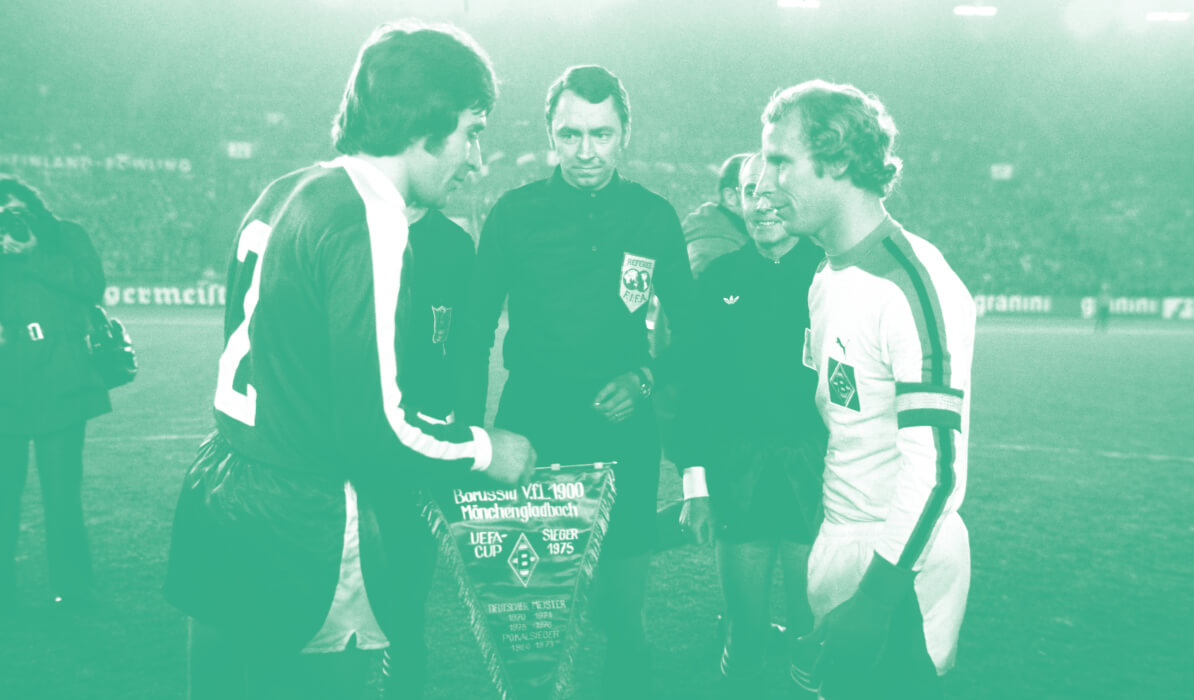
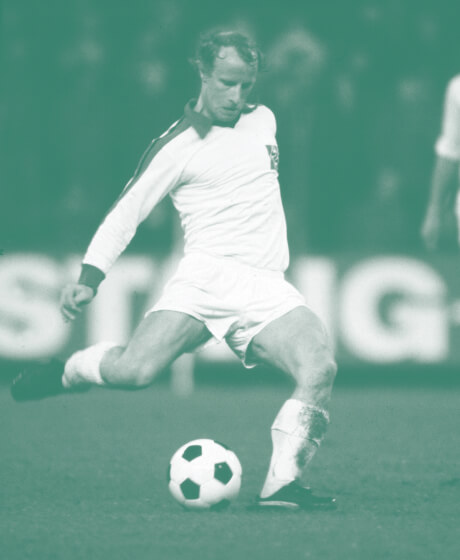
Gladbach captain Berti Vogts (right) and Club Brugge skipper Fons Bastijns (left) ahead of the quarter-final first leg
Waiting in the wings
Another of the 1976/77 quarter-finals brought together two teams enjoying heydays of their own – and soon to take their turns as Liverpool’s first pair of European Cup final opponents
“At school, it was either them or us,” says Borussia Mönchengladbach fan Guido Rohn, summing up the German football scene of the 1970s. “You either supported Bayern München if you wanted success and were a little bit conservative or you were for Gladbach if you had long hair and were a bit left-leaning and wanted wild football. There was no in-between.”
Supporters tend to romanticise their own team’s virtues, but there was an undeniable underdog appeal to Mönchengladbach in this era. Hailing from a city of just 150,000 inhabitants, and forced to play their biggest games in Düsseldorf due to the size of their Bökelbergstadion home, they also rose to prominence playing a gung-ho brand of football. “Better to lose 6-5 than 1-0,” was the motto of coach Hennes Weisweiler, the man who oversaw their first three Bundesliga titles and their maiden UEFA Cup triumph in 1974/75.
Overall, Gladbach claimed five league titles in the 1970s, outshining Bayern’s three, with the last two masterminded by former Bayern boss Udo Lattek. Inheriting the likes of right-back and captain Berti Vogts, free-scoring forward Jupp Heynckes and 1977 Ballon d’Or winner Allan Simonsen, Lattek ensured that Die Fohlen (the Foals) remained a European powerhouse too. That was certainly the case in 1976/77, and having marched through to the quarter-finals, they prepared to face a side similarly on the rise: Club Brugge.
A year before Ernst Happel took the Club Brugge reins in 1974, plans were afoot to turn the Bruges outfit into a feeder team for Union Saint-Gilloise and convert their stadium into apartments. Five years later, the legendary Austrian coach had steered them to two European finals and a hat-trick of domestic titles. The gruff genius in a thick fur coat had done it again, engineering another side to be feared.
“The whole country went mad,” defender Georges Leekens later recalled, with fans across Belgium falling under the spell as Happel worked his magic. The man who had already turned Feyenoord into European champions in 1970 would later become the first coach to lift the trophy with two different clubs when he repeated the feat with Hamburg in 1983 – and he came tantalisingly close to putting Club Brugge in that same exalted company.
“You either supported Bayern München if you were a bit conservative or Gladbach if you had long hair and were a bit left-leaning”
“Happel built a hard-working team with a lot of modern football – very physical, attacking football,” said Leekens. “We had a little bit of the Ajax style and I think the only weakness was that we were sometimes too attacking.” What Happel was not, however, was a charismatic communicator. A man of few words, the words he did use tended to be crabby and cutting. But it worked. “The guys were afraid of him. He was a real leader. He got 200% out of the group. He made every player better and we played for the team. He was very tough in pre-season. He killed us. That was the basis for our good condition.”
A glance at some of the clubs they overcame under Happel speaks volumes: Roma, AC Milan, Hamburg, Real Madrid, Atlético de Madrid and Juventus, a run of results built on exceptional home form. Indeed, just one continental side were able to triumph at the Jan Breydelstadion in those years – and that was Mönchengladbach, who could settle for nothing less in their quarter-final showdown after Club Brugge had drawn the first leg 2-2 in Düsseldorf.
Happel’s side had led 2-0 at one point, but they still came away with the away-goals advantage and a tentative foot in the last four. It wasn’t to be, although it took a mix-up for Gladbach’s Wilfried Hannes to head in his 84th-minute winner, goalkeeper Birger Jensen rushing off his line as Hannes beat Leekens in an aerial challenge on the edge of the area. The German side then left it late in the semis as well, Hans-Jürgen Wittkamp their hero as they recovered from a 1-0 away loss by beating Dynamo Kyiv 2-0 at ‘home’. All that mattered, of course, was that they were through to their first European Cup final. The Stadio Olimpico awaited.
“The following day, I booked a flight to Rome,” remembers Rohn. “It was special for me because I’m afraid of flying and I’ve not flown since.” Sadly for Gladbach, they lost 3-1 to Liverpool, Simonsen’s second-half equaliser the highlight after Rainer Bonhof had hit a post at 0-0. “The problem is that Gladbach’s players had become German champions just a few days earlier,” adds Rohn. “I know from Berti Vogts that they were having parties in Munich before they flew. I was so disappointed, knowing our chance would never come again.”
This was not the end of the road, however. Two seasons later, they were crowned UEFA Cup champions for a second time, a Simonsen penalty settling a 2-1 aggregate victory against Crvena Zvezda. And with Heynckes taking over from Lattek, there was one last adventure the following season as they returned to the UEFA Cup showpiece, losing only on away goals to Eintracht Frankfurt. The years since may have been fraught, but, as Rohn proudly recalls, “In ’75, ’76, ’77, we were one of the best teams in the world.”
As for Club Brugge, they got their own tilt at the European Cup final in 1978, the year after Gladbach’s loss. They too had to tackle Liverpool, hoping for revenge after falling victim to the same opponents in the 1976 UEFA Cup decider as the first Belgian side to reach a continental showpiece. Instead, they slipped to another heartbreakingly narrow loss, a dinked finish by Kenny Dalglish – Kevin Keegan’s Anfield replacement – crushing the dreams of the 25,000 fans who had packed ferry after ferry en route to Wembley. “We had one problem,” noted Leekens, reflecting on that stirring period of success and near misses. “It was Liverpool.” In that, they were far from alone.
Liverpool winger Steve Heighway (top left); Petro Slobodian (No14) heads home the winner (left); Mönchengladbach captain Berti Vogts (top)
Liverpool winger Steve Heighway (top left); Petro Slobodian (No14) heads home the winner (left); Mönchengladbach captain Berti Vogts (top)
Liverpool fans during the quarter-final second leg against Saint-Étienne
The rising force
Liverpool’s first great European Cup comeback would help propel them all the way against opponents who’ve never been as far in the competition since
Bill Shankly had a theory about the old UEFA Cup. In his time as Liverpool manager, Shankly posited that it was the competition in which “you came across the sides who were on their way up”. Elton Welsby, then commentating on Merseyside football for Radio City, a Liverpool-based independent radio station, remembers hearing it from Shankly and wonders whether the Scot was being mischievous, given it was the one European trophy he brought to Anfield – the club’s first continental honour in 1973.
Yet the notion that Liverpool were the coming force certainly gained weight when Bob Paisley, Shankly’s successor, led them to a second UEFA Cup triumph in 1976. As Welsby recalls, it created “a great belief among the players that they would win the European Cup”.
That belief had its biggest test in March 1977 when Liverpool were drawn against Saint-Étienne in the quarter-finals. Liverpool had their UEFA Cups, but since reaching the semi-finals on their European Cup debut in 1964/65, they had got no further than the second round in two subsequent attempts in the senior competition. And now one of Europe’s outstanding teams of the ’70s – the previous season’s runners-up no less – stood in their way.
When Kermit the Frog sang “It’s not easy being green” during this decade, they were clearly not listening at the Stade Geoffroy-Guichard. Along with three straight league titles between 1974 and 1976, for a brief, sparkling moment, the French outsiders had threatened to paint the whole of Europe green.
The man behind St-Étienne’s continental heyday was coach Robert Herbin, instantly recognisable thanks to a wild curly mane of red hair. Quiet and enigmatic, Herbin was nicknamed the Sphinx due to his inscrutable manner. He was remarkably young – retiring as a player to take the reins aged 33 in 1972 – yet was undaunted by tough decisions, replacing many of his old team-mates with academy talents, including Dominique Rocheteau, the darling of French football, Dominique Bathenay and Jacques Santini.
With a colourful side also featuring midfield icon Jean-Michel Larqué and the Revelli brothers, Hervé and Patrick, Les Verts excelled in Europe with their hard-pressing football and reached the 1974/75 European Cup semi-finals, losing to Bayern. A year later, they saw off Rangers, Dynamo Kyiv and PSV Eindhoven to make it all the way to the final, where Bayern again lay in wait.
Backed by around 30,000 fans in Glasgow, St-Étienne came agonisingly close to victory, with Bathenay and Santini both striking the crossbar in the first half – and sparking the legend of “les poteaux carrés” (the square posts now on display in the club museum). Had the outdated Hampden Park goal frame been round, many insisted, those efforts would have bounced in and Les Verts would have triumphed, instead of losing to a Franz Roth free-kick. Having become the first French side to reach the European Cup final since Reims in 1959, they drew 100,000 people to the Champs-Élysées in Paris for a parade on their return.
This then was the challenge facing Liverpool and in the first leg in France, on 2 March, it grew even greater as St-Étienne gained a 1-0 advantage, Bathenay flicking in the winning goal on the volley following a corner in the 79th minute. A single-goal lead was not insubstantial given the fact St-Étienne had conceded just once in their previous nine European Cup games.
So to Anfield on 16 March. In the previous season’s UEFA Cup final first leg against Club Brugge, Ray Kennedy, Jimmy Case and Kevin Keegan had scored the second-half goals that overturned a 2-0 half-time deficit. Paisley’s men had since shrugged off a 1-0 first-leg loss when beating Trabzonspor 3-0 at home to set up the St-Étienne tie. What followed would prove another key step towards hardwiring European comebacks into Anfield’s muscle memory. “We didn’t expect to win,” remembers Chris Howard, one of the 55,043 fans present. Yet those home fans certainly hoped and they brought ferocious backing, according to Welsby. “It was a standing Kop to start with and that made a huge difference,” he recalls. “I think Anfield then was more intimidating.”
For Howard, the scene outside the ground before kick-off was memorable in itself. He describes the Liverpool team bus inching its way through a mass of bodies “ten deep” – and the reaction of Reds striker David Johnson, a friend of his. “Everybody was banging on the side of the coach, trying to wave at the players,” says Howard. “The bus stopped by us and Kevin Keegan was at the window seat, right by us. You had all these people jumping up and down shouting, but Johnno was next to him and he stood up, leaned over Keegan and started banging on the window at us.”
It was forward Keegan, in his final months as a Liverpool player before joining Hamburg, who ensured the match started with a bang. He had missed the first leg because of injury but made an immediate impact with a goal after one minute and 42 seconds. Steve Heighway played a short corner to Keegan and his cross from the left flew over the head of goalkeeper Ivan Curković and into the net.
There were spectators still flowing into the ground at that point. By the time the stadium had filled up, Ian McDermott, another Reds fan, found himself marvelling at the extra colour the visiting supporters brought to the occasion. “It was unusual to see such vivid green berets on their fans,” he recounts. “And their kit was a very modern, shiny green, which was unusual too. I also recall seeing their fans drinking red wine from actual wine glasses in the stands!”
Those travelling fans had an equalising goal to toast in the 51st minute as Bathenay unleashed his second of the tie – an exceptional swerving strike from 30 metres out. Liverpool now needed two more goals against opponents with five straight European Cup shutouts behind them. Yet midfielder Kennedy got the first within seven minutes via a first-time shot from the edge of the area that beat the dive of Curković. Then up stepped substitute David Fairclough – a player with a happy knack of scoring goals off the bench. In a time before electronic boards, his entrance was announced by a piece of white card with the number 12 inked on it in red.
Welsby remembers: “The crowd became the 12th man, if you like. Well, no, they didn’t. They became the 13th man because Fairclough became the 12th man. He was so direct and he was so quick.” As Paisley would attest later that night: “Dave has the pace, ability and skill I was looking for to take to the French defenders, who were tiring.”
The supersub replaced centre-forward John Toshack in the 72th minute and 12 minutes later delivered the tie’s deciding goal. The inception was straightforward enough as Kennedy, inside Liverpool’s half, lifted the ball over the St-Étienne back line for Fairclough to race onto, getting in front of centre-back Christian Lopez and shooting low past Curković.
“The whole ground was shaking,” says Welsby of the jubilant atmosphere inside Anfield. This was the night a chant was born as Liverpool’s fans responded to the visitors’ cries of “Allez, les Verts” with their own chorus of “Allez, les Rouges.” Yet, adds Ian McDermott, “‘We shall not be moved’ was probably the biggest and loudest and most prolonged chant that night after the winning goal.” They really meant it too. As history tells us, Liverpool would not be moved: their days as a European power had arrived. Ten weeks later, with their Rome triumph over Borussia Mönchengladbach, they lifted the European Cup for the first time.
Ernst Happel of Club Brugge (above); Bayern legends Gerd Müller (left) and Franz Beckenbauer (right) pose with Mick Jagger (top right); Gladbach coach Udo Lattek (right)
Ernst Happel of Club Brugge (above); Bayern legends Gerd Müller (left) and Franz Beckenbauer (right) pose with Mick Jagger (top right); Gladbach coach Udo Lattek (right)
Read the full story
Sign up now to get access to this and every premium feature on Champions Journal. You will also get access to member-only competitions and offers. And you get all of that completely free!
"It was unusual to see such vivid green berets on their fans,” he recounts. “And their kit was a very modern, shiny green, which was unusual too. I also recall seeing their fans drinking red wine from actual wine glasses in the stands!"
Holders lose their crown
Bayern’s three-year tenure as European champions masked growing frailties that Dynamo Kyiv and their pioneering coach were more than happy to pounce on
If there’s one piece of wisdom every football fan knows, it’s this: you can’t always get what you want. Mick Jagger could have sung it in person to the entire Bayern München squad when he walked into the wrong room at their Glasgow hotel ahead of the 1976 European Cup final. The Rolling Stones were staying a floor above the German side before their showdown with St-Étienne, keeping the players up with their partying at night and now intruding on a meeting. “Mick, you have to leave the room because I’m preparing the team,” said coach Dettmar Cramer, as if this were all completely normal.
Cramer had taken the reins from Udo Lattek in January 1975 and steered Bayern to their second and third European titles in that remarkable hat-trick run. But he had taken over a team past its peak, the core trio of goalkeeper Sepp Maier, iconic captain Franz Beckenbauer and goal machine Gerd Müller having all played together since 1964. Beckenbauer himself would leave for the New York Cosmos at the end of the 1976/77 campaign, as grimly aware as his colleagues that this once dominant side was lurching into decline.
Switching to a counterattacking style under Cramer, Bayern were unable to compete on all fronts, focusing their energies on European nights as they went five years without a Bundesliga title after 1973/74. Even their fans seemed weary, heavily outnumbered by the St-Étienne faithful for that Glasgow last hurrah. “For our supporters, it was starting to get a bit boring,” match winner Franz Roth later theorised, capturing the suspicion that the party was nearly over. By the time Dynamo Kyiv were done with them in the last eight the next season, it was.
The club from the Soviet Union had form, having beaten Bayern 3-0 on aggregate in the 1975 UEFA Super Cup, explosive forward Oleh Blokhin notching all the goals. That performance had helped Blokhin secure the Ballon d’Or that year, becoming the first Ukrainian to do so, though curiously he had to wait until the second leg of the quarter-final against Bayern to receive his prize – after Beckenbauer had been presented with the 1976 Ballon d’Or ahead of the first leg. This quirk of timing merely added to the sense of a prestige occasion.
Many had tried to downplay the 1975 Super Cup result as a one-off, but now Dynamo had the chance to set the record straight. Football had thrived in Ukraine since the late 1920s – 2027 will actually mark Dynamo’s 100th birthday – and it gave players and fans a rare source of entertainment under Soviet rule, not to mention a chance to thumb their nose at Moscow. Dynamo’s feats energised the locals, particularly when they beat Ferencváros 3-0 in the 1975 European Cup Winners’ Cup final to become the first Soviet club to lift a continental trophy. And they did it thanks to one of football’s most innovative coaches, a man bent on bringing scientific rigour into the game.
Valeriy Lobanovskyi was decades ahead of his time. Blessed with the mind of a mathematician, he had graduated as an engineer before applying similar principles to the teams in his charge, adopting the mantra: “You do not adapt the system to the players; you adapt the players to the system.” Behind the scenes, he brought in specialists from the Kyiv Institute of Physical Education, as well as experts from athletics, gymnastics and swimming, planning every training session and recovery programme down to the minute.
He also found ways to circumvent the oppressive nature of life in the Soviet Union. “Lobanovskyi used to send his assistant Mykhailo Oshemkov to Zakarpattia, one of the westernmost regions of the USSR,” says former midfielder Leonid Buryak, who would come to play a crucial role in the Bayern tie. “Oshemkov would spend around ten days there, picking up television broadcasts from Western countries showing European club matches. He would record and compile the footage so it could be analysed.”
Not that the players themselves felt they needed the help. “We had a team back then that didn’t care whether it was Bayern or anyone else,” adds Buryak. “We understood that there wasn’t a team in Europe – or even the world – that Dynamo Kyiv couldn’t compete with on equal terms.” And they soon proved that to everyone, though not without suffering a 1-0 loss in Munich in the first leg. The deficit could have been worse too, with Müller missing due to a back injury and his replacement Rainer Künkel nowhere near as clinical, despite notching the goal.
The return game was far from straightforward either, and Dynamo had to lift themselves after Blokhin won and spurned a penalty in the first half, changing his mind in the run-up and failing to beat Maier. “Everyone understood that receiving the Ballon d’Or trophy was a huge moment for Oleh,” explains Buryak. “It was a real celebration for him, and he desperately wanted to score. After he missed the penalty, we all supported him. But in the dressing room at half-time, Lobanovskyi simply asked him, ‘Who told you to take it?’ That was the end of the discussion.”
Backed by over 100,000 fans at Central Stadium, Dynamo had to wait until the 83rd minute to finally level the tie – via another penalty, no less. This time, Blokhin did not take it. “I remember Sepp Maier saying something to me in German,” recalls Buryak, who stepped up instead. “He was probably trying to get under my skin, but I simply turned away, placed the ball on the spot, took my run-up and scored.” The future Dynamo and Ukraine coach then delivered the free-kick for the winner five minutes later, a delicious floating ball into the area which Petro Slobodian reached before Maier to head in.
Not long after, the final whistle brought the curtain down on Bayern’s three-year European reign – and it would be a quarter of a century before their next continental conquest. For Dynamo, meanwhile, the result showed the world how seriously they deserved to be taken. “We were completely exhausted – physically and emotionally drained,” recounts Buryak. “Some players even almost fainted. Lobanovskyi tried not to look in their direction so they wouldn’t feel embarrassed afterwards.
“I spoke with Beckenbauer several times afterwards, and we looked back on those matches – including the fact that it was Dynamo Kyiv who denied Bayern a fourth consecutive European Cup title. I still remember Franz saying, ‘You can’t even imagine how much money you cost us back then.’ As for us, we received just 100 roubles each for the win.”
The real prize, of course, was the European Cup itself, but Dynamo’s pursuit was promptly halted in the next round, Buryak and Co losing 2-0 away to Borussia Mönchengladbach following a 1-0 victory at home. “After Bayern, nobody thought this would be an easier opponent. Borussia had outstanding players too – Berti Vogts, Rainer Bonhof, Jupp Heynckes. It was a very strong team. Every defeat was disappointing for us, but losing the tie that denied us a place in the European Cup final hurt even more. Especially because we knew how good we were.” After Bayern before them, now it was Dynamo’s time to learn Mick Jagger’s memorable line.
Gladbach captain Berti Vogts (right) and Club Brugge skipper Fons Bastijns (left) ahead of the quarter-final first leg
Waiting in the wings
Another of the 1976/77 quarter-finals brought together two teams enjoying heydays of their own – and soon to take their turns as Liverpool’s first pair of European Cup final opponents
“At school, it was either them or us,” says Borussia Mönchengladbach fan Guido Rohn, summing up the German football scene of the 1970s. “You either supported Bayern München if you wanted success and were a little bit conservative or you were for Gladbach if you had long hair and were a bit left-leaning and wanted wild football. There was no in-between.”
Supporters tend to romanticise their own team’s virtues, but there was an undeniable underdog appeal to Mönchengladbach in this era. Hailing from a city of just 150,000 inhabitants, and forced to play their biggest games in Düsseldorf due to the size of their Bökelbergstadion home, they also rose to prominence playing a gung-ho brand of football. “Better to lose 6-5 than 1-0,” was the motto of coach Hennes Weisweiler, the man who oversaw their first three Bundesliga titles and their maiden UEFA Cup triumph in 1974/75.
Overall, Gladbach claimed five league titles in the 1970s, outshining Bayern’s three, with the last two masterminded by former Bayern boss Udo Lattek. Inheriting the likes of right-back and captain Berti Vogts, free-scoring forward Jupp Heynckes and 1977 Ballon d’Or winner Allan Simonsen, Lattek ensured that Die Fohlen (the Foals) remained a European powerhouse too. That was certainly the case in 1976/77, and having marched through to the quarter-finals, they prepared to face a side similarly on the rise: Club Brugge.
A year before Ernst Happel took the Club Brugge reins in 1974, plans were afoot to turn the Bruges outfit into a feeder team for Union Saint-Gilloise and convert their stadium into apartments. Five years later, the legendary Austrian coach had steered them to two European finals and a hat-trick of domestic titles. The gruff genius in a thick fur coat had done it again, engineering another side to be feared.
“The whole country went mad,” defender Georges Leekens later recalled, with fans across Belgium falling under the spell as Happel worked his magic. The man who had already turned Feyenoord into European champions in 1970 would later become the first coach to lift the trophy with two different clubs when he repeated the feat with Hamburg in 1983 – and he came tantalisingly close to putting Club Brugge in that same exalted company.
“You either supported Bayern München if you were a bit conservative or Gladbach if you had long hair and were a bit left-leaning”
“Happel built a hard-working team with a lot of modern football – very physical, attacking football,” said Leekens. “We had a little bit of the Ajax style and I think the only weakness was that we were sometimes too attacking.” What Happel was not, however, was a charismatic communicator. A man of few words, the words he did use tended to be crabby and cutting. But it worked. “The guys were afraid of him. He was a real leader. He got 200% out of the group. He made every player better and we played for the team. He was very tough in pre-season. He killed us. That was the basis for our good condition.”
A glance at some of the clubs they overcame under Happel speaks volumes: Roma, AC Milan, Hamburg, Real Madrid, Atlético de Madrid and Juventus, a run of results built on exceptional home form. Indeed, just one continental side were able to triumph at the Jan Breydelstadion in those years – and that was Mönchengladbach, who could settle for nothing less in their quarter-final showdown after Club Brugge had drawn the first leg 2-2 in Düsseldorf.
Happel’s side had led 2-0 at one point, but they still came away with the away-goals advantage and a tentative foot in the last four. It wasn’t to be, although it took a mix-up for Gladbach’s Wilfried Hannes to head in his 84th-minute winner, goalkeeper Birger Jensen rushing off his line as Hannes beat Leekens in an aerial challenge on the edge of the area. The German side then left it late in the semis as well, Hans-Jürgen Wittkamp their hero as they recovered from a 1-0 away loss by beating Dynamo Kyiv 2-0 at ‘home’. All that mattered, of course, was that they were through to their first European Cup final. The Stadio Olimpico awaited.
“The following day, I booked a flight to Rome,” remembers Rohn. “It was special for me because I’m afraid of flying and I’ve not flown since.” Sadly for Gladbach, they lost 3-1 to Liverpool, Simonsen’s second-half equaliser the highlight after Rainer Bonhof had hit a post at 0-0. “The problem is that Gladbach’s players had become German champions just a few days earlier,” adds Rohn. “I know from Berti Vogts that they were having parties in Munich before they flew. I was so disappointed, knowing our chance would never come again.”
This was not the end of the road, however. Two seasons later, they were crowned UEFA Cup champions for a second time, a Simonsen penalty settling a 2-1 aggregate victory against Crvena Zvezda. And with Heynckes taking over from Lattek, there was one last adventure the following season as they returned to the UEFA Cup showpiece, losing only on away goals to Eintracht Frankfurt. The years since may have been fraught, but, as Rohn proudly recalls, “In ’75, ’76, ’77, we were one of the best teams in the world.”
As for Club Brugge, they got their own tilt at the European Cup final in 1978, the year after Gladbach’s loss. They too had to tackle Liverpool, hoping for revenge after falling victim to the same opponents in the 1976 UEFA Cup decider as the first Belgian side to reach a continental showpiece. Instead, they slipped to another heartbreakingly narrow loss, a dinked finish by Kenny Dalglish – Kevin Keegan’s Anfield replacement – crushing the dreams of the 25,000 fans who had packed ferry after ferry en route to Wembley. “We had one problem,” noted Leekens, reflecting on that stirring period of success and near misses. “It was Liverpool.” In that, they were far from alone.
Liverpool winger Steve Heighway (top left); Petro Slobodian (No14) heads home the winner (left); Mönchengladbach captain Berti Vogts (top)
Liverpool winger Steve Heighway (top left); Petro Slobodian (No14) heads home the winner (left); Mönchengladbach captain Berti Vogts (top)
Liverpool fans during the quarter-final second leg against Saint-Étienne
The rising force
Liverpool’s first great European Cup comeback would help propel them all the way against opponents who’ve never been as far in the competition since
Bill Shankly had a theory about the old UEFA Cup. In his time as Liverpool manager, Shankly posited that it was the competition in which “you came across the sides who were on their way up”. Elton Welsby, then commentating on Merseyside football for Radio City, a Liverpool-based independent radio station, remembers hearing it from Shankly and wonders whether the Scot was being mischievous, given it was the one European trophy he brought to Anfield – the club’s first continental honour in 1973.
Yet the notion that Liverpool were the coming force certainly gained weight when Bob Paisley, Shankly’s successor, led them to a second UEFA Cup triumph in 1976. As Welsby recalls, it created “a great belief among the players that they would win the European Cup”.
That belief had its biggest test in March 1977 when Liverpool were drawn against Saint-Étienne in the quarter-finals. Liverpool had their UEFA Cups, but since reaching the semi-finals on their European Cup debut in 1964/65, they had got no further than the second round in two subsequent attempts in the senior competition. And now one of Europe’s outstanding teams of the ’70s – the previous season’s runners-up no less – stood in their way.
When Kermit the Frog sang “It’s not easy being green” during this decade, they were clearly not listening at the Stade Geoffroy-Guichard. Along with three straight league titles between 1974 and 1976, for a brief, sparkling moment, the French outsiders had threatened to paint the whole of Europe green.
The man behind St-Étienne’s continental heyday was coach Robert Herbin, instantly recognisable thanks to a wild curly mane of red hair. Quiet and enigmatic, Herbin was nicknamed the Sphinx due to his inscrutable manner. He was remarkably young – retiring as a player to take the reins aged 33 in 1972 – yet was undaunted by tough decisions, replacing many of his old team-mates with academy talents, including Dominique Rocheteau, the darling of French football, Dominique Bathenay and Jacques Santini.
With a colourful side also featuring midfield icon Jean-Michel Larqué and the Revelli brothers, Hervé and Patrick, Les Verts excelled in Europe with their hard-pressing football and reached the 1974/75 European Cup semi-finals, losing to Bayern. A year later, they saw off Rangers, Dynamo Kyiv and PSV Eindhoven to make it all the way to the final, where Bayern again lay in wait.
Backed by around 30,000 fans in Glasgow, St-Étienne came agonisingly close to victory, with Bathenay and Santini both striking the crossbar in the first half – and sparking the legend of “les poteaux carrés” (the square posts now on display in the club museum). Had the outdated Hampden Park goal frame been round, many insisted, those efforts would have bounced in and Les Verts would have triumphed, instead of losing to a Franz Roth free-kick. Having become the first French side to reach the European Cup final since Reims in 1959, they drew 100,000 people to the Champs-Élysées in Paris for a parade on their return.
This then was the challenge facing Liverpool and in the first leg in France, on 2 March, it grew even greater as St-Étienne gained a 1-0 advantage, Bathenay flicking in the winning goal on the volley following a corner in the 79th minute. A single-goal lead was not insubstantial given the fact St-Étienne had conceded just once in their previous nine European Cup games.
So to Anfield on 16 March. In the previous season’s UEFA Cup final first leg against Club Brugge, Ray Kennedy, Jimmy Case and Kevin Keegan had scored the second-half goals that overturned a 2-0 half-time deficit. Paisley’s men had since shrugged off a 1-0 first-leg loss when beating Trabzonspor 3-0 at home to set up the St-Étienne tie. What followed would prove another key step towards hardwiring European comebacks into Anfield’s muscle memory. “We didn’t expect to win,” remembers Chris Howard, one of the 55,043 fans present. Yet those home fans certainly hoped and they brought ferocious backing, according to Welsby. “It was a standing Kop to start with and that made a huge difference,” he recalls. “I think Anfield then was more intimidating.”
For Howard, the scene outside the ground before kick-off was memorable in itself. He describes the Liverpool team bus inching its way through a mass of bodies “ten deep” – and the reaction of Reds striker David Johnson, a friend of his. “Everybody was banging on the side of the coach, trying to wave at the players,” says Howard. “The bus stopped by us and Kevin Keegan was at the window seat, right by us. You had all these people jumping up and down shouting, but Johnno was next to him and he stood up, leaned over Keegan and started banging on the window at us.”
It was forward Keegan, in his final months as a Liverpool player before joining Hamburg, who ensured the match started with a bang. He had missed the first leg because of injury but made an immediate impact with a goal after one minute and 42 seconds. Steve Heighway played a short corner to Keegan and his cross from the left flew over the head of goalkeeper Ivan Curković and into the net.
There were spectators still flowing into the ground at that point. By the time the stadium had filled up, Ian McDermott, another Reds fan, found himself marvelling at the extra colour the visiting supporters brought to the occasion. “It was unusual to see such vivid green berets on their fans,” he recounts. “And their kit was a very modern, shiny green, which was unusual too. I also recall seeing their fans drinking red wine from actual wine glasses in the stands!”
Those travelling fans had an equalising goal to toast in the 51st minute as Bathenay unleashed his second of the tie – an exceptional swerving strike from 30 metres out. Liverpool now needed two more goals against opponents with five straight European Cup shutouts behind them. Yet midfielder Kennedy got the first within seven minutes via a first-time shot from the edge of the area that beat the dive of Curković. Then up stepped substitute David Fairclough – a player with a happy knack of scoring goals off the bench. In a time before electronic boards, his entrance was announced by a piece of white card with the number 12 inked on it in red.
Welsby remembers: “The crowd became the 12th man, if you like. Well, no, they didn’t. They became the 13th man because Fairclough became the 12th man. He was so direct and he was so quick.” As Paisley would attest later that night: “Dave has the pace, ability and skill I was looking for to take to the French defenders, who were tiring.”
The supersub replaced centre-forward John Toshack in the 72th minute and 12 minutes later delivered the tie’s deciding goal. The inception was straightforward enough as Kennedy, inside Liverpool’s half, lifted the ball over the St-Étienne back line for Fairclough to race onto, getting in front of centre-back Christian Lopez and shooting low past Curković.
“The whole ground was shaking,” says Welsby of the jubilant atmosphere inside Anfield. This was the night a chant was born as Liverpool’s fans responded to the visitors’ cries of “Allez, les Verts” with their own chorus of “Allez, les Rouges.” Yet, adds Ian McDermott, “‘We shall not be moved’ was probably the biggest and loudest and most prolonged chant that night after the winning goal.” They really meant it too. As history tells us, Liverpool would not be moved: their days as a European power had arrived. Ten weeks later, with their Rome triumph over Borussia Mönchengladbach, they lifted the European Cup for the first time.
Ernst Happel of Club Brugge (above); Bayern legends Gerd Müller (left) and Franz Beckenbauer (right) pose with Mick Jagger (top right); Gladbach coach Udo Lattek (right)
Ernst Happel of Club Brugge (above); Bayern legends Gerd Müller (left) and Franz Beckenbauer (right) pose with Mick Jagger (top right); Gladbach coach Udo Lattek (right)
"It was unusual to see such vivid green berets on their fans,” he recounts. “And their kit was a very modern, shiny green, which was unusual too. I also recall seeing their fans drinking red wine from actual wine glasses in the stands!"
Holders lose their crown
Bayern’s three-year tenure as European champions masked growing frailties that Dynamo Kyiv and their pioneering coach were more than happy to pounce on
If there’s one piece of wisdom every football fan knows, it’s this: you can’t always get what you want. Mick Jagger could have sung it in person to the entire Bayern München squad when he walked into the wrong room at their Glasgow hotel ahead of the 1976 European Cup final. The Rolling Stones were staying a floor above the German side before their showdown with St-Étienne, keeping the players up with their partying at night and now intruding on a meeting. “Mick, you have to leave the room because I’m preparing the team,” said coach Dettmar Cramer, as if this were all completely normal.
Cramer had taken the reins from Udo Lattek in January 1975 and steered Bayern to their second and third European titles in that remarkable hat-trick run. But he had taken over a team past its peak, the core trio of goalkeeper Sepp Maier, iconic captain Franz Beckenbauer and goal machine Gerd Müller having all played together since 1964. Beckenbauer himself would leave for the New York Cosmos at the end of the 1976/77 campaign, as grimly aware as his colleagues that this once dominant side was lurching into decline.
Switching to a counterattacking style under Cramer, Bayern were unable to compete on all fronts, focusing their energies on European nights as they went five years without a Bundesliga title after 1973/74. Even their fans seemed weary, heavily outnumbered by the St-Étienne faithful for that Glasgow last hurrah. “For our supporters, it was starting to get a bit boring,” match winner Franz Roth later theorised, capturing the suspicion that the party was nearly over. By the time Dynamo Kyiv were done with them in the last eight the next season, it was.
The club from the Soviet Union had form, having beaten Bayern 3-0 on aggregate in the 1975 UEFA Super Cup, explosive forward Oleh Blokhin notching all the goals. That performance had helped Blokhin secure the Ballon d’Or that year, becoming the first Ukrainian to do so, though curiously he had to wait until the second leg of the quarter-final against Bayern to receive his prize – after Beckenbauer had been presented with the 1976 Ballon d’Or ahead of the first leg. This quirk of timing merely added to the sense of a prestige occasion.
Many had tried to downplay the 1975 Super Cup result as a one-off, but now Dynamo had the chance to set the record straight. Football had thrived in Ukraine since the late 1920s – 2027 will actually mark Dynamo’s 100th birthday – and it gave players and fans a rare source of entertainment under Soviet rule, not to mention a chance to thumb their nose at Moscow. Dynamo’s feats energised the locals, particularly when they beat Ferencváros 3-0 in the 1975 European Cup Winners’ Cup final to become the first Soviet club to lift a continental trophy. And they did it thanks to one of football’s most innovative coaches, a man bent on bringing scientific rigour into the game.
Valeriy Lobanovskyi was decades ahead of his time. Blessed with the mind of a mathematician, he had graduated as an engineer before applying similar principles to the teams in his charge, adopting the mantra: “You do not adapt the system to the players; you adapt the players to the system.” Behind the scenes, he brought in specialists from the Kyiv Institute of Physical Education, as well as experts from athletics, gymnastics and swimming, planning every training session and recovery programme down to the minute.
He also found ways to circumvent the oppressive nature of life in the Soviet Union. “Lobanovskyi used to send his assistant Mykhailo Oshemkov to Zakarpattia, one of the westernmost regions of the USSR,” says former midfielder Leonid Buryak, who would come to play a crucial role in the Bayern tie. “Oshemkov would spend around ten days there, picking up television broadcasts from Western countries showing European club matches. He would record and compile the footage so it could be analysed.”
Not that the players themselves felt they needed the help. “We had a team back then that didn’t care whether it was Bayern or anyone else,” adds Buryak. “We understood that there wasn’t a team in Europe – or even the world – that Dynamo Kyiv couldn’t compete with on equal terms.” And they soon proved that to everyone, though not without suffering a 1-0 loss in Munich in the first leg. The deficit could have been worse too, with Müller missing due to a back injury and his replacement Rainer Künkel nowhere near as clinical, despite notching the goal.
The return game was far from straightforward either, and Dynamo had to lift themselves after Blokhin won and spurned a penalty in the first half, changing his mind in the run-up and failing to beat Maier. “Everyone understood that receiving the Ballon d’Or trophy was a huge moment for Oleh,” explains Buryak. “It was a real celebration for him, and he desperately wanted to score. After he missed the penalty, we all supported him. But in the dressing room at half-time, Lobanovskyi simply asked him, ‘Who told you to take it?’ That was the end of the discussion.”
Backed by over 100,000 fans at Central Stadium, Dynamo had to wait until the 83rd minute to finally level the tie – via another penalty, no less. This time, Blokhin did not take it. “I remember Sepp Maier saying something to me in German,” recalls Buryak, who stepped up instead. “He was probably trying to get under my skin, but I simply turned away, placed the ball on the spot, took my run-up and scored.” The future Dynamo and Ukraine coach then delivered the free-kick for the winner five minutes later, a delicious floating ball into the area which Petro Slobodian reached before Maier to head in.
Not long after, the final whistle brought the curtain down on Bayern’s three-year European reign – and it would be a quarter of a century before their next continental conquest. For Dynamo, meanwhile, the result showed the world how seriously they deserved to be taken. “We were completely exhausted – physically and emotionally drained,” recounts Buryak. “Some players even almost fainted. Lobanovskyi tried not to look in their direction so they wouldn’t feel embarrassed afterwards.
“I spoke with Beckenbauer several times afterwards, and we looked back on those matches – including the fact that it was Dynamo Kyiv who denied Bayern a fourth consecutive European Cup title. I still remember Franz saying, ‘You can’t even imagine how much money you cost us back then.’ As for us, we received just 100 roubles each for the win.”
The real prize, of course, was the European Cup itself, but Dynamo’s pursuit was promptly halted in the next round, Buryak and Co losing 2-0 away to Borussia Mönchengladbach following a 1-0 victory at home. “After Bayern, nobody thought this would be an easier opponent. Borussia had outstanding players too – Berti Vogts, Rainer Bonhof, Jupp Heynckes. It was a very strong team. Every defeat was disappointing for us, but losing the tie that denied us a place in the European Cup final hurt even more. Especially because we knew how good we were.” After Bayern before them, now it was Dynamo’s time to learn Mick Jagger’s memorable line.
Gladbach captain Berti Vogts (right) and Club Brugge skipper Fons Bastijns (left) ahead of the quarter-final first leg
Waiting in the wings
Another of the 1976/77 quarter-finals brought together two teams enjoying heydays of their own – and soon to take their turns as Liverpool’s first pair of European Cup final opponents
“At school, it was either them or us,” says Borussia Mönchengladbach fan Guido Rohn, summing up the German football scene of the 1970s. “You either supported Bayern München if you wanted success and were a little bit conservative or you were for Gladbach if you had long hair and were a bit left-leaning and wanted wild football. There was no in-between.”
Supporters tend to romanticise their own team’s virtues, but there was an undeniable underdog appeal to Mönchengladbach in this era. Hailing from a city of just 150,000 inhabitants, and forced to play their biggest games in Düsseldorf due to the size of their Bökelbergstadion home, they also rose to prominence playing a gung-ho brand of football. “Better to lose 6-5 than 1-0,” was the motto of coach Hennes Weisweiler, the man who oversaw their first three Bundesliga titles and their maiden UEFA Cup triumph in 1974/75.
Overall, Gladbach claimed five league titles in the 1970s, outshining Bayern’s three, with the last two masterminded by former Bayern boss Udo Lattek. Inheriting the likes of right-back and captain Berti Vogts, free-scoring forward Jupp Heynckes and 1977 Ballon d’Or winner Allan Simonsen, Lattek ensured that Die Fohlen (the Foals) remained a European powerhouse too. That was certainly the case in 1976/77, and having marched through to the quarter-finals, they prepared to face a side similarly on the rise: Club Brugge.
A year before Ernst Happel took the Club Brugge reins in 1974, plans were afoot to turn the Bruges outfit into a feeder team for Union Saint-Gilloise and convert their stadium into apartments. Five years later, the legendary Austrian coach had steered them to two European finals and a hat-trick of domestic titles. The gruff genius in a thick fur coat had done it again, engineering another side to be feared.
“The whole country went mad,” defender Georges Leekens later recalled, with fans across Belgium falling under the spell as Happel worked his magic. The man who had already turned Feyenoord into European champions in 1970 would later become the first coach to lift the trophy with two different clubs when he repeated the feat with Hamburg in 1983 – and he came tantalisingly close to putting Club Brugge in that same exalted company.
“You either supported Bayern München if you were a bit conservative or Gladbach if you had long hair and were a bit left-leaning”
“Happel built a hard-working team with a lot of modern football – very physical, attacking football,” said Leekens. “We had a little bit of the Ajax style and I think the only weakness was that we were sometimes too attacking.” What Happel was not, however, was a charismatic communicator. A man of few words, the words he did use tended to be crabby and cutting. But it worked. “The guys were afraid of him. He was a real leader. He got 200% out of the group. He made every player better and we played for the team. He was very tough in pre-season. He killed us. That was the basis for our good condition.”
A glance at some of the clubs they overcame under Happel speaks volumes: Roma, AC Milan, Hamburg, Real Madrid, Atlético de Madrid and Juventus, a run of results built on exceptional home form. Indeed, just one continental side were able to triumph at the Jan Breydelstadion in those years – and that was Mönchengladbach, who could settle for nothing less in their quarter-final showdown after Club Brugge had drawn the first leg 2-2 in Düsseldorf.
Happel’s side had led 2-0 at one point, but they still came away with the away-goals advantage and a tentative foot in the last four. It wasn’t to be, although it took a mix-up for Gladbach’s Wilfried Hannes to head in his 84th-minute winner, goalkeeper Birger Jensen rushing off his line as Hannes beat Leekens in an aerial challenge on the edge of the area. The German side then left it late in the semis as well, Hans-Jürgen Wittkamp their hero as they recovered from a 1-0 away loss by beating Dynamo Kyiv 2-0 at ‘home’. All that mattered, of course, was that they were through to their first European Cup final. The Stadio Olimpico awaited.
“The following day, I booked a flight to Rome,” remembers Rohn. “It was special for me because I’m afraid of flying and I’ve not flown since.” Sadly for Gladbach, they lost 3-1 to Liverpool, Simonsen’s second-half equaliser the highlight after Rainer Bonhof had hit a post at 0-0. “The problem is that Gladbach’s players had become German champions just a few days earlier,” adds Rohn. “I know from Berti Vogts that they were having parties in Munich before they flew. I was so disappointed, knowing our chance would never come again.”
This was not the end of the road, however. Two seasons later, they were crowned UEFA Cup champions for a second time, a Simonsen penalty settling a 2-1 aggregate victory against Crvena Zvezda. And with Heynckes taking over from Lattek, there was one last adventure the following season as they returned to the UEFA Cup showpiece, losing only on away goals to Eintracht Frankfurt. The years since may have been fraught, but, as Rohn proudly recalls, “In ’75, ’76, ’77, we were one of the best teams in the world.”
As for Club Brugge, they got their own tilt at the European Cup final in 1978, the year after Gladbach’s loss. They too had to tackle Liverpool, hoping for revenge after falling victim to the same opponents in the 1976 UEFA Cup decider as the first Belgian side to reach a continental showpiece. Instead, they slipped to another heartbreakingly narrow loss, a dinked finish by Kenny Dalglish – Kevin Keegan’s Anfield replacement – crushing the dreams of the 25,000 fans who had packed ferry after ferry en route to Wembley. “We had one problem,” noted Leekens, reflecting on that stirring period of success and near misses. “It was Liverpool.” In that, they were far from alone.
Liverpool winger Steve Heighway (top left); Petro Slobodian (No14) heads home the winner (left); Mönchengladbach captain Berti Vogts (top)
Liverpool winger Steve Heighway (top left); Petro Slobodian (No14) heads home the winner (left); Mönchengladbach captain Berti Vogts (top)
Share this feature:
History
Changing of the guard
1976/77 European Cup quarter-finals
Zürich v Dynamo Dresden(2-1, 2-3)
4-4 on aggregate, Zürich win on away goals
St-Étienne v Liverpool(1-0, 1-3)
Liverpool win 3-2 on aggregate
Bayern München v Dynamo Kyiv(1-0, 0-2)
Dynamo win 2-1 on aggregate
Mönchengladbach v Club Brugge(2-2, 1-0)
Gladbach win 3-2 on aggregate
Thanks for your interest
To access this article, as well as all CJ+ content and competitions, you will need a subscription to Champions Journal.