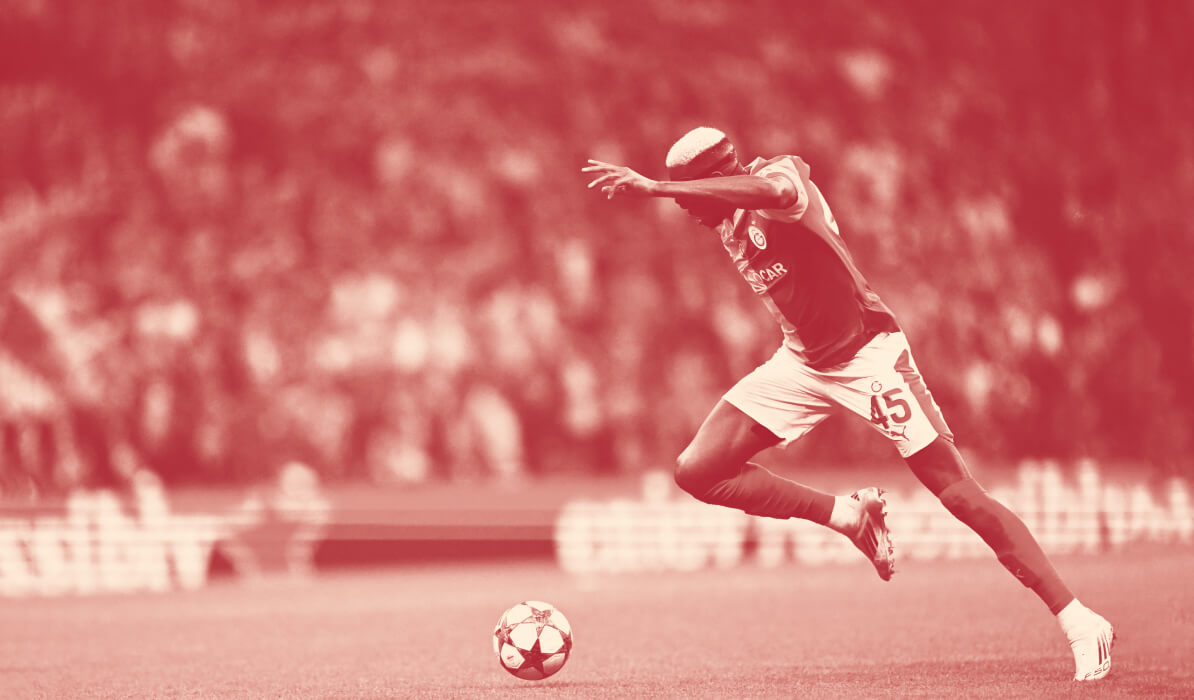
When you think about Victor Osimhen, the first thing that comes to mind is his famous mask. His self-proclaimed good luck charm has quickly become an unmistakable badge of identity for the Nigerian marksman. Typically, you might associate a mask with one of two things. You either wear it to assume a different persona and hide your true feelings, mainly anguish – or because it grants you superpowers. Looking at Osimhen’s story, he’d have every right to justify choosing anguish, but instead he picked hope. His superpowers extend well beyond his pace, power and shooting ability on the pitch. His tale is one of incredible grit, self-belief, bravery and the irrepressible human will to survive (and thrive) at all costs.
Osimhen grew up near the Olusosun landfill, a 40-hectare dumpsite in Lagos – the biggest in Africa and among the largest in the world. Having lost his mother at an early age, he had to find any way possible to earn money with his father and siblings. That included salvaging scrap from the landfill, a dangerous environment for anyone, particularly children, with garbage stacked 18 metres high and waste pickers not just at risk of falling, but constantly exposed to sharp objects, toxic fumes and insect and snake bites. It was here, too, that the youngster scrambled around for the shoes that would allow him to indulge his passion for football, pairing together any mismatched footwear he could find.
The daily struggle to simply obtain food injected Osimhen with an uncommon determination that has served him well ever since, from his breakthrough with Nigeria’s Under-17s to his current exploits at Galatasaray. The Istanbul giants paid a Turkish record fee last summer to secure his permanent switch from Napoli, where the masked man helped clinch the club’s first league title in 33 years, and he has flourished in front of Gala’s fervent fans, rewarding them the only way he knows – bagging goal after goal. Here, Osimhen takes off his mask and bares all, explaining how his journey from Lagos to Istanbul has been incredibly arduous, and how he wouldn’t change it for the world.
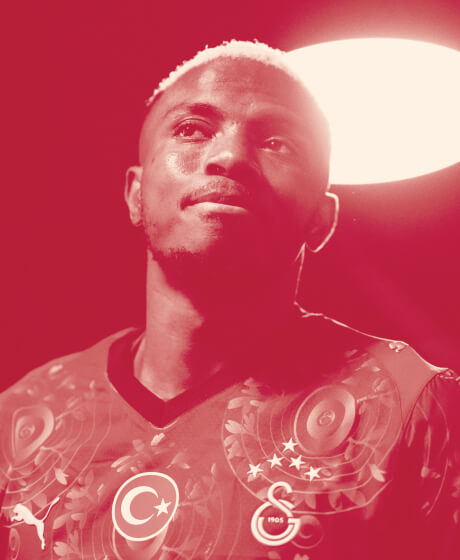
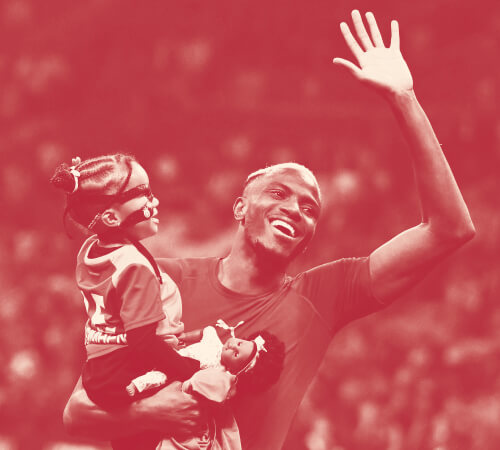
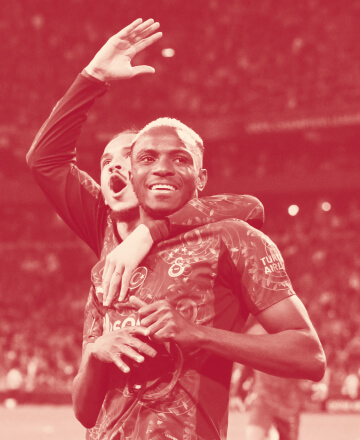
I came from a very poor background. I’m the last born of seven. I lost my mum at a very young age, and my father passed on in 2020. My childhood was really tough. As a young lad, I had to help my siblings raise money. Nobody believed my family would amount to something. I don’t think I would be anywhere if God didn’t intervene. Football was the only escape route for me and my family, and I had to do everything I could to get them out of abject poverty. I didn’t have the privilege of a good life. I didn’t have the privilege of completing education. But I believe so much in myself. I believe so much in my talent, knowing I’m going to make it in one way or another. This is not me encouraging young kids to drop out. But I was the kind of person that believed so much in myself. I just had to do what I needed to do for my family, for myself, because, most of the time, it was difficult to get three square meals. My father would beg for food he could take on credit. It was disgrace upon disgrace on the streets for my father, for my family. But I’m grateful to God that I’m where I am today and that I’m able to give my family the good life until the end of my life.
When they closed down the school field where we used to train, a lot of dreams died. Seventy or eighty per cent of the boys there dreamed of being a professional football player, inspired by the likes of John Obi Mikel, Didier Drogba. After they closed down the pitch, some of my friends stopped playing football. Some of them went to look for jobs. Me and a few others went outside our comfort zone, to try to train and look for opportunities, and make sure that we actually realised our dreams of becoming a professional player. Thankfully, we had people around us who encouraged us to pursue football. There was a great man called Mr Paul Erikewe who assembled everyone in the community and met with our parents to discuss education; a guy named Branuru from the hood who would buy some of us shoes and gave us money for food; and a youth coach, Henry, who was very disciplined, very hard on us, but in a good way at that time.
Close to the pitch is a dumpsite where me and other friends used to look for shoes. When you get the right foot, it’s one brand, and you get the left foot, it’s another brand – you just put everything together, take it home, wash it, put it in the sun, and then the next day you can use it to play. The struggle I went through in Olusosun is the same in football. This place is what shaped me to become the kind of person I am today and, to be honest, it taught me life lessons that have helped me through life’s journey. So, for me, it’s really an amazing place. That’s the reason why, any time I’m in Nigeria, I always go there to show gratitude, to show the young kids growing up that if I could make it out of this place, I believe that you can. With hard work, seriousness and the help of God, I think everything is possible.

The death of my mum still hurts me today. Because of everything she sacrificed, she wasn’t able to be alive to enjoy it. But I’m grateful to God that my father actually enjoyed my wealth and saw his grandfather’s name grow so prominent in the world. It’s a kind of bliss and satisfaction which I’m really proud of. Olusosun is a place that’s not promising, but it’s a small community. A lot of things go on there – so many things – and I’m attached to this place, even now.
It was just about the hustle, just about making a living to try to help my family. My brother sold sports newspapers on the roadside. You have your newspaper in your hand and you walk through the cars, holding it up. He would come back home and give my sister some money to try to get some food for the family. He was the person that actually inspired me to hustle so hard. I started to sell bottled water on the road, trying to chase the bus and everything like that. The way I play is the same. I’ve always been like this. Growing up, I didn’t play with friends my age; I played with the big guys, with the big boys. I used to get hit a lot, but one thing I will not do is stay down, give up. My struggle – selling bottled water, that type of thing – meant you had to run. I had to keep on going. I never stayed down. That hustle really is reflected in my game, the way I play.
When I arrived in Istanbul, I’d never seen that in my life before. It was incredible, so many people at the airport at two or three in the morning. You see them and you look at the time. Many of them were supposed to be sleeping with their family, just relaxing at home. They were outside for one person, to see me. It puts that fire in you to make sure that all the sweat you give, you give it for the badge. Every run you make, you make it for the badge. When I saw that, it was like a fresh breeze came over me. Genuinely, passionately, I love this club. I’m ready to go through everything with the club – the good, the bad, the ugly – but I hope for more good than bad.
When you think about Victor Osimhen, the first thing that comes to mind is his famous mask. His self-proclaimed good luck charm has quickly become an unmistakable badge of identity for the Nigerian marksman. Typically, you might associate a mask with one of two things. You either wear it to assume a different persona and hide your true feelings, mainly anguish – or because it grants you superpowers. Looking at Osimhen’s story, he’d have every right to justify choosing anguish, but instead he picked hope. His superpowers extend well beyond his pace, power and shooting ability on the pitch. His tale is one of incredible grit, self-belief, bravery and the irrepressible human will to survive (and thrive) at all costs.
Osimhen grew up near the Olusosun landfill, a 40-hectare dumpsite in Lagos – the biggest in Africa and among the largest in the world. Having lost his mother at an early age, he had to find any way possible to earn money with his father and siblings. That included salvaging scrap from the landfill, a dangerous environment for anyone, particularly children, with garbage stacked 18 metres high and waste pickers not just at risk of falling, but constantly exposed to sharp objects, toxic fumes and insect and snake bites. It was here, too, that the youngster scrambled around for the shoes that would allow him to indulge his passion for football, pairing together any mismatched footwear he could find.
The daily struggle to simply obtain food injected Osimhen with an uncommon determination that has served him well ever since, from his breakthrough with Nigeria’s Under-17s to his current exploits at Galatasaray. The Istanbul giants paid a Turkish record fee last summer to secure his permanent switch from Napoli, where the masked man helped clinch the club’s first league title in 33 years, and he has flourished in front of Gala’s fervent fans, rewarding them the only way he knows – bagging goal after goal. Here, Osimhen takes off his mask and bares all, explaining how his journey from Lagos to Istanbul has been incredibly arduous, and how he wouldn’t change it for the world.


I came from a very poor background. I’m the last born of seven. I lost my mum at a very young age, and my father passed on in 2020. My childhood was really tough. As a young lad, I had to help my siblings raise money. Nobody believed my family would amount to something. I don’t think I would be anywhere if God didn’t intervene. Football was the only escape route for me and my family, and I had to do everything I could to get them out of abject poverty. I didn’t have the privilege of a good life. I didn’t have the privilege of completing education. But I believe so much in myself. I believe so much in my talent, knowing I’m going to make it in one way or another. This is not me encouraging young kids to drop out. But I was the kind of person that believed so much in myself. I just had to do what I needed to do for my family, for myself, because, most of the time, it was difficult to get three square meals. My father would beg for food he could take on credit. It was disgrace upon disgrace on the streets for my father, for my family. But I’m grateful to God that I’m where I am today and that I’m able to give my family the good life until the end of my life.
When they closed down the school field where we used to train, a lot of dreams died. Seventy or eighty per cent of the boys there dreamed of being a professional football player, inspired by the likes of John Obi Mikel, Didier Drogba. After they closed down the pitch, some of my friends stopped playing football. Some of them went to look for jobs. Me and a few others went outside our comfort zone, to try to train and look for opportunities, and make sure that we actually realised our dreams of becoming a professional player. Thankfully, we had people around us who encouraged us to pursue football. There was a great man called Mr Paul Erikewe who assembled everyone in the community and met with our parents to discuss education; a guy named Branuru from the hood who would buy some of us shoes and gave us money for food; and a youth coach, Henry, who was very disciplined, very hard on us, but in a good way at that time.
Close to the pitch is a dumpsite where me and other friends used to look for shoes. When you get the right foot, it’s one brand, and you get the left foot, it’s another brand – you just put everything together, take it home, wash it, put it in the sun, and then the next day you can use it to play. The struggle I went through in Olusosun is the same in football. This place is what shaped me to become the kind of person I am today and, to be honest, it taught me life lessons that have helped me through life’s journey. So, for me, it’s really an amazing place. That’s the reason why, any time I’m in Nigeria, I always go there to show gratitude, to show the young kids growing up that if I could make it out of this place, I believe that you can. With hard work, seriousness and the help of God, I think everything is possible.
The death of my mum still hurts me today. Because of everything she sacrificed, she wasn’t able to be alive to enjoy it. But I’m grateful to God that my father actually enjoyed my wealth and saw his grandfather’s name grow so prominent in the world. It’s a kind of bliss and satisfaction which I’m really proud of. Olusosun is a place that’s not promising, but it’s a small community. A lot of things go on there – so many things – and I’m attached to this place, even now.
It was just about the hustle, just about making a living to try to help my family. My brother sold sports newspapers on the roadside. You have your newspaper in your hand and you walk through the cars, holding it up. He would come back home and give my sister some money to try to get some food for the family. He was the person that actually inspired me to hustle so hard. I started to sell bottled water on the road, trying to chase the bus and everything like that. The way I play is the same. I’ve always been like this. Growing up, I didn’t play with friends my age; I played with the big guys, with the big boys. I used to get hit a lot, but one thing I will not do is stay down, give up. My struggle – selling bottled water, that type of thing – meant you had to run. I had to keep on going. I never stayed down. That hustle really is reflected in my game, the way I play.
When I arrived in Istanbul, I’d never seen that in my life before. It was incredible, so many people at the airport at two or three in the morning. You see them and you look at the time. Many of them were supposed to be sleeping with their family, just relaxing at home. They were outside for one person, to see me. It puts that fire in you to make sure that all the sweat you give, you give it for the badge. Every run you make, you make it for the badge. When I saw that, it was like a fresh breeze came over me. Genuinely, passionately, I love this club. I’m ready to go through everything with the club – the good, the bad, the ugly – but I hope for more good than bad.
When you think about Victor Osimhen, the first thing that comes to mind is his famous mask. His self-proclaimed good luck charm has quickly become an unmistakable badge of identity for the Nigerian marksman. Typically, you might associate a mask with one of two things. You either wear it to assume a different persona and hide your true feelings, mainly anguish – or because it grants you superpowers. Looking at Osimhen’s story, he’d have every right to justify choosing anguish, but instead he picked hope. His superpowers extend well beyond his pace, power and shooting ability on the pitch. His tale is one of incredible grit, self-belief, bravery and the irrepressible human will to survive (and thrive) at all costs.
Osimhen grew up near the Olusosun landfill, a 40-hectare dumpsite in Lagos – the biggest in Africa and among the largest in the world. Having lost his mother at an early age, he had to find any way possible to earn money with his father and siblings. That included salvaging scrap from the landfill, a dangerous environment for anyone, particularly children, with garbage stacked 18 metres high and waste pickers not just at risk of falling, but constantly exposed to sharp objects, toxic fumes and insect and snake bites. It was here, too, that the youngster scrambled around for the shoes that would allow him to indulge his passion for football, pairing together any mismatched footwear he could find.
The daily struggle to simply obtain food injected Osimhen with an uncommon determination that has served him well ever since, from his breakthrough with Nigeria’s Under-17s to his current exploits at Galatasaray. The Istanbul giants paid a Turkish record fee last summer to secure his permanent switch from Napoli, where the masked man helped clinch the club’s first league title in 33 years, and he has flourished in front of Gala’s fervent fans, rewarding them the only way he knows – bagging goal after goal. Here, Osimhen takes off his mask and bares all, explaining how his journey from Lagos to Istanbul has been incredibly arduous, and how he wouldn’t change it for the world.
I came from a very poor background. I’m the last born of seven. I lost my mum at a very young age, and my father passed on in 2020. My childhood was really tough. As a young lad, I had to help my siblings raise money. Nobody believed my family would amount to something. I don’t think I would be anywhere if God didn’t intervene. Football was the only escape route for me and my family, and I had to do everything I could to get them out of abject poverty. I didn’t have the privilege of a good life. I didn’t have the privilege of completing education. But I believe so much in myself. I believe so much in my talent, knowing I’m going to make it in one way or another. This is not me encouraging young kids to drop out. But I was the kind of person that believed so much in myself. I just had to do what I needed to do for my family, for myself, because, most of the time, it was difficult to get three square meals. My father would beg for food he could take on credit. It was disgrace upon disgrace on the streets for my father, for my family. But I’m grateful to God that I’m where I am today and that I’m able to give my family the good life until the end of my life.
When they closed down the school field where we used to train, a lot of dreams died. Seventy or eighty per cent of the boys there dreamed of being a professional football player, inspired by the likes of John Obi Mikel, Didier Drogba. After they closed down the pitch, some of my friends stopped playing football. Some of them went to look for jobs. Me and a few others went outside our comfort zone, to try to train and look for opportunities, and make sure that we actually realised our dreams of becoming a professional player. Thankfully, we had people around us who encouraged us to pursue football. There was a great man called Mr Paul Erikewe who assembled everyone in the community and met with our parents to discuss education; a guy named Branuru from the hood who would buy some of us shoes and gave us money for food; and a youth coach, Henry, who was very disciplined, very hard on us, but in a good way at that time.
Close to the pitch is a dumpsite where me and other friends used to look for shoes. When you get the right foot, it’s one brand, and you get the left foot, it’s another brand – you just put everything together, take it home, wash it, put it in the sun, and then the next day you can use it to play. The struggle I went through in Olusosun is the same in football. This place is what shaped me to become the kind of person I am today and, to be honest, it taught me life lessons that have helped me through life’s journey. So, for me, it’s really an amazing place. That’s the reason why, any time I’m in Nigeria, I always go there to show gratitude, to show the young kids growing up that if I could make it out of this place, I believe that you can. With hard work, seriousness and the help of God, I think everything is possible.
The death of my mum still hurts me today. Because of everything she sacrificed, she wasn’t able to be alive to enjoy it. But I’m grateful to God that my father actually enjoyed my wealth and saw his grandfather’s name grow so prominent in the world. It’s a kind of bliss and satisfaction which I’m really proud of. Olusosun is a place that’s not promising, but it’s a small community. A lot of things go on there – so many things – and I’m attached to this place, even now.
It was just about the hustle, just about making a living to try to help my family. My brother sold sports newspapers on the roadside. You have your newspaper in your hand and you walk through the cars, holding it up. He would come back home and give my sister some money to try to get some food for the family. He was the person that actually inspired me to hustle so hard. I started to sell bottled water on the road, trying to chase the bus and everything like that. The way I play is the same. I’ve always been like this. Growing up, I didn’t play with friends my age; I played with the big guys, with the big boys. I used to get hit a lot, but one thing I will not do is stay down, give up. My struggle – selling bottled water, that type of thing – meant you had to run. I had to keep on going. I never stayed down. That hustle really is reflected in my game, the way I play.
When I arrived in Istanbul, I’d never seen that in my life before. It was incredible, so many people at the airport at two or three in the morning. You see them and you look at the time. Many of them were supposed to be sleeping with their family, just relaxing at home. They were outside for one person, to see me. It puts that fire in you to make sure that all the sweat you give, you give it for the badge. Every run you make, you make it for the badge. When I saw that, it was like a fresh breeze came over me. Genuinely, passionately, I love this club. I’m ready to go through everything with the club – the good, the bad, the ugly – but I hope for more good than bad.