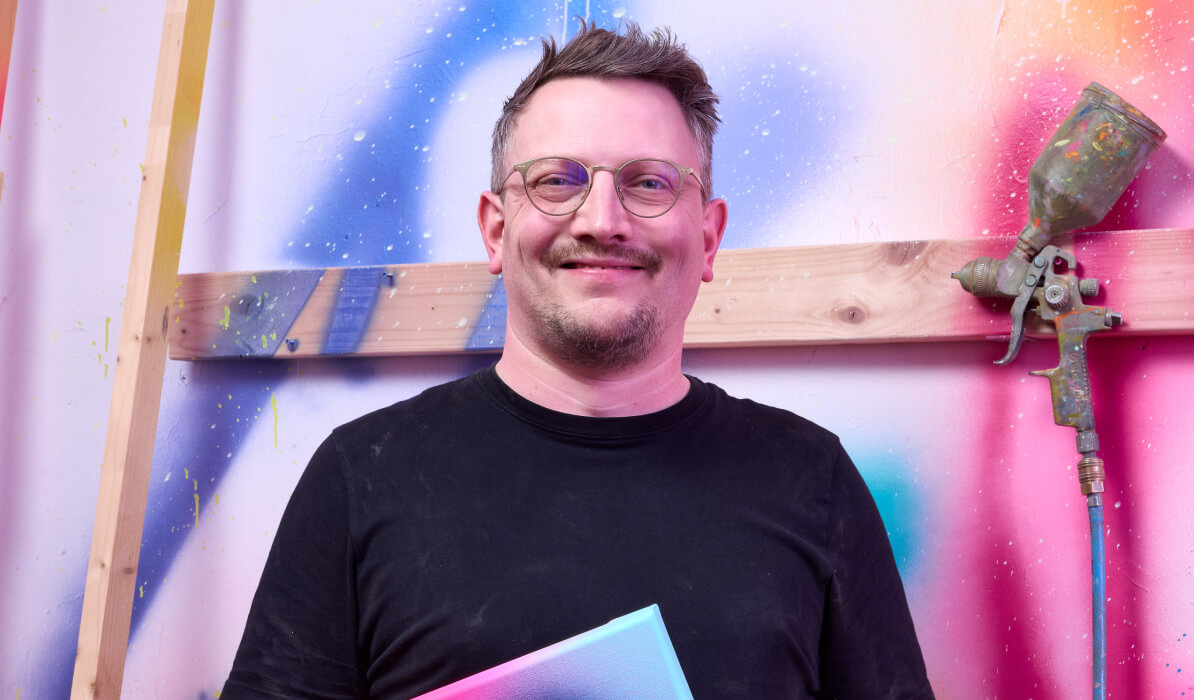
Márton Nemes is telling me a tale of two cities. Specifically, he’s telling me about Buda and Pest, the two cities that combined to become today’s modern Budapest, the place he calls his home. “Buda was more aristocratic, whereas Pest was always a bit more industrial,” he explains. “Buda has the hills and the palaces. Pest is more flat, and there is a lot going on in terms of clubs, bars, theatres and galleries. There is this duality; when the two cities united, they created this very interesting mixture. It all comes together to make this very unique, cool city.”
Duality turns out to be a theme of my conversation with Nemes, who is the artist chosen to design the branding for this year’s Champions League final, held in the Hungarian capital. For starters, there’s the duality of a highly conceptual artist, more used to exhibiting at the Venice Biennale than on lamp-posts and stadium walls, being asked to design a piece for mass consumption. Some might view it as a challenge, or even a compromise, but Nemes sees an opportunity to reach new people. “Visual artists already have their audience – people who are interested in art and who go to galleries,” he says. “This is a platform where everyone will see my work. Maybe, for people who want to get closer to contemporary art but don’t know how, this is their opportunity.”
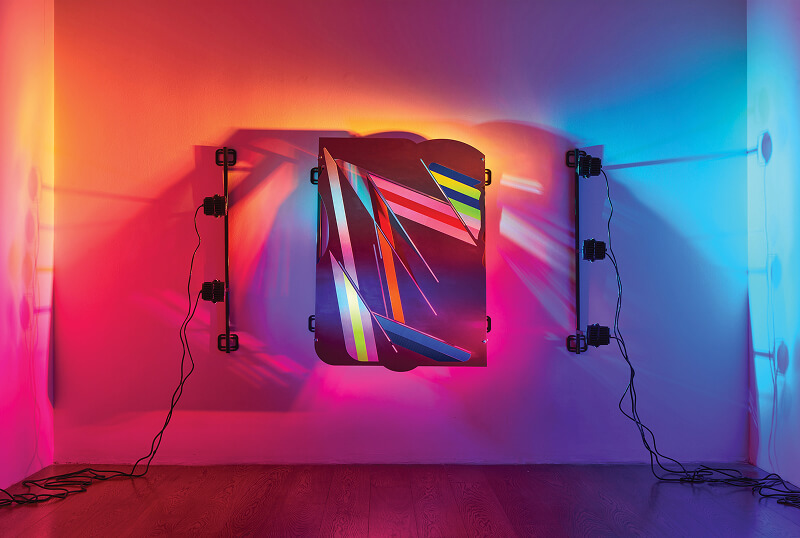
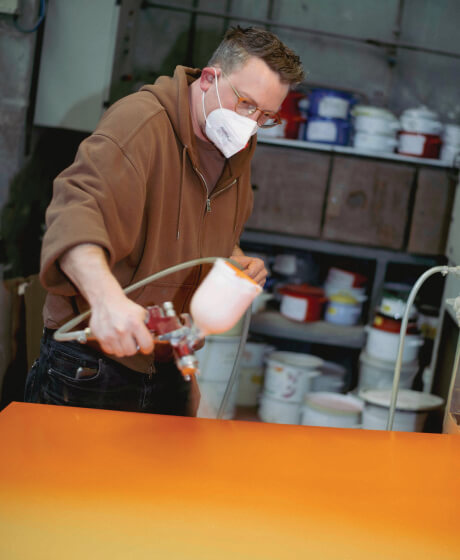
It isn’t just Buda and Pest acting as opposing forces in Nemes’ life and work. His artistic style is a combination of fluid, energetic shapes and colours, which collide with technical, engineered construction. “Fundamentally, everything that I do always has this bit of engineering; I always build artworks from bricks, always with squares, always with triangles,” he says. “But then I play with colour and splashes too. I like this balance between something that is very tactile and visible, and something that is invisible, that you feel.”

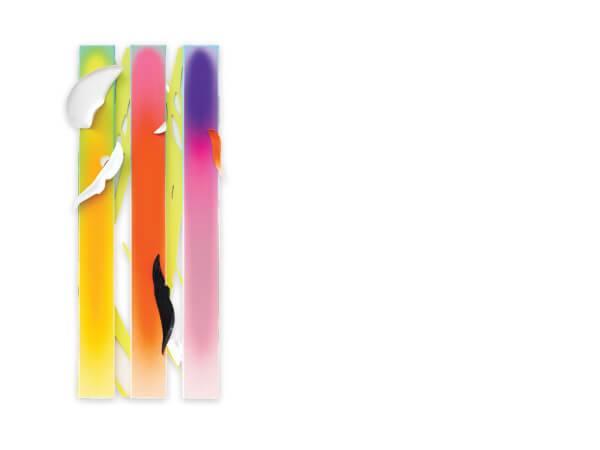
Nemes’ design for the final branding is a balance too – of references immediately understandable at first glance and other motifs that require deeper contemplation. One instantly recognisable feature is the iconic Danube river, which slices the design – and Budapest – in two. “The Danube is very special,” Nemes enthuses. “We have seven bridges going across it.
The bridges were built in different centuries and at different times, so they are architecturally very distinctive.” One bridge, in particular, features prominently in the design: the Széchenyi Chain Bridge, which clearly fires up Nemes’ artistic imagination. “For me, it’s the most beautiful bridge. It’s not a chain like you might imagine – it’s more like some interesting metal plates which are lined up, creating this chain-like structure. It’s a very beautiful, dynamic way of creating a shape and movement.”
It’s clear that Nemes’ artistic eye finds design inspiration from all around him in his home city, and has been doing so since he was a child. “In the 20th century, when there was communism here, neon lights were everywhere – on bars and businesses and shops,” he tells me. “They all had the same style because in communism everything was always the same. Nowadays, most of this has disappeared, but it was a very strong childhood experience for me.” Although much of the Cold War neon has now gone, there are still places it can be seen. “In Ferenciek square in the 5th district, there’s a place called Ibolya Espresso, which is a bar that still has the old-style neon.”
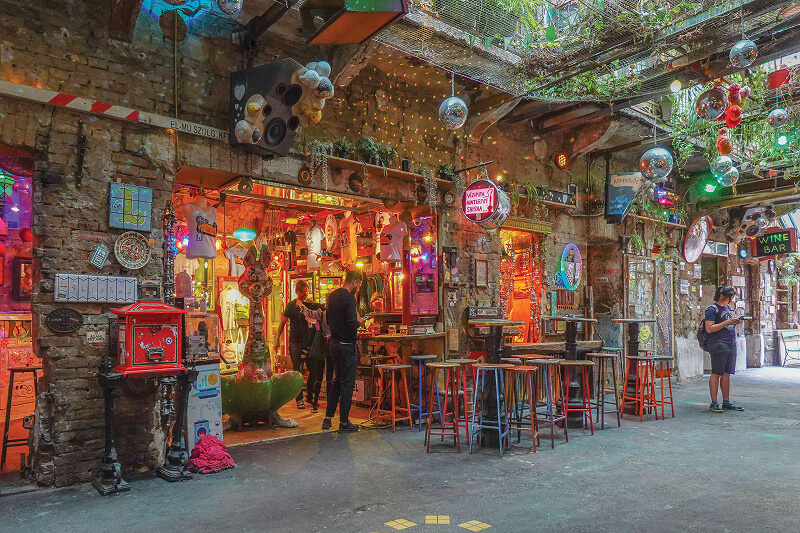
Once you know about Budapest’s history with neon, its influence on Nemes’ design is clear, with luminous yellows and pinks bursting out of the vibrant artwork. As well as being drawn to Eastern bloc-era neon, Nemes took inspiration from his love of rave culture – “a rave is an almost tribal experience where you connect to the colours in lights” – and also from Budapest’s ‘ruin bars’. Nemes’ studio is situated in the very centre of the capital in the buzzy 7th district, just around the corner from the city’s most famous ruin bar, Szimpla Kert.

Nemes explains Budapest’s tradition with these ruin bars: “Some buildings here are still in the same condition as they were after the Second World War, or after our revolution against Russia in the ’50s. There was a lot of gunfire in the city, and tanks came – you can literally see the holes that the bullets made on the facade of the buildings. Afterwards, they didn’t have enough money to restore these buildings, so they kept them as they were: semi-abandoned buildings, but with a bar placed in the middle. You get this feeling that you’re going through history. You enter something that is the same condition as it was 50, 60 years ago, and still you can drink and have fun in there. It feels like time travel.”
Budapest through Nemes’ eyes feels like a city of contrasts, a blend of old and new. It makes sense for a country that was cut off from the outside world until relatively recently, and to Nemes it’s noticeable how this has impacted the place artistically. “Hungarian people couldn’t really travel until the ’90s,” he says. “Artists were literally locked in – they didn’t go anywhere, so the art scene in the 20th century was very isolated. Obviously, that isn’t the case any more; now the Hungarian contemporary art scene is really developing internationally.” The isolation, followed by the sudden explosion of external influence, has created an artistic culture that Nemes sees as very diverse. “There’s no such thing as typical Hungarian art. It’s not a taste that you can define and say exactly what Hungarian people are doing here.” He namechecks artists Victor Vasarely and László Moholy-Nagy as particular inspirations, with the Bauhaus movement’s effect on the city’s architecture and artists also exerting a lasting pull.
It’s obvious from speaking to Nemes, and looking at his design for the final, that a series of competing influences have made both him and Budapest what they are today. Where Buda meets Pest, where old meets new, where art meets engineering, sits the Hungarian capital, with Nemes in his studio at its centre. In the Champions League final, there can be only one winner, but everywhere else in Budapest, contrasts sit easily together, making something unique where they intersect.
Márton Nemes is telling me a tale of two cities. Specifically, he’s telling me about Buda and Pest, the two cities that combined to become today’s modern Budapest, the place he calls his home. “Buda was more aristocratic, whereas Pest was always a bit more industrial,” he explains. “Buda has the hills and the palaces. Pest is more flat, and there is a lot going on in terms of clubs, bars, theatres and galleries. There is this duality; when the two cities united, they created this very interesting mixture. It all comes together to make this very unique, cool city.”
Duality turns out to be a theme of my conversation with Nemes, who is the artist chosen to design the branding for this year’s Champions League final, held in the Hungarian capital. For starters, there’s the duality of a highly conceptual artist, more used to exhibiting at the Venice Biennale than on lamp-posts and stadium walls, being asked to design a piece for mass consumption. Some might view it as a challenge, or even a compromise, but Nemes sees an opportunity to reach new people. “Visual artists already have their audience – people who are interested in art and who go to galleries,” he says. “This is a platform where everyone will see my work. Maybe, for people who want to get closer to contemporary art but don’t know how, this is their opportunity.”
It isn’t just Buda and Pest acting as opposing forces in Nemes’ life and work. His artistic style is a combination of fluid, energetic shapes and colours, which collide with technical, engineered construction. “Fundamentally, everything that I do always has this bit of engineering; I always build artworks from bricks, always with squares, always with triangles,” he says. “But then I play with colour and splashes too. I like this balance between something that is very tactile and visible, and something that is invisible, that you feel.”


Nemes’ design for the final branding is a balance too – of references immediately understandable at first glance and other motifs that require deeper contemplation. One instantly recognisable feature is the iconic Danube river, which slices the design – and Budapest – in two. “The Danube is very special,” Nemes enthuses. “We have seven bridges going across it.
The bridges were built in different centuries and at different times, so they are architecturally very distinctive.” One bridge, in particular, features prominently in the design: the Széchenyi Chain Bridge, which clearly fires up Nemes’ artistic imagination. “For me, it’s the most beautiful bridge. It’s not a chain like you might imagine – it’s more like some interesting metal plates which are lined up, creating this chain-like structure. It’s a very beautiful, dynamic way of creating a shape and movement.”
It’s clear that Nemes’ artistic eye finds design inspiration from all around him in his home city, and has been doing so since he was a child. “In the 20th century, when there was communism here, neon lights were everywhere – on bars and businesses and shops,” he tells me. “They all had the same style because in communism everything was always the same. Nowadays, most of this has disappeared, but it was a very strong childhood experience for me.” Although much of the Cold War neon has now gone, there are still places it can be seen. “In Ferenciek square in the 5th district, there’s a place called Ibolya Espresso, which is a bar that still has the old-style neon.”
Once you know about Budapest’s history with neon, its influence on Nemes’ design is clear, with luminous yellows and pinks bursting out of the vibrant artwork. As well as being drawn to Eastern bloc-era neon, Nemes took inspiration from his love of rave culture – “a rave is an almost tribal experience where you connect to the colours in lights” – and also from Budapest’s ‘ruin bars’. Nemes’ studio is situated in the very centre of the capital in the buzzy 7th district, just around the corner from the city’s most famous ruin bar, Szimpla Kert.
Nemes explains Budapest’s tradition with these ruin bars: “Some buildings here are still in the same condition as they were after the Second World War, or after our revolution against Russia in the ’50s. There was a lot of gunfire in the city, and tanks came – you can literally see the holes that the bullets made on the facade of the buildings. Afterwards, they didn’t have enough money to restore these buildings, so they kept them as they were: semi-abandoned buildings, but with a bar placed in the middle. You get this feeling that you’re going through history. You enter something that is the same condition as it was 50, 60 years ago, and still you can drink and have fun in there. It feels like time travel.”
Budapest through Nemes’ eyes feels like a city of contrasts, a blend of old and new. It makes sense for a country that was cut off from the outside world until relatively recently, and to Nemes it’s noticeable how this has impacted the place artistically. “Hungarian people couldn’t really travel until the ’90s,” he says. “Artists were literally locked in – they didn’t go anywhere, so the art scene in the 20th century was very isolated. Obviously, that isn’t the case any more; now the Hungarian contemporary art scene is really developing internationally.” The isolation, followed by the sudden explosion of external influence, has created an artistic culture that Nemes sees as very diverse. “There’s no such thing as typical Hungarian art. It’s not a taste that you can define and say exactly what Hungarian people are doing here.” He namechecks artists Victor Vasarely and László Moholy-Nagy as particular inspirations, with the Bauhaus movement’s effect on the city’s architecture and artists also exerting a lasting pull.
It’s obvious from speaking to Nemes, and looking at his design for the final, that a series of competing influences have made both him and Budapest what they are today. Where Buda meets Pest, where old meets new, where art meets engineering, sits the Hungarian capital, with Nemes in his studio at its centre. In the Champions League final, there can be only one winner, but everywhere else in Budapest, contrasts sit easily together, making something unique where they intersect.
Márton Nemes is telling me a tale of two cities. Specifically, he’s telling me about Buda and Pest, the two cities that combined to become today’s modern Budapest, the place he calls his home. “Buda was more aristocratic, whereas Pest was always a bit more industrial,” he explains. “Buda has the hills and the palaces. Pest is more flat, and there is a lot going on in terms of clubs, bars, theatres and galleries. There is this duality; when the two cities united, they created this very interesting mixture. It all comes together to make this very unique, cool city.”
Duality turns out to be a theme of my conversation with Nemes, who is the artist chosen to design the branding for this year’s Champions League final, held in the Hungarian capital. For starters, there’s the duality of a highly conceptual artist, more used to exhibiting at the Venice Biennale than on lamp-posts and stadium walls, being asked to design a piece for mass consumption. Some might view it as a challenge, or even a compromise, but Nemes sees an opportunity to reach new people. “Visual artists already have their audience – people who are interested in art and who go to galleries,” he says. “This is a platform where everyone will see my work. Maybe, for people who want to get closer to contemporary art but don’t know how, this is their opportunity.”
It isn’t just Buda and Pest acting as opposing forces in Nemes’ life and work. His artistic style is a combination of fluid, energetic shapes and colours, which collide with technical, engineered construction. “Fundamentally, everything that I do always has this bit of engineering; I always build artworks from bricks, always with squares, always with triangles,” he says. “But then I play with colour and splashes too. I like this balance between something that is very tactile and visible, and something that is invisible, that you feel.”
Nemes’ design for the final branding is a balance too – of references immediately understandable at first glance and other motifs that require deeper contemplation. One instantly recognisable feature is the iconic Danube river, which slices the design – and Budapest – in two. “The Danube is very special,” Nemes enthuses. “We have seven bridges going across it.
The bridges were built in different centuries and at different times, so they are architecturally very distinctive.” One bridge, in particular, features prominently in the design: the Széchenyi Chain Bridge, which clearly fires up Nemes’ artistic imagination. “For me, it’s the most beautiful bridge. It’s not a chain like you might imagine – it’s more like some interesting metal plates which are lined up, creating this chain-like structure. It’s a very beautiful, dynamic way of creating a shape and movement.”
It’s clear that Nemes’ artistic eye finds design inspiration from all around him in his home city, and has been doing so since he was a child. “In the 20th century, when there was communism here, neon lights were everywhere – on bars and businesses and shops,” he tells me. “They all had the same style because in communism everything was always the same. Nowadays, most of this has disappeared, but it was a very strong childhood experience for me.” Although much of the Cold War neon has now gone, there are still places it can be seen. “In Ferenciek square in the 5th district, there’s a place called Ibolya Espresso, which is a bar that still has the old-style neon.”
Once you know about Budapest’s history with neon, its influence on Nemes’ design is clear, with luminous yellows and pinks bursting out of the vibrant artwork. As well as being drawn to Eastern bloc-era neon, Nemes took inspiration from his love of rave culture – “a rave is an almost tribal experience where you connect to the colours in lights” – and also from Budapest’s ‘ruin bars’. Nemes’ studio is situated in the very centre of the capital in the buzzy 7th district, just around the corner from the city’s most famous ruin bar, Szimpla Kert.
Nemes explains Budapest’s tradition with these ruin bars: “Some buildings here are still in the same condition as they were after the Second World War, or after our revolution against Russia in the ’50s. There was a lot of gunfire in the city, and tanks came – you can literally see the holes that the bullets made on the facade of the buildings. Afterwards, they didn’t have enough money to restore these buildings, so they kept them as they were: semi-abandoned buildings, but with a bar placed in the middle. You get this feeling that you’re going through history. You enter something that is the same condition as it was 50, 60 years ago, and still you can drink and have fun in there. It feels like time travel.”
Budapest through Nemes’ eyes feels like a city of contrasts, a blend of old and new. It makes sense for a country that was cut off from the outside world until relatively recently, and to Nemes it’s noticeable how this has impacted the place artistically. “Hungarian people couldn’t really travel until the ’90s,” he says. “Artists were literally locked in – they didn’t go anywhere, so the art scene in the 20th century was very isolated. Obviously, that isn’t the case any more; now the Hungarian contemporary art scene is really developing internationally.” The isolation, followed by the sudden explosion of external influence, has created an artistic culture that Nemes sees as very diverse. “There’s no such thing as typical Hungarian art. It’s not a taste that you can define and say exactly what Hungarian people are doing here.” He namechecks artists Victor Vasarely and László Moholy-Nagy as particular inspirations, with the Bauhaus movement’s effect on the city’s architecture and artists also exerting a lasting pull.
It’s obvious from speaking to Nemes, and looking at his design for the final, that a series of competing influences have made both him and Budapest what they are today. Where Buda meets Pest, where old meets new, where art meets engineering, sits the Hungarian capital, with Nemes in his studio at its centre. In the Champions League final, there can be only one winner, but everywhere else in Budapest, contrasts sit easily together, making something unique where they intersect.