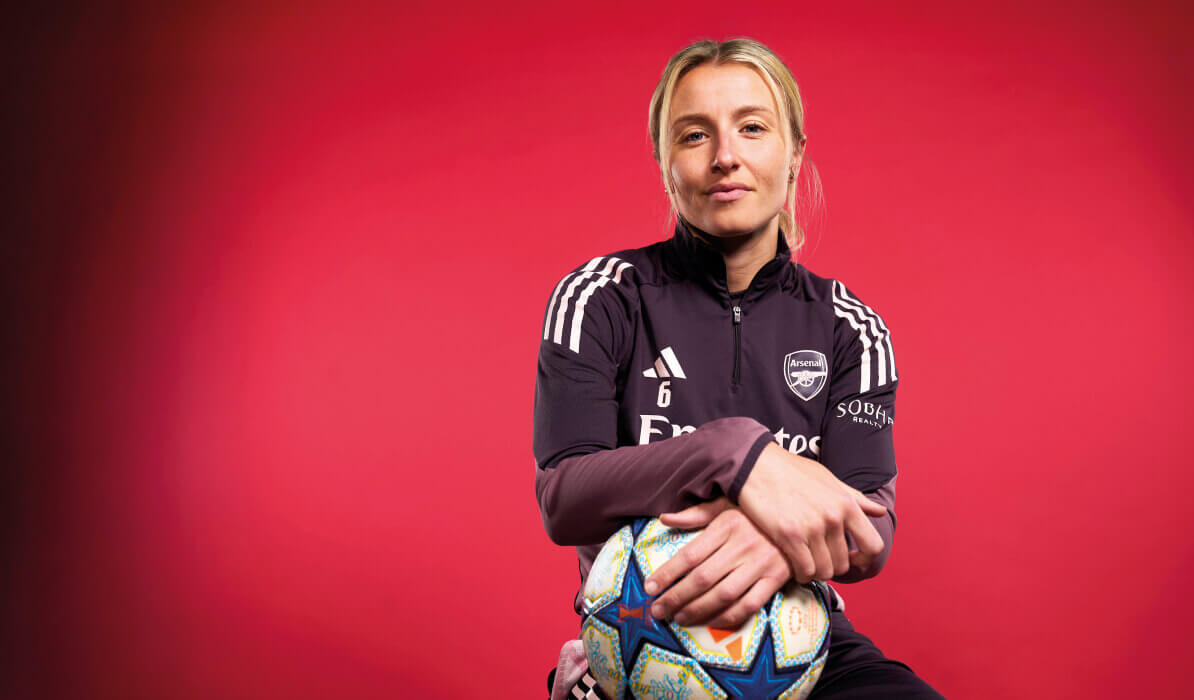
Nobody wins afraid of losing,” sings the heavily bearded, husky-voiced country music star Chris Stapleton on his hit song Starting Over. Around 6,500 kilometres away from his home town of Lexington, Kentucky, Milton Keynes-born Arsenal and England defender Leah Williamson took that to heart.
“I love his music,” the 28-year-old tells me, as we sit ensconced in a corner of Arsenal’s indoor training pitch for our interview. I spent the summer just gone watching Williamson rack up accolade after accolade – in person at the Women’s Champions League final in Lisbon, at home on TV for the Women’s EURO final, in person again at the Lionesses’ London trophy parade – so sitting with her here in the flesh feels a little surreal. So surreal, in fact, that I have somehow found myself opening our interview by asking her about country music instead of football.
“It’s special music,” she says, discussing her love of the genre. Williamson might be from Milton Keynes but she’s a die-hard country fan. Last year, she turned a lifelong dream into reality with a trip to the spiritual home of country music, Nashville, Tennessee. “I went with my grandma and cousin,” she explains. “We’d always wanted to go. My schedule is unforgiving, but in the two free weeks I did have, I snuck away.”
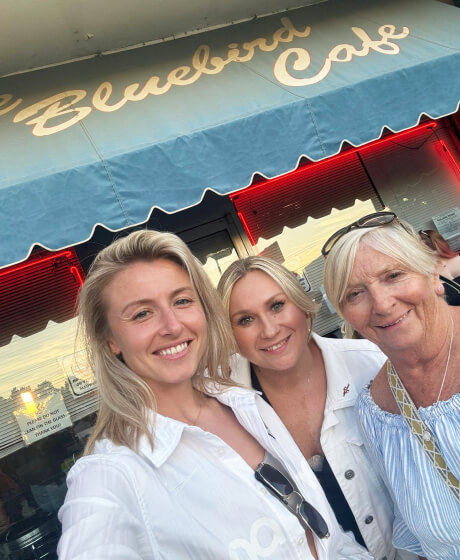
Williamson and her family spent the time soaking in as much country music as possible, visiting the iconic Bluebird Cafe venue (twice!) and taking in a festival. Her Instagram posts from the trip show her in a cowboy hat and boots and smiling from ear to ear. “It was great, just live music every day,” she reminisces. “We went to CMA [Country Music Association] Fest, so you literally walk out onto the street and there’s music everywhere.”
She’s telling me about this once-in-a-lifetime trip, but you can tell it already feels a world away. Given the year she’s had, it comes as no surprise when our conversation about country music swiftly leads back to football. When she’s telling me why she likes the Chris Stapleton quote that began this piece, she notes that the lyric “is so transferable to football”. Even when being asked about an interest away from the pitch, her mind quickly takes us back onto it.
That line is certainly transferable to Williamson’s career – nobody could accuse the Arsenal ace and England captain of being afraid of losing. Not that she’s done much of that recently, though. She’s sitting down with me today reflecting on a truly remarkable year by anyone’s standards, one that brought her the Champions League trophy with Arsenal and the EURO title with England in the space of three months.
In a BBC interview before that Champions League final, Williamson was asked about Arsenal’s opponents, Barcelona, and whether she felt that Arsenal were underdogs. She made a pretty definitive statement in the opposite direction, telling the interviewer firmly: “We’re going to win.” Watching that interview the morning after Arsenal’s impressive 1-0 victory, the total confidence and conviction behind that comment stuck with me. As we talk at Arsenal’s training ground in Hertfordshire, I ask her about it. “I’m a very logical person,” she says. “I looked at it logically. I don’t care how much of an underdog you are – on the day, there’s always an opportunity for anything to happen. To me, we had a chance to win and the opportunity was there, so why not?”
It’s one thing to believe you’ll win, quite another to express it to a national media outlet on the eve of such an important game. I’m curious about where that confidence and self-belief come from – is it innate or something she’s had to work on? “I don’t know about that, whether it’s learned or if it’s just you,” she muses. “I think it’s who I’ve been moulded into as a human, in terms of the environments I’ve been in.”
Her thoughts go back to those early environments and the figures in her life who helped nurture that self-assurance. “At England [under-19s], I had a coach, Mo Marley, and the way she treated me, I just felt like, ‘This is somebody who’s invested in me.’ That’s what I always took confidence in, that people were taking the time to invest in me – not massive outward shows of praise towards me or anything like that. I wanted to be worth the investment, so then it drove me to prove to them right.”
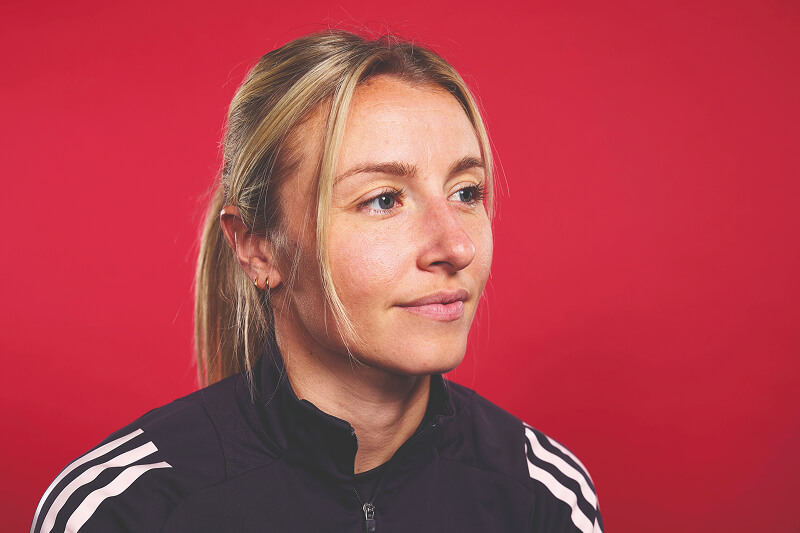
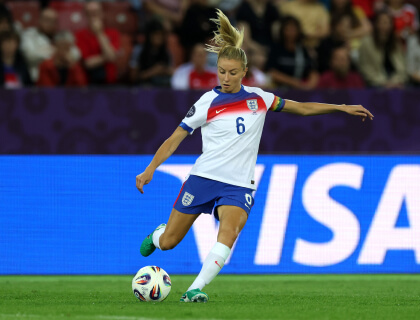
I’d say that they have very much been proven right. Williamson played crucial roles in both her sides’ trophy campaigns. In May, she put in the shift of her life in Lisbon, seemingly everywhere at once at the back under pressure from three-time champions Barcelona, either side of Stina Blackstenius’ goal for Arsenal. It was much the same in Basel for England’s final, her crucial blocks and clearances keeping the ship steady and her team-mates locked in.
I ask her to think back to both finals and that innate/not-innate confidence again. “For the Champions League final, I knew that we were defensively solid,” she says. “As the game’s going on, I’m thinking, OK, we’re all having a good game, that’s important. And then the EURO final was the same. There were just a couple of things that happened where you think, ‘On another day, a mistake, or a step left, or a step right would have been a different story,’ and it just wasn’t.”
Here comes that logical side again. “A goal in the 96th minute, and a goal in the first minute, is exactly the same concept – the ball goes in the back of the net. It’s easy, it’s not easy, it’s a worldie, it’s a tap-in, it’s a scrappy goal… whatever. Ultimately, the team that scores in the 96th minute usually does it because they just don’t die. The mentality is focused on one thing and they’re not willing to stop.”

That never-say-die attitude was the defining feature of both campaigns. Although they ended in triumph, they followed similar trajectories – both Arsenal and England found themselves behind in multiple games and had to dig deep to make it through. Williamson characteristically downplays her role as a leader in making that happen. “It’s rare that you find a team that’s successful because one person stands at the front and says, ‘Follow me,’” she notes. “In a good team, everybody takes that on and plays their role in different ways. It has to be in everybody, and it has to be something you live and breathe every day.”
I’m talking to Williamson at Arsenal’s Champions League access day, when different media outlets all come together to interview, film and photograph players. I’ve been to days like this at Arsenal before, but I’ve never seen it this busy. The Gunners’ new status as European champions, added to the exploding popularity of the women’s game, mean this is a hot ticket. Does that new scrutiny come with challenges for her and her team-mates? “We’re all well versed in mental resilience, and we all know how to manage ourselves,” she says. “But the main thing the skyrocketing of the game has done is that teams have to come together a lot more. It really is the outside world versus you. Even if people are saying nice things, you don’t want that to come in. It can’t come in, because it doesn’t hold any weight in terms of what you’re trying to achieve. You have to protect the environment.”
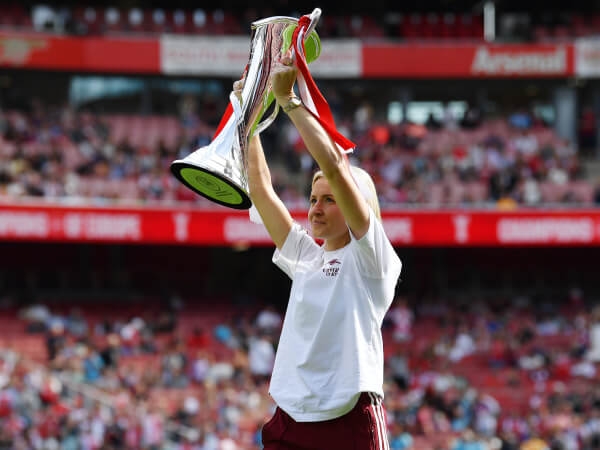
Williamson might have been able to block out the outside noise during each triumphant campaign, but once the titles were secured, she got to enjoy two enormous trophy celebrations. Around 75,000 people turned out to welcome the jubilant Lionesses home, and 10,000 crowded outside Arsenal’s stadium to cheer on the Champions League winners. “We capped the attendance for that, so imagine how many people there would have been otherwise,” she is quick to point out about the Gunners’ victory event. “The fans that are coming to the games are involved in the changing of our world, so to bring everybody together and celebrate, it was a lovely moment.”
It was also the most full-circle of full-circle moments possible, given that the last time Arsenal won the trophy, in 2007, the then ten-year-old Williamson was a player mascot leading out the team. “Standing in front of the stadium, which has artwork on the side celebrating the last time it was achieved… It was very full circle for me and for my family. I’m grateful to have been able to play a part.”
I imagine it might not be too long until Williamson and the rest of Arsenal’s Champions League-winning side find themselves featuring in that stadium artwork too. “I always wanted to leave history,” she says. “It’s one thing playing for your club, but it’s another thing actually giving back in that way. Now I feel like, in the smallest of ways, I’ve given back what I could never repay for what this club has done for me.”
For my final question, I ask her if she thinks her beloved team can etch their name on the trophy again. “My logical brain’s popping up again…” she smiles. “Who’s to say not?”
Nobody wins afraid of losing,” sings the heavily bearded, husky-voiced country music star Chris Stapleton on his hit song Starting Over. Around 6,500 kilometres away from his home town of Lexington, Kentucky, Milton Keynes-born Arsenal and England defender Leah Williamson took that to heart.
“I love his music,” the 28-year-old tells me, as we sit ensconced in a corner of Arsenal’s indoor training pitch for our interview. I spent the summer just gone watching Williamson rack up accolade after accolade – in person at the Women’s Champions League final in Lisbon, at home on TV for the Women’s EURO final, in person again at the Lionesses’ London trophy parade – so sitting with her here in the flesh feels a little surreal. So surreal, in fact, that I have somehow found myself opening our interview by asking her about country music instead of football.
“It’s special music,” she says, discussing her love of the genre. Williamson might be from Milton Keynes but she’s a die-hard country fan. Last year, she turned a lifelong dream into reality with a trip to the spiritual home of country music, Nashville, Tennessee. “I went with my grandma and cousin,” she explains. “We’d always wanted to go. My schedule is unforgiving, but in the two free weeks I did have, I snuck away.”
Williamson and her family spent the time soaking in as much country music as possible, visiting the iconic Bluebird Cafe venue (twice!) and taking in a festival. Her Instagram posts from the trip show her in a cowboy hat and boots and smiling from ear to ear. “It was great, just live music every day,” she reminisces. “We went to CMA [Country Music Association] Fest, so you literally walk out onto the street and there’s music everywhere.”
She’s telling me about this once-in-a-lifetime trip, but you can tell it already feels a world away. Given the year she’s had, it comes as no surprise when our conversation about country music swiftly leads back to football. When she’s telling me why she likes the Chris Stapleton quote that began this piece, she notes that the lyric “is so transferable to football”. Even when being asked about an interest away from the pitch, her mind quickly takes us back onto it.
That line is certainly transferable to Williamson’s career – nobody could accuse the Arsenal ace and England captain of being afraid of losing. Not that she’s done much of that recently, though. She’s sitting down with me today reflecting on a truly remarkable year by anyone’s standards, one that brought her the Champions League trophy with Arsenal and the EURO title with England in the space of three months.


In a BBC interview before that Champions League final, Williamson was asked about Arsenal’s opponents, Barcelona, and whether she felt that Arsenal were underdogs. She made a pretty definitive statement in the opposite direction, telling the interviewer firmly: “We’re going to win.” Watching that interview the morning after Arsenal’s impressive 1-0 victory, the total confidence and conviction behind that comment stuck with me. As we talk at Arsenal’s training ground in Hertfordshire, I ask her about it. “I’m a very logical person,” she says. “I looked at it logically. I don’t care how much of an underdog you are – on the day, there’s always an opportunity for anything to happen. To me, we had a chance to win and the opportunity was there, so why not?”
It’s one thing to believe you’ll win, quite another to express it to a national media outlet on the eve of such an important game. I’m curious about where that confidence and self-belief come from – is it innate or something she’s had to work on? “I don’t know about that, whether it’s learned or if it’s just you,” she muses. “I think it’s who I’ve been moulded into as a human, in terms of the environments I’ve been in.”
Her thoughts go back to those early environments and the figures in her life who helped nurture that self-assurance. “At England [under-19s], I had a coach, Mo Marley, and the way she treated me, I just felt like, ‘This is somebody who’s invested in me.’ That’s what I always took confidence in, that people were taking the time to invest in me – not massive outward shows of praise towards me or anything like that. I wanted to be worth the investment, so then it drove me to prove to them right.”
I’d say that they have very much been proven right. Williamson played crucial roles in both her sides’ trophy campaigns. In May, she put in the shift of her life in Lisbon, seemingly everywhere at once at the back under pressure from three-time champions Barcelona, either side of Stina Blackstenius’ goal for Arsenal. It was much the same in Basel for England’s final, her crucial blocks and clearances keeping the ship steady and her team-mates locked in.
I ask her to think back to both finals and that innate/not-innate confidence again. “For the Champions League final, I knew that we were defensively solid,” she says. “As the game’s going on, I’m thinking, OK, we’re all having a good game, that’s important. And then the EURO final was the same. There were just a couple of things that happened where you think, ‘On another day, a mistake, or a step left, or a step right would have been a different story,’ and it just wasn’t.”
Here comes that logical side again. “A goal in the 96th minute, and a goal in the first minute, is exactly the same concept – the ball goes in the back of the net. It’s easy, it’s not easy, it’s a worldie, it’s a tap-in, it’s a scrappy goal… whatever. Ultimately, the team that scores in the 96th minute usually does it because they just don’t die. The mentality is focused on one thing and they’re not willing to stop.”
That never-say-die attitude was the defining feature of both campaigns. Although they ended in triumph, they followed similar trajectories – both Arsenal and England found themselves behind in multiple games and had to dig deep to make it through. Williamson characteristically downplays her role as a leader in making that happen. “It’s rare that you find a team that’s successful because one person stands at the front and says, ‘Follow me,’” she notes. “In a good team, everybody takes that on and plays their role in different ways. It has to be in everybody, and it has to be something you live and breathe every day.”
I’m talking to Williamson at Arsenal’s Champions League access day, when different media outlets all come together to interview, film and photograph players. I’ve been to days like this at Arsenal before, but I’ve never seen it this busy. The Gunners’ new status as European champions, added to the exploding popularity of the women’s game, mean this is a hot ticket. Does that new scrutiny come with challenges for her and her team-mates? “We’re all well versed in mental resilience, and we all know how to manage ourselves,” she says. “But the main thing the skyrocketing of the game has done is that teams have to come together a lot more. It really is the outside world versus you. Even if people are saying nice things, you don’t want that to come in. It can’t come in, because it doesn’t hold any weight in terms of what you’re trying to achieve. You have to protect the environment.”
Williamson might have been able to block out the outside noise during each triumphant campaign, but once the titles were secured, she got to enjoy two enormous trophy celebrations. Around 75,000 people turned out to welcome the jubilant Lionesses home, and 10,000 crowded outside Arsenal’s stadium to cheer on the Champions League winners. “We capped the attendance for that, so imagine how many people there would have been otherwise,” she is quick to point out about the Gunners’ victory event. “The fans that are coming to the games are involved in the changing of our world, so to bring everybody together and celebrate, it was a lovely moment.”
It was also the most full-circle of full-circle moments possible, given that the last time Arsenal won the trophy, in 2007, the then ten-year-old Williamson was a player mascot leading out the team. “Standing in front of the stadium, which has artwork on the side celebrating the last time it was achieved… It was very full circle for me and for my family. I’m grateful to have been able to play a part.”
I imagine it might not be too long until Williamson and the rest of Arsenal’s Champions League-winning side find themselves featuring in that stadium artwork too. “I always wanted to leave history,” she says. “It’s one thing playing for your club, but it’s another thing actually giving back in that way. Now I feel like, in the smallest of ways, I’ve given back what I could never repay for what this club has done for me.”
For my final question, I ask her if she thinks her beloved team can etch their name on the trophy again. “My logical brain’s popping up again…” she smiles. “Who’s to say not?”
Nobody wins afraid of losing,” sings the heavily bearded, husky-voiced country music star Chris Stapleton on his hit song Starting Over. Around 6,500 kilometres away from his home town of Lexington, Kentucky, Milton Keynes-born Arsenal and England defender Leah Williamson took that to heart.
“I love his music,” the 28-year-old tells me, as we sit ensconced in a corner of Arsenal’s indoor training pitch for our interview. I spent the summer just gone watching Williamson rack up accolade after accolade – in person at the Women’s Champions League final in Lisbon, at home on TV for the Women’s EURO final, in person again at the Lionesses’ London trophy parade – so sitting with her here in the flesh feels a little surreal. So surreal, in fact, that I have somehow found myself opening our interview by asking her about country music instead of football.
“It’s special music,” she says, discussing her love of the genre. Williamson might be from Milton Keynes but she’s a die-hard country fan. Last year, she turned a lifelong dream into reality with a trip to the spiritual home of country music, Nashville, Tennessee. “I went with my grandma and cousin,” she explains. “We’d always wanted to go. My schedule is unforgiving, but in the two free weeks I did have, I snuck away.”
Williamson and her family spent the time soaking in as much country music as possible, visiting the iconic Bluebird Cafe venue (twice!) and taking in a festival. Her Instagram posts from the trip show her in a cowboy hat and boots and smiling from ear to ear. “It was great, just live music every day,” she reminisces. “We went to CMA [Country Music Association] Fest, so you literally walk out onto the street and there’s music everywhere.”
She’s telling me about this once-in-a-lifetime trip, but you can tell it already feels a world away. Given the year she’s had, it comes as no surprise when our conversation about country music swiftly leads back to football. When she’s telling me why she likes the Chris Stapleton quote that began this piece, she notes that the lyric “is so transferable to football”. Even when being asked about an interest away from the pitch, her mind quickly takes us back onto it.
That line is certainly transferable to Williamson’s career – nobody could accuse the Arsenal ace and England captain of being afraid of losing. Not that she’s done much of that recently, though. She’s sitting down with me today reflecting on a truly remarkable year by anyone’s standards, one that brought her the Champions League trophy with Arsenal and the EURO title with England in the space of three months.
In a BBC interview before that Champions League final, Williamson was asked about Arsenal’s opponents, Barcelona, and whether she felt that Arsenal were underdogs. She made a pretty definitive statement in the opposite direction, telling the interviewer firmly: “We’re going to win.” Watching that interview the morning after Arsenal’s impressive 1-0 victory, the total confidence and conviction behind that comment stuck with me. As we talk at Arsenal’s training ground in Hertfordshire, I ask her about it. “I’m a very logical person,” she says. “I looked at it logically. I don’t care how much of an underdog you are – on the day, there’s always an opportunity for anything to happen. To me, we had a chance to win and the opportunity was there, so why not?”
It’s one thing to believe you’ll win, quite another to express it to a national media outlet on the eve of such an important game. I’m curious about where that confidence and self-belief come from – is it innate or something she’s had to work on? “I don’t know about that, whether it’s learned or if it’s just you,” she muses. “I think it’s who I’ve been moulded into as a human, in terms of the environments I’ve been in.”
Her thoughts go back to those early environments and the figures in her life who helped nurture that self-assurance. “At England [under-19s], I had a coach, Mo Marley, and the way she treated me, I just felt like, ‘This is somebody who’s invested in me.’ That’s what I always took confidence in, that people were taking the time to invest in me – not massive outward shows of praise towards me or anything like that. I wanted to be worth the investment, so then it drove me to prove to them right.”
I’d say that they have very much been proven right. Williamson played crucial roles in both her sides’ trophy campaigns. In May, she put in the shift of her life in Lisbon, seemingly everywhere at once at the back under pressure from three-time champions Barcelona, either side of Stina Blackstenius’ goal for Arsenal. It was much the same in Basel for England’s final, her crucial blocks and clearances keeping the ship steady and her team-mates locked in.
I ask her to think back to both finals and that innate/not-innate confidence again. “For the Champions League final, I knew that we were defensively solid,” she says. “As the game’s going on, I’m thinking, OK, we’re all having a good game, that’s important. And then the EURO final was the same. There were just a couple of things that happened where you think, ‘On another day, a mistake, or a step left, or a step right would have been a different story,’ and it just wasn’t.”
Here comes that logical side again. “A goal in the 96th minute, and a goal in the first minute, is exactly the same concept – the ball goes in the back of the net. It’s easy, it’s not easy, it’s a worldie, it’s a tap-in, it’s a scrappy goal… whatever. Ultimately, the team that scores in the 96th minute usually does it because they just don’t die. The mentality is focused on one thing and they’re not willing to stop.”
That never-say-die attitude was the defining feature of both campaigns. Although they ended in triumph, they followed similar trajectories – both Arsenal and England found themselves behind in multiple games and had to dig deep to make it through. Williamson characteristically downplays her role as a leader in making that happen. “It’s rare that you find a team that’s successful because one person stands at the front and says, ‘Follow me,’” she notes. “In a good team, everybody takes that on and plays their role in different ways. It has to be in everybody, and it has to be something you live and breathe every day.”
I’m talking to Williamson at Arsenal’s Champions League access day, when different media outlets all come together to interview, film and photograph players. I’ve been to days like this at Arsenal before, but I’ve never seen it this busy. The Gunners’ new status as European champions, added to the exploding popularity of the women’s game, mean this is a hot ticket. Does that new scrutiny come with challenges for her and her team-mates? “We’re all well versed in mental resilience, and we all know how to manage ourselves,” she says. “But the main thing the skyrocketing of the game has done is that teams have to come together a lot more. It really is the outside world versus you. Even if people are saying nice things, you don’t want that to come in. It can’t come in, because it doesn’t hold any weight in terms of what you’re trying to achieve. You have to protect the environment.”
Williamson might have been able to block out the outside noise during each triumphant campaign, but once the titles were secured, she got to enjoy two enormous trophy celebrations. Around 75,000 people turned out to welcome the jubilant Lionesses home, and 10,000 crowded outside Arsenal’s stadium to cheer on the Champions League winners. “We capped the attendance for that, so imagine how many people there would have been otherwise,” she is quick to point out about the Gunners’ victory event. “The fans that are coming to the games are involved in the changing of our world, so to bring everybody together and celebrate, it was a lovely moment.”
It was also the most full-circle of full-circle moments possible, given that the last time Arsenal won the trophy, in 2007, the then ten-year-old Williamson was a player mascot leading out the team. “Standing in front of the stadium, which has artwork on the side celebrating the last time it was achieved… It was very full circle for me and for my family. I’m grateful to have been able to play a part.”
I imagine it might not be too long until Williamson and the rest of Arsenal’s Champions League-winning side find themselves featuring in that stadium artwork too. “I always wanted to leave history,” she says. “It’s one thing playing for your club, but it’s another thing actually giving back in that way. Now I feel like, in the smallest of ways, I’ve given back what I could never repay for what this club has done for me.”
For my final question, I ask her if she thinks her beloved team can etch their name on the trophy again. “My logical brain’s popping up again…” she smiles. “Who’s to say not?”