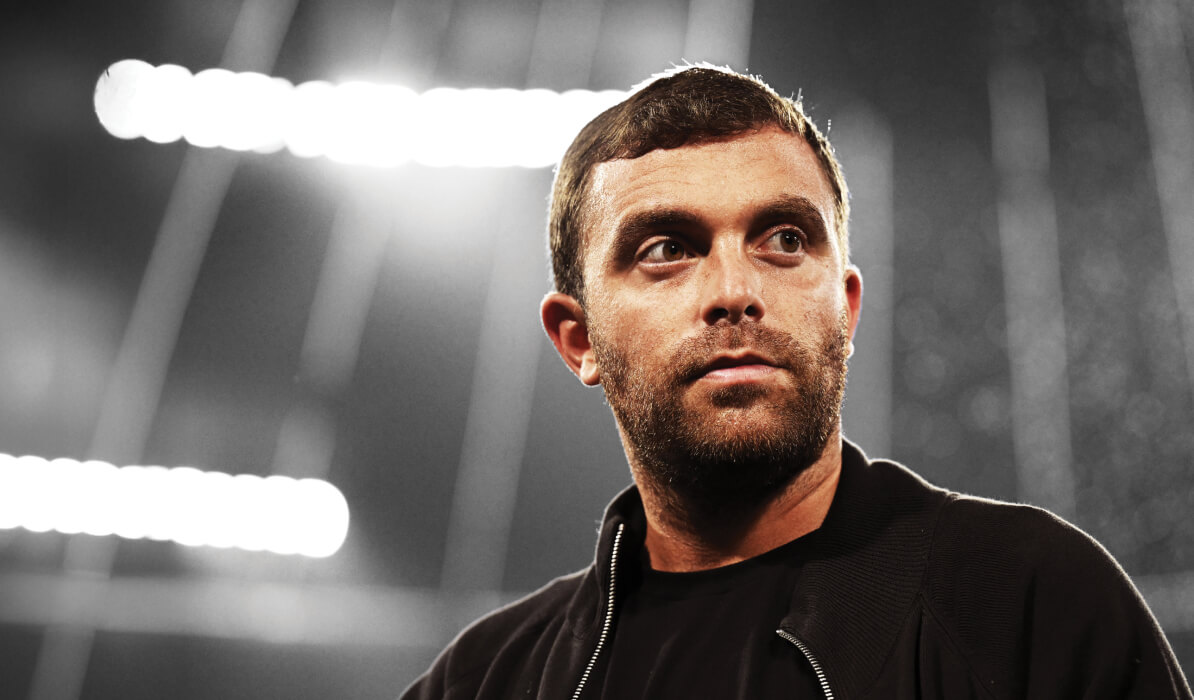
In late August, when most social media timelines were filled with sunsets, monuments or mouthwatering holiday meals, one post bucked the summer trend: a photo of a smartly dressed Italian chap caught mid-sentence on a television screen. “Is anyone else’s boyfriend obsessed with this man?” read the caption. “I have to listen to his football updates EVERYDAY.” The face which inspired this light-hearted cry for help belonged to Fabrizio Romano, the social media sensation whose transfer bulletins are catnip to supporters all around the globe... But let’s be honest, if you are reading Champions Journal, you already know who he is.
Naples-born Romano has emerged as the authority on transfer news, boasting 41 million followers on Instagram, 26.5 million on X (formerly known as Twitter) and 2.92 million subscribers to his YouTube channel. Champions Journal is chatting to Romano via phone in Sardinia, where he is semi-relaxing after the closure of the summer transfer window. The 32-year-old’s explanation of his lofty status is straightforward: “I’ve had the fortune of traversing two different worlds: the first was traditional journalism, when I went to work for Sky Sport Italia as an 18-year-old, until I was about 25. And I’m from the generation that’s grown up with social media. People look at me now as this figure with tons of followers and hits, but there’s more to it than that. The journalistic basics are vital.”
Romano learned the old-school values of journalism in his early 20s. “I would spend all summer on the right streets in Milan looking for information, speaking to people. No holidays, but three months in the summer in and around the city. Likewise in January during the transfer window. On the street, outside hotels and restaurants, in the freezing cold, seeking tip-offs, talking to directors, to agents, getting to know all the right people. I created my network.
“Then I began to add social media and its possibilities, which allow you to speak to people in other countries. Obviously, the traditional method of walking the beat is impossible if you’re not actually in the city, but social media means you can still speak to people and get information quickly. What I was doing online worked well in Italy, so I asked myself, ‘Why can’t my methods function in other countries too?’ and I combined the old values with the social media-based journalism of today. And that means I can do my work anywhere. I can go to London for a match, or Madrid, and continue working.”
Aside from his native Italian, he knows English, Spanish and is developing his Portuguese. The question that his army of admirers and rivals asks is: where does he get his scoops? “The majority of my information comes from social media, from a variety of people. Above all, Instagram, which can put you in direct contact with players, presidents, chairmen and agents. Sometimes, I can receive an informal communication from a club director. But you can also get messages from friends of players or people who work at a club but aren’t necessarily directors.”
From there, his transfer titbits go out into the world, but how does it feel to confirm the dreams or worst fears of millions of people? “It’s really satisfying when I publish a piece of news and the fans react positively. I love their emotions. But there can also be different emotions if a much-loved player is leaving. I view it as something parallel to a match. During games, you have ups and downs, and the transfer market can also give you highs and lows. Many people live the transfer with the same excitement and anxiety as they do a match.”


Revealing Argentinian striker Mauro Icardi’s switch from Barcelona to Sampdoria in 2011 put Romano on the map, though there are other moves he is particularly attached to. “I’ll never forget the night I announced that head coach Julian Nagelsmann was to be axed by Bayern and replaced by Thomas Tuchel. It was 23 March 2023, during the international break. Bayern weren’t doing that badly under Nagelsmann. When my source told me the news, I thought it was very odd. I reported it but knew it was a risk because the story seemed so unlikely. There was no indication that the board wanted to change the manager. If my source had been wrong, it would’ve been very bad for my reputation. But I made some calls at around midnight, and it was true. The next day, Germany and Bayern legend Lothar Matthäus said he was impressed an Italian journalist broke this story before the German press. That meant a lot to me.”
The intrigue and excitement surrounding the transfer market goes back a long way, and Romano remembers his own introduction to the buzz. “When I was a child, my dad followed the transfers very closely. Every day, he read La Gazzetta dello Sport intently, and that interest was passed down to me.”
That era, long before the rise of social media, still holds a special place in his heart. “I remember Adriano Galliani’s time as CEO at AC Milan, particularly the 2000s, when they made big signings and every transfer felt like a new Hollywood film. I was a schoolboy but recall the arrivals of players like Kaká or Zlatan Ibrahimović. We always heard rumours of secret meetings between club directors and it fascinated me. I wanted to get involved in this world.”
The younger generation might not know that, between 1975 and 2000, Italian clubs were almost exclusively responsible for breaking the world record for transfer fees (including Diego Maradona to Napoli from Barcelona, Roberto Baggio to Juventus from Fiorentina and Jean-Pierre Papin leaving Marseille for Milan). It all feels a long time ago. “It’s a shame that Serie A clubs are no longer involved in blockbusting transfers very often,” laments Romano.
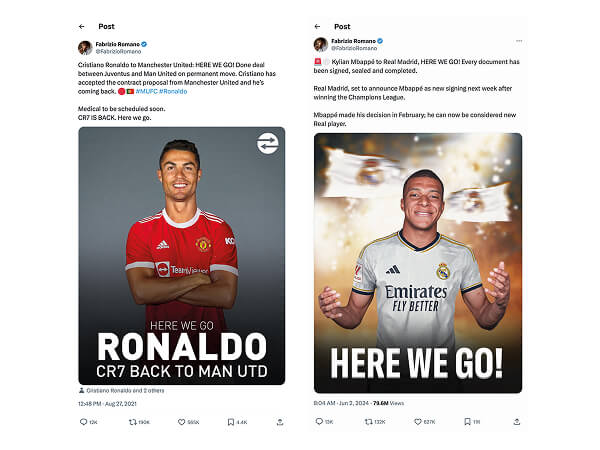
It’s rare for a journalist to have a catchphrase, but Romano has turned “Here we go!” into a brand identity. What was once a stadium terrace staple in 1980s Britain has become his go-to slogan whenever a transfer is announced. “It was not a conscious choice. About ten years ago, after a negotiation had ended for a transfer, I don’t even remember which one, I wrote ‘Here we go!’ to underline the fact that the move was finally completed after days of updates. And, almost immediately, people wrote to me asking me to give them a ‘Here we go!’ for their club’s transfers. They wanted a seal of authenticity that a transfer had been finalised. For me, it became that phrase. But it was purely coincidental, not a plan.”

If that merging of reporting and entertainment has helped Romano raise his profile, the advice he offers to those eager to emulate his success is more nuts and bolts. “The first thing is to speak several languages, but speak them well. If you can communicate with people in their own language, it’s a sign of respect. And I’ve noticed that people are more open to you and their attitude changes when you speak to them in their own language with competence.”
The second key is originality. “Find something that no one else is doing. Don’t copy or provide a service somebody else already covers. Now there are so many platforms and social networks. This gives you the chance to express yourself in a different way. When I started, it was just Facebook. The old-style journalism is still very important and should be studied, but this new world is very helpful. Be aware, though, that you’ll never make it to the top of the mountain copying someone else. The only way is to do something new or different.”
Be aware, too, that celebrity comes with scrutiny, especially in the murky transfer world. Romano has faced plenty himself, though he insists his methods are clean. “It annoys me when people say I take payment from agents to report news which is favourable for one of their players. I’ve never been paid for anything by an agent. If I did that even once, everyone would know after five seconds. The football world is small. And I’ve never asked for a euro from any of my followers. You know, I could create an app and ask for a small fee from my followers and do very well. But I would never ask for anything from them.” Instead, he says, working with big brands on advertising campaigns enables him to continue his business model without charging fans.
The other major downside is the relentlessness of the rumour mill. Imitators take note: Romano is a workaholic. “I never know the date. I know if it is Monday, Tuesday, etc. – but the date, no. It could be Christmas Day, my birthday or Easter, and I am working, on my phone. I made a decision to never stop. There’s a lot of pressure and you never want to get something wrong.”
So, how long does he intend to keep going? “I want to keep up my position but change the way I do it. I’ve been working very intensely for many years, providing quality information, a really high quantity, with lots of news and details. But now I’m thinking of a slight reduction. Not in the quality, obviously, but in quantity. Still covering the stories that everyone wants to know about, but also a few more interviews with the people who make the difference in football and people I work with, like players and managers. A few more stories about football in general. The transfer stuff will be a bit more filtered, selective.”
While Romano is never far from his mobile, to get away from football he listens to music, including Italian artist Paolo Conte and Brazilian samba. There is a life outside the transfer market, and he would like to expand it. But fear not, he will still be reporting the news for years to come. And it might not be long before your favourite team receives a “Here we go!”
In late August, when most social media timelines were filled with sunsets, monuments or mouthwatering holiday meals, one post bucked the summer trend: a photo of a smartly dressed Italian chap caught mid-sentence on a television screen. “Is anyone else’s boyfriend obsessed with this man?” read the caption. “I have to listen to his football updates EVERYDAY.” The face which inspired this light-hearted cry for help belonged to Fabrizio Romano, the social media sensation whose transfer bulletins are catnip to supporters all around the globe... But let’s be honest, if you are reading Champions Journal, you already know who he is.
Naples-born Romano has emerged as the authority on transfer news, boasting 41 million followers on Instagram, 26.5 million on X (formerly known as Twitter) and 2.92 million subscribers to his YouTube channel. Champions Journal is chatting to Romano via phone in Sardinia, where he is semi-relaxing after the closure of the summer transfer window. The 32-year-old’s explanation of his lofty status is straightforward: “I’ve had the fortune of traversing two different worlds: the first was traditional journalism, when I went to work for Sky Sport Italia as an 18-year-old, until I was about 25. And I’m from the generation that’s grown up with social media. People look at me now as this figure with tons of followers and hits, but there’s more to it than that. The journalistic basics are vital.”
Romano learned the old-school values of journalism in his early 20s. “I would spend all summer on the right streets in Milan looking for information, speaking to people. No holidays, but three months in the summer in and around the city. Likewise in January during the transfer window. On the street, outside hotels and restaurants, in the freezing cold, seeking tip-offs, talking to directors, to agents, getting to know all the right people. I created my network.
“Then I began to add social media and its possibilities, which allow you to speak to people in other countries. Obviously, the traditional method of walking the beat is impossible if you’re not actually in the city, but social media means you can still speak to people and get information quickly. What I was doing online worked well in Italy, so I asked myself, ‘Why can’t my methods function in other countries too?’ and I combined the old values with the social media-based journalism of today. And that means I can do my work anywhere. I can go to London for a match, or Madrid, and continue working.”
Aside from his native Italian, he knows English, Spanish and is developing his Portuguese. The question that his army of admirers and rivals asks is: where does he get his scoops? “The majority of my information comes from social media, from a variety of people. Above all, Instagram, which can put you in direct contact with players, presidents, chairmen and agents. Sometimes, I can receive an informal communication from a club director. But you can also get messages from friends of players or people who work at a club but aren’t necessarily directors.”
From there, his transfer titbits go out into the world, but how does it feel to confirm the dreams or worst fears of millions of people? “It’s really satisfying when I publish a piece of news and the fans react positively. I love their emotions. But there can also be different emotions if a much-loved player is leaving. I view it as something parallel to a match. During games, you have ups and downs, and the transfer market can also give you highs and lows. Many people live the transfer with the same excitement and anxiety as they do a match.”


Revealing Argentinian striker Mauro Icardi’s switch from Barcelona to Sampdoria in 2011 put Romano on the map, though there are other moves he is particularly attached to. “I’ll never forget the night I announced that head coach Julian Nagelsmann was to be axed by Bayern and replaced by Thomas Tuchel. It was 23 March 2023, during the international break. Bayern weren’t doing that badly under Nagelsmann. When my source told me the news, I thought it was very odd. I reported it but knew it was a risk because the story seemed so unlikely. There was no indication that the board wanted to change the manager. If my source had been wrong, it would’ve been very bad for my reputation. But I made some calls at around midnight, and it was true. The next day, Germany and Bayern legend Lothar Matthäus said he was impressed an Italian journalist broke this story before the German press. That meant a lot to me.”
The intrigue and excitement surrounding the transfer market goes back a long way, and Romano remembers his own introduction to the buzz. “When I was a child, my dad followed the transfers very closely. Every day, he read La Gazzetta dello Sport intently, and that interest was passed down to me.”
That era, long before the rise of social media, still holds a special place in his heart. “I remember Adriano Galliani’s time as CEO at AC Milan, particularly the 2000s, when they made big signings and every transfer felt like a new Hollywood film. I was a schoolboy but recall the arrivals of players like Kaká or Zlatan Ibrahimović. We always heard rumours of secret meetings between club directors and it fascinated me. I wanted to get involved in this world.”
The younger generation might not know that, between 1975 and 2000, Italian clubs were almost exclusively responsible for breaking the world record for transfer fees (including Diego Maradona to Napoli from Barcelona, Roberto Baggio to Juventus from Fiorentina and Jean-Pierre Papin leaving Marseille for Milan). It all feels a long time ago. “It’s a shame that Serie A clubs are no longer involved in blockbusting transfers very often,” laments Romano.
It’s rare for a journalist to have a catchphrase, but Romano has turned “Here we go!” into a brand identity. What was once a stadium terrace staple in 1980s Britain has become his go-to slogan whenever a transfer is announced. “It was not a conscious choice. About ten years ago, after a negotiation had ended for a transfer, I don’t even remember which one, I wrote ‘Here we go!’ to underline the fact that the move was finally completed after days of updates. And, almost immediately, people wrote to me asking me to give them a ‘Here we go!’ for their club’s transfers. They wanted a seal of authenticity that a transfer had been finalised. For me, it became that phrase. But it was purely coincidental, not a plan.”
If that merging of reporting and entertainment has helped Romano raise his profile, the advice he offers to those eager to emulate his success is more nuts and bolts. “The first thing is to speak several languages, but speak them well. If you can communicate with people in their own language, it’s a sign of respect. And I’ve noticed that people are more open to you and their attitude changes when you speak to them in their own language with competence.”
The second key is originality. “Find something that no one else is doing. Don’t copy or provide a service somebody else already covers. Now there are so many platforms and social networks. This gives you the chance to express yourself in a different way. When I started, it was just Facebook. The old-style journalism is still very important and should be studied, but this new world is very helpful. Be aware, though, that you’ll never make it to the top of the mountain copying someone else. The only way is to do something new or different.”
Be aware, too, that celebrity comes with scrutiny, especially in the murky transfer world. Romano has faced plenty himself, though he insists his methods are clean. “It annoys me when people say I take payment from agents to report news which is favourable for one of their players. I’ve never been paid for anything by an agent. If I did that even once, everyone would know after five seconds. The football world is small. And I’ve never asked for a euro from any of my followers. You know, I could create an app and ask for a small fee from my followers and do very well. But I would never ask for anything from them.” Instead, he says, working with big brands on advertising campaigns enables him to continue his business model without charging fans.
The other major downside is the relentlessness of the rumour mill. Imitators take note: Romano is a workaholic. “I never know the date. I know if it is Monday, Tuesday, etc. – but the date, no. It could be Christmas Day, my birthday or Easter, and I am working, on my phone. I made a decision to never stop. There’s a lot of pressure and you never want to get something wrong.”
So, how long does he intend to keep going? “I want to keep up my position but change the way I do it. I’ve been working very intensely for many years, providing quality information, a really high quantity, with lots of news and details. But now I’m thinking of a slight reduction. Not in the quality, obviously, but in quantity. Still covering the stories that everyone wants to know about, but also a few more interviews with the people who make the difference in football and people I work with, like players and managers. A few more stories about football in general. The transfer stuff will be a bit more filtered, selective.”
While Romano is never far from his mobile, to get away from football he listens to music, including Italian artist Paolo Conte and Brazilian samba. There is a life outside the transfer market, and he would like to expand it. But fear not, he will still be reporting the news for years to come. And it might not be long before your favourite team receives a “Here we go!”
In late August, when most social media timelines were filled with sunsets, monuments or mouthwatering holiday meals, one post bucked the summer trend: a photo of a smartly dressed Italian chap caught mid-sentence on a television screen. “Is anyone else’s boyfriend obsessed with this man?” read the caption. “I have to listen to his football updates EVERYDAY.” The face which inspired this light-hearted cry for help belonged to Fabrizio Romano, the social media sensation whose transfer bulletins are catnip to supporters all around the globe... But let’s be honest, if you are reading Champions Journal, you already know who he is.
Naples-born Romano has emerged as the authority on transfer news, boasting 41 million followers on Instagram, 26.5 million on X (formerly known as Twitter) and 2.92 million subscribers to his YouTube channel. Champions Journal is chatting to Romano via phone in Sardinia, where he is semi-relaxing after the closure of the summer transfer window. The 32-year-old’s explanation of his lofty status is straightforward: “I’ve had the fortune of traversing two different worlds: the first was traditional journalism, when I went to work for Sky Sport Italia as an 18-year-old, until I was about 25. And I’m from the generation that’s grown up with social media. People look at me now as this figure with tons of followers and hits, but there’s more to it than that. The journalistic basics are vital.”
Romano learned the old-school values of journalism in his early 20s. “I would spend all summer on the right streets in Milan looking for information, speaking to people. No holidays, but three months in the summer in and around the city. Likewise in January during the transfer window. On the street, outside hotels and restaurants, in the freezing cold, seeking tip-offs, talking to directors, to agents, getting to know all the right people. I created my network.
“Then I began to add social media and its possibilities, which allow you to speak to people in other countries. Obviously, the traditional method of walking the beat is impossible if you’re not actually in the city, but social media means you can still speak to people and get information quickly. What I was doing online worked well in Italy, so I asked myself, ‘Why can’t my methods function in other countries too?’ and I combined the old values with the social media-based journalism of today. And that means I can do my work anywhere. I can go to London for a match, or Madrid, and continue working.”
Aside from his native Italian, he knows English, Spanish and is developing his Portuguese. The question that his army of admirers and rivals asks is: where does he get his scoops? “The majority of my information comes from social media, from a variety of people. Above all, Instagram, which can put you in direct contact with players, presidents, chairmen and agents. Sometimes, I can receive an informal communication from a club director. But you can also get messages from friends of players or people who work at a club but aren’t necessarily directors.”
From there, his transfer titbits go out into the world, but how does it feel to confirm the dreams or worst fears of millions of people? “It’s really satisfying when I publish a piece of news and the fans react positively. I love their emotions. But there can also be different emotions if a much-loved player is leaving. I view it as something parallel to a match. During games, you have ups and downs, and the transfer market can also give you highs and lows. Many people live the transfer with the same excitement and anxiety as they do a match.”
Revealing Argentinian striker Mauro Icardi’s switch from Barcelona to Sampdoria in 2011 put Romano on the map, though there are other moves he is particularly attached to. “I’ll never forget the night I announced that head coach Julian Nagelsmann was to be axed by Bayern and replaced by Thomas Tuchel. It was 23 March 2023, during the international break. Bayern weren’t doing that badly under Nagelsmann. When my source told me the news, I thought it was very odd. I reported it but knew it was a risk because the story seemed so unlikely. There was no indication that the board wanted to change the manager. If my source had been wrong, it would’ve been very bad for my reputation. But I made some calls at around midnight, and it was true. The next day, Germany and Bayern legend Lothar Matthäus said he was impressed an Italian journalist broke this story before the German press. That meant a lot to me.”
The intrigue and excitement surrounding the transfer market goes back a long way, and Romano remembers his own introduction to the buzz. “When I was a child, my dad followed the transfers very closely. Every day, he read La Gazzetta dello Sport intently, and that interest was passed down to me.”
That era, long before the rise of social media, still holds a special place in his heart. “I remember Adriano Galliani’s time as CEO at AC Milan, particularly the 2000s, when they made big signings and every transfer felt like a new Hollywood film. I was a schoolboy but recall the arrivals of players like Kaká or Zlatan Ibrahimović. We always heard rumours of secret meetings between club directors and it fascinated me. I wanted to get involved in this world.”
The younger generation might not know that, between 1975 and 2000, Italian clubs were almost exclusively responsible for breaking the world record for transfer fees (including Diego Maradona to Napoli from Barcelona, Roberto Baggio to Juventus from Fiorentina and Jean-Pierre Papin leaving Marseille for Milan). It all feels a long time ago. “It’s a shame that Serie A clubs are no longer involved in blockbusting transfers very often,” laments Romano.
It’s rare for a journalist to have a catchphrase, but Romano has turned “Here we go!” into a brand identity. What was once a stadium terrace staple in 1980s Britain has become his go-to slogan whenever a transfer is announced. “It was not a conscious choice. About ten years ago, after a negotiation had ended for a transfer, I don’t even remember which one, I wrote ‘Here we go!’ to underline the fact that the move was finally completed after days of updates. And, almost immediately, people wrote to me asking me to give them a ‘Here we go!’ for their club’s transfers. They wanted a seal of authenticity that a transfer had been finalised. For me, it became that phrase. But it was purely coincidental, not a plan.”
If that merging of reporting and entertainment has helped Romano raise his profile, the advice he offers to those eager to emulate his success is more nuts and bolts. “The first thing is to speak several languages, but speak them well. If you can communicate with people in their own language, it’s a sign of respect. And I’ve noticed that people are more open to you and their attitude changes when you speak to them in their own language with competence.”
The second key is originality. “Find something that no one else is doing. Don’t copy or provide a service somebody else already covers. Now there are so many platforms and social networks. This gives you the chance to express yourself in a different way. When I started, it was just Facebook. The old-style journalism is still very important and should be studied, but this new world is very helpful. Be aware, though, that you’ll never make it to the top of the mountain copying someone else. The only way is to do something new or different.”
Be aware, too, that celebrity comes with scrutiny, especially in the murky transfer world. Romano has faced plenty himself, though he insists his methods are clean. “It annoys me when people say I take payment from agents to report news which is favourable for one of their players. I’ve never been paid for anything by an agent. If I did that even once, everyone would know after five seconds. The football world is small. And I’ve never asked for a euro from any of my followers. You know, I could create an app and ask for a small fee from my followers and do very well. But I would never ask for anything from them.” Instead, he says, working with big brands on advertising campaigns enables him to continue his business model without charging fans.
The other major downside is the relentlessness of the rumour mill. Imitators take note: Romano is a workaholic. “I never know the date. I know if it is Monday, Tuesday, etc. – but the date, no. It could be Christmas Day, my birthday or Easter, and I am working, on my phone. I made a decision to never stop. There’s a lot of pressure and you never want to get something wrong.”
So, how long does he intend to keep going? “I want to keep up my position but change the way I do it. I’ve been working very intensely for many years, providing quality information, a really high quantity, with lots of news and details. But now I’m thinking of a slight reduction. Not in the quality, obviously, but in quantity. Still covering the stories that everyone wants to know about, but also a few more interviews with the people who make the difference in football and people I work with, like players and managers. A few more stories about football in general. The transfer stuff will be a bit more filtered, selective.”
While Romano is never far from his mobile, to get away from football he listens to music, including Italian artist Paolo Conte and Brazilian samba. There is a life outside the transfer market, and he would like to expand it. But fear not, he will still be reporting the news for years to come. And it might not be long before your favourite team receives a “Here we go!”