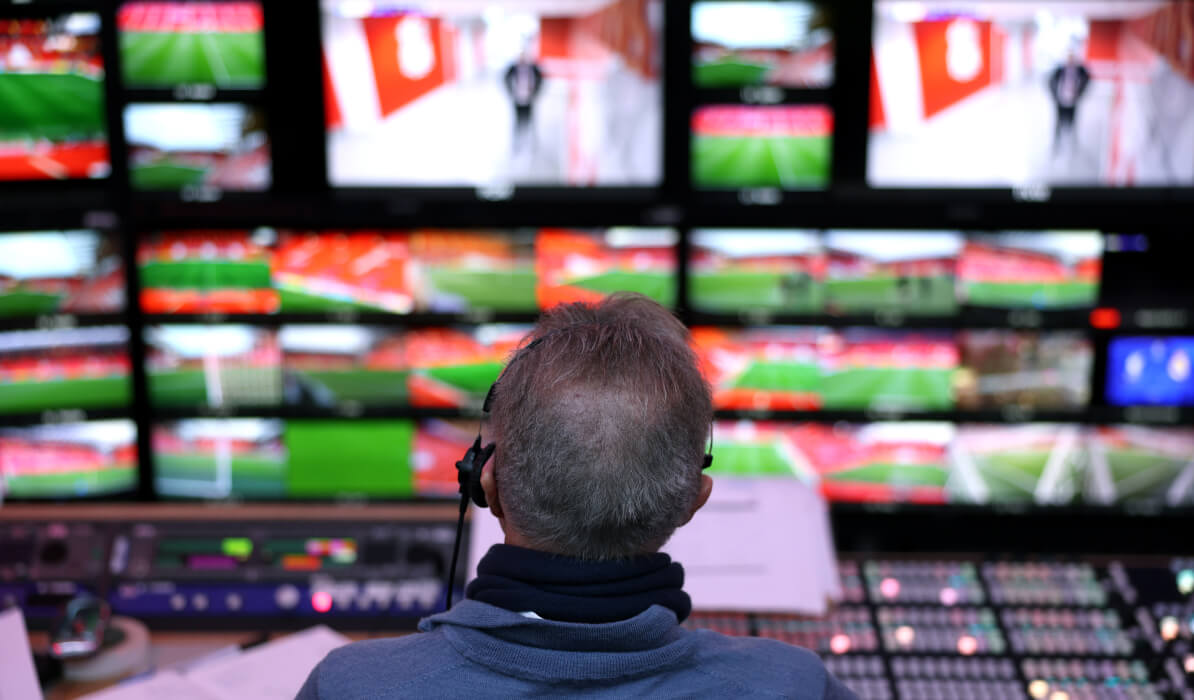
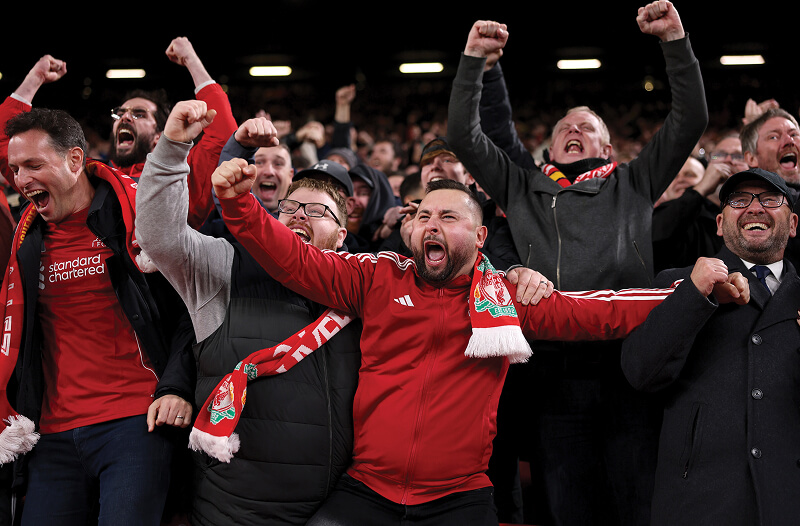
It is exactly 61 minutes into the Liverpool vs Real Madrid league phase game at Anfield, and Alexis Mac Allister has just headed in a goal for the home team. In the stands, fans are jumping all over each other with excitement. But inside a truck parked in a compound just outside the stadium, the reaction is a little different.
First, there is a quick and muted cheer – the team inside the truck are happy the game they’re working on has seen a goal. Next, a rapid-fire string of instructions begins to flow. “Stand by two, go two,” comes first. Then: “Seven, eight, OK, go three, eight, Bellingham, where’s Bellingham? Two, four… Fans on five, manager on 13… OK, roll replay A, roll B, roll C – take your time, we have plenty of time.”
Those instructions are all coming from Jamie Oakford, the director for this match, part of the outside broadcast team working in the truck. The numbers he’s firing out refer to different numbered cameras and, as he announces each figure, he (or his colleague Jordi Alfaro) presses a button. At the instant of the button press, a red light flashes atop a camera positioned somewhere inside the stadium, and the output of the designated camera goes live on the air.
Oakford is directing this game for Prime Video, which on this occasion is acting as the host broadcaster for UC3 (the joint venture between UEFA and the European Football Clubs) and UEFA, meaning that broadcasters all over the world can use its live feed for their programming. It’s also running its own separate unilateral production effort with commentators Jon Champion and Alan Shearer, plus a host of big-name pundits. This season, Prime Video has the exclusive rights to 17 Champions League games in the UK, and this fixture is a big one. Oakford is no stranger to grandstand occasions, however – he’s directed three Champions League finals, the 2020 EURO decider, and in 2014 was sat in front of his wall of screens directing the Germany-Argentina World Cup final.
“There’s 60,000 people here at the game tonight, but there’s probably ten million people sitting home watching around the world,” he tells me when we chat before the game, his casual tone a little at odds with the gravity of what he’s just said. He clearly notices my jaw drop because he quickly adds: “It’s not about pressure; I don’t feel the pressure. I do feel a responsibility to the fans at home, to make sure they enjoy the experience and see what they want to see.”
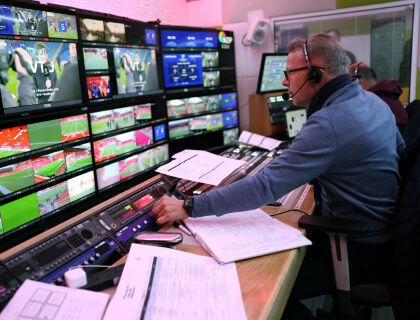
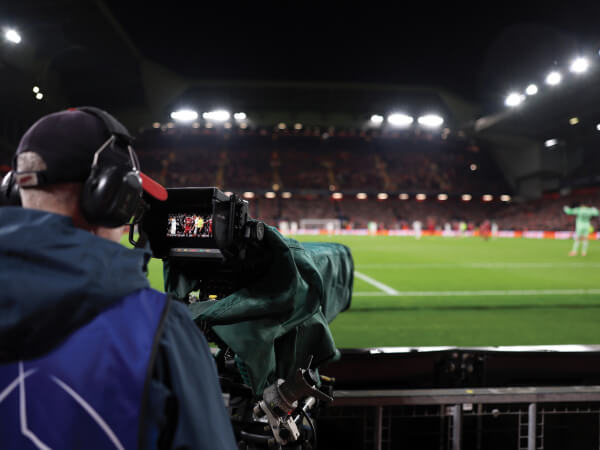
A huge amount has gone into ensuring that top-tier experience for viewers of Prime Video’s broadcast tonight, bringing them closer to the action. “We have 28 different cameras here,” Oakford says. “We have the spidercam, a drone, super slow motion cameras, steadicams, pole cameras behind the goals… There’s an expectation that we do things differently because we’ve got more cameras to use.” From my position in the truck, I can see all those cameras feeding through on to at least 57 different screens of varying sizes. As well as all the camera angles, four of those screens are dedicated to replays – they’re the work of another team next door entirely dedicated to rewinding and clipping footage to find the best shots to repeat in slow motion. In total, there are over 100 people working on tonight’s broadcast.
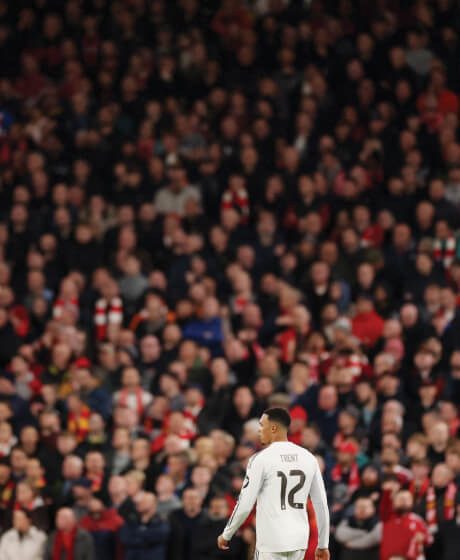
Oakford will direct the game live, but a lot of work happens beforehand to make sure everything runs smoothly. One pre-match meeting brings together all the camera operators for a rundown of the shots he’d like to show during the game. Tonight marks the return of Trent Alexander-Arnold to Anfield after his Real Madrid switch in the summer, and Oakford knows he’s a big story. “We all want to see him. He’s probably going to be on the bench so I’ve got certain cameras looking at him at certain times. If Liverpool score, for example, I want to see what his reaction might be. I don’t want to make him the story, but he’s part of the narrative of the game.”
“I’ve got cameras on Trent at certain times... he’s part of the narrative of the game”
Oakford also does this pre-game preparation with the commentators. “For example, if Jon wants something to be shown, we liaise about that before the game. He gives me suggestions and says, ‘I might need a shot of him because I have a point I want to make.’ If I don’t know that beforehand, I might never find that person – especially if it’s not a well-known face – so I’ll get a photo of them to the camera operators so they know what they look like and can find them during the game.”
He’s also heard by both commentators through their earpieces as they’re calling the game. “They commentate with me yapping away in their ear – I don’t know how they do it,” he says. “It does serve a purpose. If I say I’m going to cut to camera two, with a close-up on somebody, or if I’m going to go to a replay sequence, they then know that’s coming.”

Managing to focus amid a constant flow of activity and sound seems to be the theme of the evening. As the game kicks off, the live broadcast – with commentary from Champion and Shearer – plays over a speaker inside the truck. Around Oakford, production team members discuss their work with one another, the hum of server fans fills the air from the audio suite next door, and the evening’s heavy rain drums steadily on the roof. And that’s just what I can hear. Through his headset, Oakford can also be contacted by 28 camera operators whenever they need something. Somehow, with all this as his backdrop, he directs the game with apparent ease.
I’ve been trying to think of other comparable jobs to get across just what it’s like watching Oakford work. At first, I thought maybe a film editor, but a film editor is given hundreds of hours of footage and months to bring it all together. Then I thought of a conductor, but a conductor rehearses a piece with their orchestra until it’s perfect and everyone knows what’s coming next. The truth is, I’m not sure there is another job quite like this – the speed of the decisions Oakford has to make is astonishing, with a vast range of possible outcomes at any given moment, and no real way to anticipate what’s about to happen.
That said, there are periods of the game when Oakford is quiet, not saying much. That’s usually when the red light is on camera one, the main wide-shot camera that shows most of the pitch and the game unfolding. “When you go to watch football, you sit in your seat and you can see the whole stadium and all the players on the pitch,” Oakford explains. “In our world, there’s only one camera that can do that – the main camera. I sit on that camera as much as I can so I don’t take away from your enjoyment of the game. But when the ball’s not in play, that’s when a director directs. They give you shots of managers. They give you replays that you want to see. It’s marrying those two things together, the balance between the live and the non-live, that makes a good director.”
Despite just the one goal, tonight’s match is fast paced and frenetic, something that Oakford says has become more common over the years. “The biggest thing that’s changed in this job is having to make decisions faster. The ball is dead for a lot less time in the game than it used to be. Tonight, these are two elite teams who can move from one end of the pitch to the other in seconds. It’s not rocket science what we do, but you will make decisions very quickly and live and die by those decisions.”
Next time you sit down to watch a match, keep that in mind – every single thing you’re seeing on your TV screen is the result of an instantaneous decision from a director like Oakford. Despite that, he actually wants his efforts to go under the radar. “My job as a director is to give fans those intimate moments where they can appreciate the details of a game,” he says. “But if I’ve done my job well, people won’t notice me at all.”
It is exactly 61 minutes into the Liverpool vs Real Madrid league phase game at Anfield, and Alexis Mac Allister has just headed in a goal for the home team. In the stands, fans are jumping all over each other with excitement. But inside a truck parked in a compound just outside the stadium, the reaction is a little different.
First, there is a quick and muted cheer – the team inside the truck are happy the game they’re working on has seen a goal. Next, a rapid-fire string of instructions begins to flow. “Stand by two, go two,” comes first. Then: “Seven, eight, OK, go three, eight, Bellingham, where’s Bellingham? Two, four… Fans on five, manager on 13… OK, roll replay A, roll B, roll C – take your time, we have plenty of time.”
Those instructions are all coming from Jamie Oakford, the director for this match, part of the outside broadcast team working in the truck. The numbers he’s firing out refer to different numbered cameras and, as he announces each figure, he (or his colleague Jordi Alfaro) presses a button. At the instant of the button press, a red light flashes atop a camera positioned somewhere inside the stadium, and the output of the designated camera goes live on the air.
Oakford is directing this game for Prime Video, which on this occasion is acting as the host broadcaster for UC3 (the joint venture between UEFA and the European Football Clubs) and UEFA, meaning that broadcasters all over the world can use its live feed for their programming. It’s also running its own separate unilateral production effort with commentators Jon Champion and Alan Shearer, plus a host of big-name pundits. This season, Prime Video has the exclusive rights to 17 Champions League games in the UK, and this fixture is a big one. Oakford is no stranger to grandstand occasions, however – he’s directed three Champions League finals, the 2020 EURO decider, and in 2014 was sat in front of his wall of screens directing the Germany-Argentina World Cup final.
“There’s 60,000 people here at the game tonight, but there’s probably ten million people sitting home watching around the world,” he tells me when we chat before the game, his casual tone a little at odds with the gravity of what he’s just said. He clearly notices my jaw drop because he quickly adds: “It’s not about pressure; I don’t feel the pressure. I do feel a responsibility to the fans at home, to make sure they enjoy the experience and see what they want to see.”


A huge amount has gone into ensuring that top-tier experience for viewers of Prime Video’s broadcast tonight, bringing them closer to the action. “We have 28 different cameras here,” Oakford says. “We have the spidercam, a drone, super slow motion cameras, steadicams, pole cameras behind the goals… There’s an expectation that we do things differently because we’ve got more cameras to use.” From my position in the truck, I can see all those cameras feeding through on to at least 57 different screens of varying sizes. As well as all the camera angles, four of those screens are dedicated to replays – they’re the work of another team next door entirely dedicated to rewinding and clipping footage to find the best shots to repeat in slow motion. In total, there are over 100 people working on tonight’s broadcast.
Oakford will direct the game live, but a lot of work happens beforehand to make sure everything runs smoothly. One pre-match meeting brings together all the camera operators for a rundown of the shots he’d like to show during the game. Tonight marks the return of Trent Alexander-Arnold to Anfield after his Real Madrid switch in the summer, and Oakford knows he’s a big story. “We all want to see him. He’s probably going to be on the bench so I’ve got certain cameras looking at him at certain times. If Liverpool score, for example, I want to see what his reaction might be. I don’t want to make him the story, but he’s part of the narrative of the game.”
“I’ve got cameras on Trent at certain times... he’s part of the narrative of the game”
Oakford also does this pre-game preparation with the commentators. “For example, if Jon wants something to be shown, we liaise about that before the game. He gives me suggestions and says, ‘I might need a shot of him because I have a point I want to make.’ If I don’t know that beforehand, I might never find that person – especially if it’s not a well-known face – so I’ll get a photo of them to the camera operators so they know what they look like and can find them during the game.”
He’s also heard by both commentators through their earpieces as they’re calling the game. “They commentate with me yapping away in their ear – I don’t know how they do it,” he says. “It does serve a purpose. If I say I’m going to cut to camera two, with a close-up on somebody, or if I’m going to go to a replay sequence, they then know that’s coming.”
Managing to focus amid a constant flow of activity and sound seems to be the theme of the evening. As the game kicks off, the live broadcast – with commentary from Champion and Shearer – plays over a speaker inside the truck. Around Oakford, production team members discuss their work with one another, the hum of server fans fills the air from the audio suite next door, and the evening’s heavy rain drums steadily on the roof. And that’s just what I can hear. Through his headset, Oakford can also be contacted by 28 camera operators whenever they need something. Somehow, with all this as his backdrop, he directs the game with apparent ease.
I’ve been trying to think of other comparable jobs to get across just what it’s like watching Oakford work. At first, I thought maybe a film editor, but a film editor is given hundreds of hours of footage and months to bring it all together. Then I thought of a conductor, but a conductor rehearses a piece with their orchestra until it’s perfect and everyone knows what’s coming next. The truth is, I’m not sure there is another job quite like this – the speed of the decisions Oakford has to make is astonishing, with a vast range of possible outcomes at any given moment, and no real way to anticipate what’s about to happen.
That said, there are periods of the game when Oakford is quiet, not saying much. That’s usually when the red light is on camera one, the main wide-shot camera that shows most of the pitch and the game unfolding. “When you go to watch football, you sit in your seat and you can see the whole stadium and all the players on the pitch,” Oakford explains. “In our world, there’s only one camera that can do that – the main camera. I sit on that camera as much as I can so I don’t take away from your enjoyment of the game. But when the ball’s not in play, that’s when a director directs. They give you shots of managers. They give you replays that you want to see. It’s marrying those two things together, the balance between the live and the non-live, that makes a good director.”
Despite just the one goal, tonight’s match is fast paced and frenetic, something that Oakford says has become more common over the years. “The biggest thing that’s changed in this job is having to make decisions faster. The ball is dead for a lot less time in the game than it used to be. Tonight, these are two elite teams who can move from one end of the pitch to the other in seconds. It’s not rocket science what we do, but you will make decisions very quickly and live and die by those decisions.”
Next time you sit down to watch a match, keep that in mind – every single thing you’re seeing on your TV screen is the result of an instantaneous decision from a director like Oakford. Despite that, he actually wants his efforts to go under the radar. “My job as a director is to give fans those intimate moments where they can appreciate the details of a game,” he says. “But if I’ve done my job well, people won’t notice me at all.”
It is exactly 61 minutes into the Liverpool vs Real Madrid league phase game at Anfield, and Alexis Mac Allister has just headed in a goal for the home team. In the stands, fans are jumping all over each other with excitement. But inside a truck parked in a compound just outside the stadium, the reaction is a little different.
First, there is a quick and muted cheer – the team inside the truck are happy the game they’re working on has seen a goal. Next, a rapid-fire string of instructions begins to flow. “Stand by two, go two,” comes first. Then: “Seven, eight, OK, go three, eight, Bellingham, where’s Bellingham? Two, four… Fans on five, manager on 13… OK, roll replay A, roll B, roll C – take your time, we have plenty of time.”
Those instructions are all coming from Jamie Oakford, the director for this match, part of the outside broadcast team working in the truck. The numbers he’s firing out refer to different numbered cameras and, as he announces each figure, he (or his colleague Jordi Alfaro) presses a button. At the instant of the button press, a red light flashes atop a camera positioned somewhere inside the stadium, and the output of the designated camera goes live on the air.
Oakford is directing this game for Prime Video, which on this occasion is acting as the host broadcaster for UC3 (the joint venture between UEFA and the European Football Clubs) and UEFA, meaning that broadcasters all over the world can use its live feed for their programming. It’s also running its own separate unilateral production effort with commentators Jon Champion and Alan Shearer, plus a host of big-name pundits. This season, Prime Video has the exclusive rights to 17 Champions League games in the UK, and this fixture is a big one. Oakford is no stranger to grandstand occasions, however – he’s directed three Champions League finals, the 2020 EURO decider, and in 2014 was sat in front of his wall of screens directing the Germany-Argentina World Cup final.
“There’s 60,000 people here at the game tonight, but there’s probably ten million people sitting home watching around the world,” he tells me when we chat before the game, his casual tone a little at odds with the gravity of what he’s just said. He clearly notices my jaw drop because he quickly adds: “It’s not about pressure; I don’t feel the pressure. I do feel a responsibility to the fans at home, to make sure they enjoy the experience and see what they want to see.”
A huge amount has gone into ensuring that top-tier experience for viewers of Prime Video’s broadcast tonight, bringing them closer to the action. “We have 28 different cameras here,” Oakford says. “We have the spidercam, a drone, super slow motion cameras, steadicams, pole cameras behind the goals… There’s an expectation that we do things differently because we’ve got more cameras to use.” From my position in the truck, I can see all those cameras feeding through on to at least 57 different screens of varying sizes. As well as all the camera angles, four of those screens are dedicated to replays – they’re the work of another team next door entirely dedicated to rewinding and clipping footage to find the best shots to repeat in slow motion. In total, there are over 100 people working on tonight’s broadcast.
Oakford will direct the game live, but a lot of work happens beforehand to make sure everything runs smoothly. One pre-match meeting brings together all the camera operators for a rundown of the shots he’d like to show during the game. Tonight marks the return of Trent Alexander-Arnold to Anfield after his Real Madrid switch in the summer, and Oakford knows he’s a big story. “We all want to see him. He’s probably going to be on the bench so I’ve got certain cameras looking at him at certain times. If Liverpool score, for example, I want to see what his reaction might be. I don’t want to make him the story, but he’s part of the narrative of the game.”
“I’ve got cameras on Trent at certain times... he’s part of the narrative of the game”
Oakford also does this pre-game preparation with the commentators. “For example, if Jon wants something to be shown, we liaise about that before the game. He gives me suggestions and says, ‘I might need a shot of him because I have a point I want to make.’ If I don’t know that beforehand, I might never find that person – especially if it’s not a well-known face – so I’ll get a photo of them to the camera operators so they know what they look like and can find them during the game.”
He’s also heard by both commentators through their earpieces as they’re calling the game. “They commentate with me yapping away in their ear – I don’t know how they do it,” he says. “It does serve a purpose. If I say I’m going to cut to camera two, with a close-up on somebody, or if I’m going to go to a replay sequence, they then know that’s coming.”
Managing to focus amid a constant flow of activity and sound seems to be the theme of the evening. As the game kicks off, the live broadcast – with commentary from Champion and Shearer – plays over a speaker inside the truck. Around Oakford, production team members discuss their work with one another, the hum of server fans fills the air from the audio suite next door, and the evening’s heavy rain drums steadily on the roof. And that’s just what I can hear. Through his headset, Oakford can also be contacted by 28 camera operators whenever they need something. Somehow, with all this as his backdrop, he directs the game with apparent ease.
I’ve been trying to think of other comparable jobs to get across just what it’s like watching Oakford work. At first, I thought maybe a film editor, but a film editor is given hundreds of hours of footage and months to bring it all together. Then I thought of a conductor, but a conductor rehearses a piece with their orchestra until it’s perfect and everyone knows what’s coming next. The truth is, I’m not sure there is another job quite like this – the speed of the decisions Oakford has to make is astonishing, with a vast range of possible outcomes at any given moment, and no real way to anticipate what’s about to happen.
That said, there are periods of the game when Oakford is quiet, not saying much. That’s usually when the red light is on camera one, the main wide-shot camera that shows most of the pitch and the game unfolding. “When you go to watch football, you sit in your seat and you can see the whole stadium and all the players on the pitch,” Oakford explains. “In our world, there’s only one camera that can do that – the main camera. I sit on that camera as much as I can so I don’t take away from your enjoyment of the game. But when the ball’s not in play, that’s when a director directs. They give you shots of managers. They give you replays that you want to see. It’s marrying those two things together, the balance between the live and the non-live, that makes a good director.”
Despite just the one goal, tonight’s match is fast paced and frenetic, something that Oakford says has become more common over the years. “The biggest thing that’s changed in this job is having to make decisions faster. The ball is dead for a lot less time in the game than it used to be. Tonight, these are two elite teams who can move from one end of the pitch to the other in seconds. It’s not rocket science what we do, but you will make decisions very quickly and live and die by those decisions.”
Next time you sit down to watch a match, keep that in mind – every single thing you’re seeing on your TV screen is the result of an instantaneous decision from a director like Oakford. Despite that, he actually wants his efforts to go under the radar. “My job as a director is to give fans those intimate moments where they can appreciate the details of a game,” he says. “But if I’ve done my job well, people won’t notice me at all.”