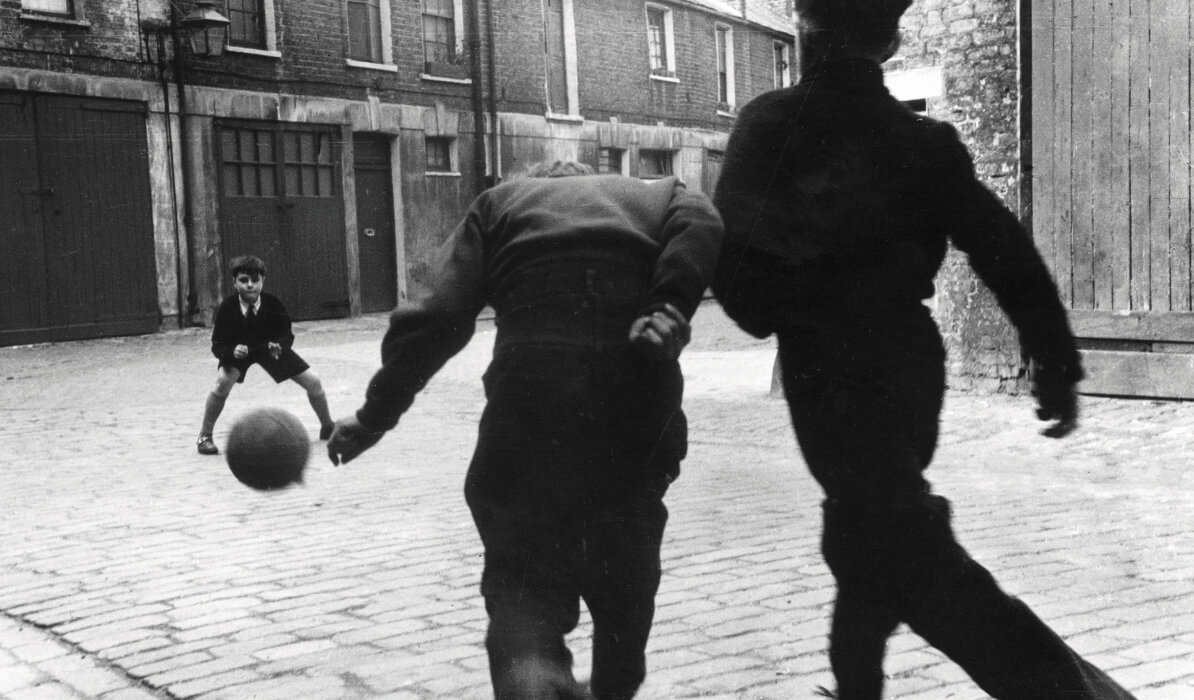
It’ll come as no surprise to anyone who witnessed Wayne Rooney’s emergence in the early 2000s that this gifted young force of nature spent his childhood honing his skills on the streets of Croxteth, Liverpool. He was out kicking a ball around after making his Everton debut in 2002. Even the day after playing his first game for England the following year, he was seen knocking a ball against a wall near his old secondary school.
The freedom and physicality of Rooney’s game, and where it all began, come to mind as I wander through the first exhibition of photographer Roger Mayne’s work focused solely on football at OOF Gallery in north London, beneath the shadow of the space-age Tottenham Hotspur Stadium.
One of Britain’s most influential and pioneering artists with a camera, Mayne hailed from Cambridge originally but was mesmerised by the vibrancy of working-class life in west London. He returned there frequently between 1956 and 1961, taking the photographs that established his reputation as a master of social documentary.
Many of them are collected in this show – stunning black-and-white snapshots of life in the capital’s most impoverished streets – and such is their intimacy that the same unrestrained joy and energy of a young Rooney are immediately recognisable in the eyes of the children pictured. Although born in a completely different era, here they are proving themselves on the very same testing ground. What Mayne produced is a time capsule paying tribute to an almost extinct way of life.
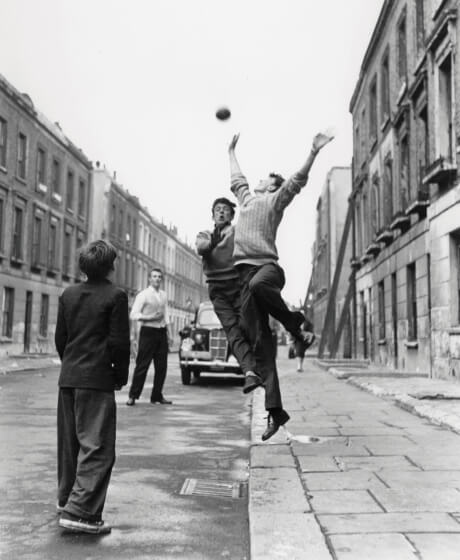
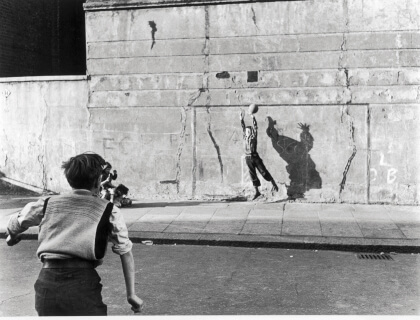
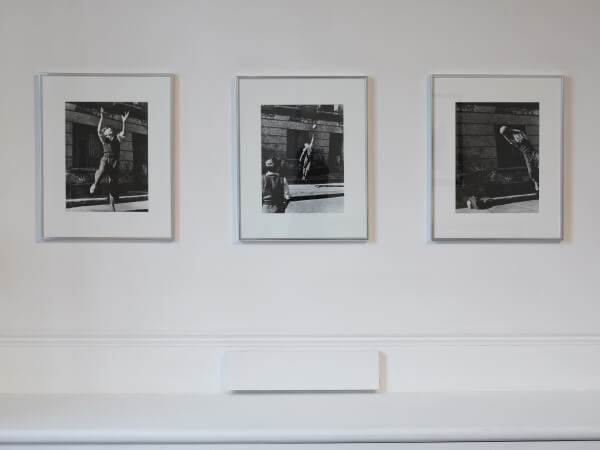
A humanist with a knack for capturing depth and detail, Mayne offers a rare insight into what football meant to the children growing up on three specific streets in the 1950s: Southam Street, Brindley Road and Addison Place, among the most deprived in west London. In 1923, there were some 2,400 people living in the 140 nine-room houses on Southam Street. In fact, most of the road was demolished to make way for Trellick Tower in the 1960s, having been deemed unfit for residence – not that you’d know it from the exuberance on display in these photos.
As a millennial, I grew up surrounded by ‘No ball games’ signs, so my pitches – like many modern professional players from inner-cities – were football cages and the odd basketball court. The thought of vying for possession with today’s gridlocked traffic is inconceivable. Yet there is no sense in these young faces that playing outside on pavements and tarmac is in the least bit inconvenient. All that matters is the ball at their feet, the cast-aside jumpers that even those of us born half a century later recognise, and the look of obsession in each pair of eyes. Indeed, what is perhaps most striking about this exhibition is that you really are too captivated by these young street ballers to notice any signs of destitution.
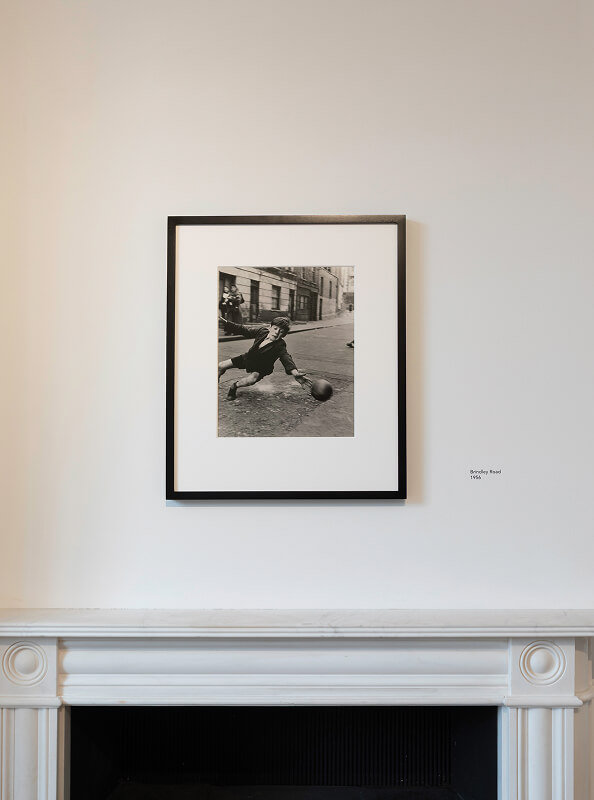
In The Goalie, a boy throws himself at both a ball and the hard concrete surface that forms his penalty area, while Street Football shows two teenagers competing in the air – elbows akimbo, highlighting the ruthless physicality we all played the game with as kids.
Then there are shots like Footballer Jumping, showing a young man hurling himself backwards at full stretch to tip the ball over a crossbar that was never there, oblivious to the brick wall rushing to meet him.

But a personal favourite is Footballer and Shadow, one of the first images you see when you step from the Tottenham Hotspur megastore into a completely different world, transported by Mayne and his lens. In the photo, a young boy unleashes what you imagine to be a thunderous effort goalward, Mayne snapping that exact moment when his head rises in anticipation, desperate to see whether he’s been stymied by the goalkeeper – and his spectacular shadow – or scored a goal that will leave him smiling for the rest of the evening. So perfect is the timing that we will never know whether his strike clatters off the crossbar or bursts into the roof of the net. That is for our imaginations to decide.
Once you’ve meandered your way through this trip down Mayne’s memory lane, you start to realise what it is that’s been making you smile to yourself throughout. It’s not the tongues poking out, the childish attitude of indestructibility or even the recognisable scrapes and bruises on each player’s knees.
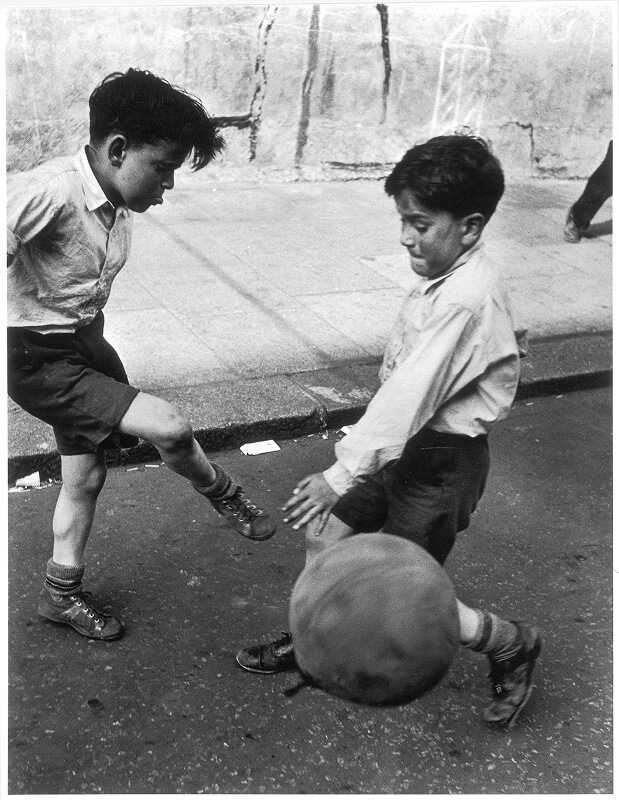
It’s your own recollections of what it felt like to play with complete disregard for anything else, and those epic kickabouts from decades ago that still live long in the memory – even when weekend plans, shopping lists and relatives’ birthdays somehow slip through the net.
Here at OOF Gallery, Mayne and his iconic photography remind us of one thing, paramount to our formative relationship with the game. Football is, and always has been, just that – a game, defined by those moments of unfiltered glee and ecstasy.
It’ll come as no surprise to anyone who witnessed Wayne Rooney’s emergence in the early 2000s that this gifted young force of nature spent his childhood honing his skills on the streets of Croxteth, Liverpool. He was out kicking a ball around after making his Everton debut in 2002. Even the day after playing his first game for England the following year, he was seen knocking a ball against a wall near his old secondary school.
The freedom and physicality of Rooney’s game, and where it all began, come to mind as I wander through the first exhibition of photographer Roger Mayne’s work focused solely on football at OOF Gallery in north London, beneath the shadow of the space-age Tottenham Hotspur Stadium.
One of Britain’s most influential and pioneering artists with a camera, Mayne hailed from Cambridge originally but was mesmerised by the vibrancy of working-class life in west London. He returned there frequently between 1956 and 1961, taking the photographs that established his reputation as a master of social documentary.
Many of them are collected in this show – stunning black-and-white snapshots of life in the capital’s most impoverished streets – and such is their intimacy that the same unrestrained joy and energy of a young Rooney are immediately recognisable in the eyes of the children pictured. Although born in a completely different era, here they are proving themselves on the very same testing ground. What Mayne produced is a time capsule paying tribute to an almost extinct way of life.


A humanist with a knack for capturing depth and detail, Mayne offers a rare insight into what football meant to the children growing up on three specific streets in the 1950s: Southam Street, Brindley Road and Addison Place, among the most deprived in west London. In 1923, there were some 2,400 people living in the 140 nine-room houses on Southam Street. In fact, most of the road was demolished to make way for Trellick Tower in the 1960s, having been deemed unfit for residence – not that you’d know it from the exuberance on display in these photos.
As a millennial, I grew up surrounded by ‘No ball games’ signs, so my pitches – like many modern professional players from inner-cities – were football cages and the odd basketball court. The thought of vying for possession with today’s gridlocked traffic is inconceivable. Yet there is no sense in these young faces that playing outside on pavements and tarmac is in the least bit inconvenient. All that matters is the ball at their feet, the cast-aside jumpers that even those of us born half a century later recognise, and the look of obsession in each pair of eyes. Indeed, what is perhaps most striking about this exhibition is that you really are too captivated by these young street ballers to notice any signs of destitution.
In The Goalie, a boy throws himself at both a ball and the hard concrete surface that forms his penalty area, while Street Football shows two teenagers competing in the air – elbows akimbo, highlighting the ruthless physicality we all played the game with as kids.
Then there are shots like Footballer Jumping, showing a young man hurling himself backwards at full stretch to tip the ball over a crossbar that was never there, oblivious to the brick wall rushing to meet him.
But a personal favourite is Footballer and Shadow, one of the first images you see when you step from the Tottenham Hotspur megastore into a completely different world, transported by Mayne and his lens. In the photo, a young boy unleashes what you imagine to be a thunderous effort goalward, Mayne snapping that exact moment when his head rises in anticipation, desperate to see whether he’s been stymied by the goalkeeper – and his spectacular shadow – or scored a goal that will leave him smiling for the rest of the evening. So perfect is the timing that we will never know whether his strike clatters off the crossbar or bursts into the roof of the net. That is for our imaginations to decide.
Once you’ve meandered your way through this trip down Mayne’s memory lane, you start to realise what it is that’s been making you smile to yourself throughout. It’s not the tongues poking out, the childish attitude of indestructibility or even the recognisable scrapes and bruises on each player’s knees.
It’s your own recollections of what it felt like to play with complete disregard for anything else, and those epic kickabouts from decades ago that still live long in the memory – even when weekend plans, shopping lists and relatives’ birthdays somehow slip through the net.
Here at OOF Gallery, Mayne and his iconic photography remind us of one thing, paramount to our formative relationship with the game. Football is, and always has been, just that – a game, defined by those moments of unfiltered glee and ecstasy.
It’ll come as no surprise to anyone who witnessed Wayne Rooney’s emergence in the early 2000s that this gifted young force of nature spent his childhood honing his skills on the streets of Croxteth, Liverpool. He was out kicking a ball around after making his Everton debut in 2002. Even the day after playing his first game for England the following year, he was seen knocking a ball against a wall near his old secondary school.
The freedom and physicality of Rooney’s game, and where it all began, come to mind as I wander through the first exhibition of photographer Roger Mayne’s work focused solely on football at OOF Gallery in north London, beneath the shadow of the space-age Tottenham Hotspur Stadium.
One of Britain’s most influential and pioneering artists with a camera, Mayne hailed from Cambridge originally but was mesmerised by the vibrancy of working-class life in west London. He returned there frequently between 1956 and 1961, taking the photographs that established his reputation as a master of social documentary.
Many of them are collected in this show – stunning black-and-white snapshots of life in the capital’s most impoverished streets – and such is their intimacy that the same unrestrained joy and energy of a young Rooney are immediately recognisable in the eyes of the children pictured. Although born in a completely different era, here they are proving themselves on the very same testing ground. What Mayne produced is a time capsule paying tribute to an almost extinct way of life.
A humanist with a knack for capturing depth and detail, Mayne offers a rare insight into what football meant to the children growing up on three specific streets in the 1950s: Southam Street, Brindley Road and Addison Place, among the most deprived in west London. In 1923, there were some 2,400 people living in the 140 nine-room houses on Southam Street. In fact, most of the road was demolished to make way for Trellick Tower in the 1960s, having been deemed unfit for residence – not that you’d know it from the exuberance on display in these photos.
As a millennial, I grew up surrounded by ‘No ball games’ signs, so my pitches – like many modern professional players from inner-cities – were football cages and the odd basketball court. The thought of vying for possession with today’s gridlocked traffic is inconceivable. Yet there is no sense in these young faces that playing outside on pavements and tarmac is in the least bit inconvenient. All that matters is the ball at their feet, the cast-aside jumpers that even those of us born half a century later recognise, and the look of obsession in each pair of eyes. Indeed, what is perhaps most striking about this exhibition is that you really are too captivated by these young street ballers to notice any signs of destitution.
In The Goalie, a boy throws himself at both a ball and the hard concrete surface that forms his penalty area, while Street Football shows two teenagers competing in the air – elbows akimbo, highlighting the ruthless physicality we all played the game with as kids.
Then there are shots like Footballer Jumping, showing a young man hurling himself backwards at full stretch to tip the ball over a crossbar that was never there, oblivious to the brick wall rushing to meet him.
But a personal favourite is Footballer and Shadow, one of the first images you see when you step from the Tottenham Hotspur megastore into a completely different world, transported by Mayne and his lens. In the photo, a young boy unleashes what you imagine to be a thunderous effort goalward, Mayne snapping that exact moment when his head rises in anticipation, desperate to see whether he’s been stymied by the goalkeeper – and his spectacular shadow – or scored a goal that will leave him smiling for the rest of the evening. So perfect is the timing that we will never know whether his strike clatters off the crossbar or bursts into the roof of the net. That is for our imaginations to decide.
Once you’ve meandered your way through this trip down Mayne’s memory lane, you start to realise what it is that’s been making you smile to yourself throughout. It’s not the tongues poking out, the childish attitude of indestructibility or even the recognisable scrapes and bruises on each player’s knees.
It’s your own recollections of what it felt like to play with complete disregard for anything else, and those epic kickabouts from decades ago that still live long in the memory – even when weekend plans, shopping lists and relatives’ birthdays somehow slip through the net.
Here at OOF Gallery, Mayne and his iconic photography remind us of one thing, paramount to our formative relationship with the game. Football is, and always has been, just that – a game, defined by those moments of unfiltered glee and ecstasy.











.webp)

