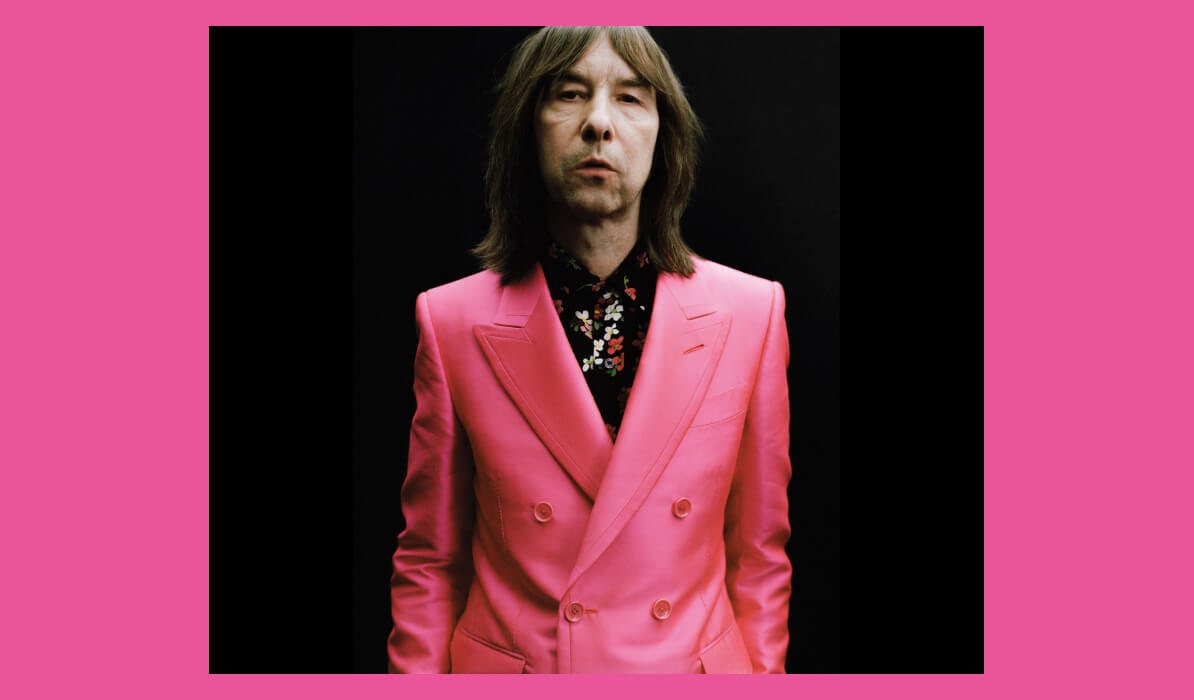
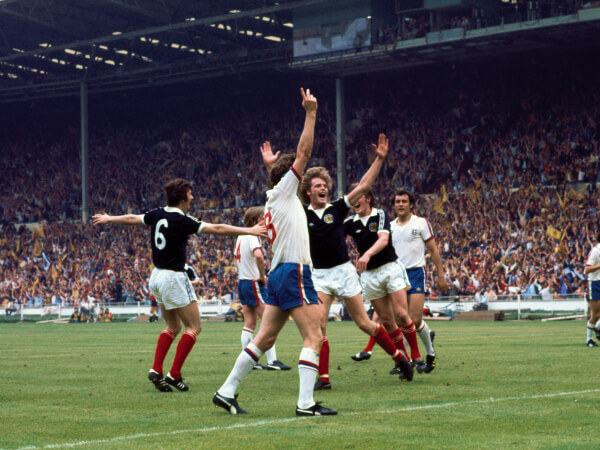
We’re half an hour into our chat when Bobby Gillespie breaks into a joyous, improvised chorus of Hey Jude. “Na na na, na na na na, Scotland!” booms the Primal Scream frontman as he vividly recalls travelling to Wembley in 1977 for the Tartan Army’s famous 2-1 win against England, a victory sealed by strikes from Gordon McQueen and Kenny Dalglish.
“I’d have been 15 and we’d driven down with some older guys. There were 80,000 Scots singing and echoing around the stadium.” He’s filled with the same starry-eyed wonder as he remembers meeting McQueen later in life. “It turns out he’s a massive Primal Scream fan. I met him and got a photo with my son when we opened for the Stone Roses for their very last gig at Hampden Park and he was just amazing.”
The mainstage veterans are back in the saddle this autumn, touring their 2000 album XTRMNTR, and Gillespie is in high spirits as he looks forward to getting back on the road. “It’s just great to be out playing again,” he tells Champions Journal from his north London flat while, outside, the unrelenting summer heatwave wears on. “We’ve changed the band line-up and we’re a lean, high-energy rock ’n’ roll outfit now. It’s really fresh and very exciting.”
Sadly, though, they will be without the late Gary ‘Mani’ Mounfield, who played bass on that seminal album and passed away in November. “Mani was an amazing musician and character; he was so positive,” Gillespie recalls. “If Mani was into something, I always felt we were on the right track. He was a real punk rocker as well. He had good standards of music, politics and taste.”
Given the album’s politically charged themes, dispatched on the likes of the trippy Kill All Hippies or the strobing anti-fascist rave anthem Swastika Eyes, Gillespie feels it’s the right time to share this material with new generations.
“It’s been 26 years since we released it and I think it was a very prescient record in terms of the subjects that we were writing about, like militarism, imperialism, warmongering, mass surveillance, attacks on civil rights and on freedoms. You could say it was a dystopian, paranoid view of the world, but a lot of the things we were writing about have come to pass. I want people to feel inspired by the sincerity of how we play and sing these songs. I want to wake people up out of their slumber and rock ’n’ roll is a great way of doing that.

“I see us in the tradition of the Clash or the Jam, writing topical songs about society. I don’t want to say politics because that’s a bit of a depressing word, but we’re writing about the things that curtail human liberation. Everybody should be free to live a peaceful life with a good standard of living, with a nice house and some kind of democratic equality.”
Primal Scream found global fame in the 1990s with their hedonistic masterpiece Screamadelica. Now, more than four decades into their career, generation-defining classics such as Movin’ On Up, Come Together and Rocks are still finding audiences far beyond festival stages, regularly surfacing at major sporting events around the world.
“It’s amazing to see those songs used when you’re seeing Messi scoring a goal or Scotland sealing a big win. It’s an absolute blast. In the ’90s, Rangers were playing a semi-final in Europe, I think, and when they showed the goals that knocked them out, someone cleverly put Don’t Fight It, Feel It over the top, which was brilliant. Rangers fans won’t like that, but it’s all a bit of fun and they’re welcome at our gigs!”
Gillespie believes football shaped his worldview as much as music did. Growing up beside Hampden Park in Glasgow, he spent countless afternoons sneaking into Scotland internationals and cup finals before graduating to the moody terraces of Celtic’s Parkhead.
“I used to love being on the terraces,” he beams. “At Hampden, I learned how to get in for free by climbing over the back wall by the bus garage, or by asking a man to lift me over the turnstiles. I always headed towards where the singing was and I quickly found out that was where all the crazies were. I just loved the noise and the madness. When I got older and started going to Parkhead, I’d always go to the Jungle, which was the equivalent of the Kop at Anfield or the Stretford End at Old Trafford. That’s where all the singing was and that’s where I wanted to be.”
It’s not long before talk turns to Celtic’s famous European Cup win over Inter in Lisbon in 1967. “From Jock Stein onwards, Celtic had this policy of playing attractive, attacking football. I’ll never forget an interview Stein gave before the final in Lisbon. He essentially said, ‘If we can win the European Cup by playing football that’s exciting and attractive to the neutral spectator then that’s the important thing. We have to show people how beautiful this game can be.’ And that’s what the Lisbon Lions achieved.”

Five at the time, Gillespie was too young to remember first-hand the impact of that historic win, as Celtic became first British team to lift the European Cup. That success, he says, set the bar which every Celtic team since must strive to live up to. “They don’t always manage it, but you have to have a code of living. That’s the standard to which Celtic fans hold every team and every manager. To me, all of that is embodied in the actions of the Green Brigade and the Bhoys. I love them, man. Fan groups are the lifeblood of the club and they embody what I see as youthful romanticism and integrity. They take a politically righteous view of what Celtic should stand for.
“It goes back to the community origins of the club, which was Brother Walfrid creating this sports club [in 1887] to give young Catholic immigrants in the East End who were living in poverty some purpose other than joining a gang or turning to crime. He saw that young men needed a place where they could vent their youthful energy in a positive way. If you take it forward to the ’60s, you get somebody like Jock Stein who grew up like Bill Shankly or Sir Matt Busby in working-class mining communities. They grew up with trade unionism, working-class solidarity and strong values of decency, fairness and treating everybody with respect. It’s a beautiful story that our club was born in a ghetto from the charitable concerns of a priest who was helping young men try to escape poverty and crime to give them a focus for their energies, which was sport.”
Primal Scream’s links to the Green Brigade run deep, with the band sponsoring the kits for Lajee Celtic, a multi-sport club based in Aida refugee camp in Bethlehem, Palestine. Born out of a partnership with the Green Brigade, the shared vision is to develop young people through sport, culture and international connection.
Through the project, Gillespie also met one of his footballing heroes, Eric Cantona, sparking a deep friendship. “To meet him and for him to help us out was incredible. The man lives up to his myth. He wrote a song about Palestine and asked me to sing on it and of course I said yes. This guy has no fear. He’s a hero in every respect and I have nothing but admiration for him. It turned out he liked Primal Scream and he’s also a fan of the Clash.
“He was a rock ’n’ roll football player the same way Maradona and George Best were. They played football with a street attitude, which is the way I want to see football played. For me, Diego and Eric are working-class footballers from the street. They were two guys who never forgot their roots among the poor, no matter how big or famous they got. They had a really good social conscience and they were punk rockers.”
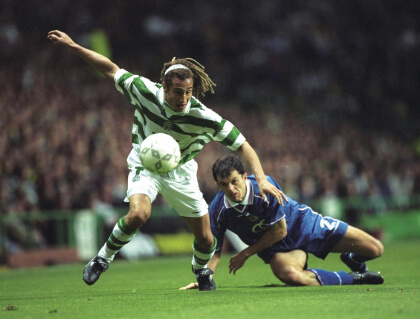
There was another star-struck moment last summer when Gillespie was asked to help launch Celtic’s away strip. “It was amazing,” he says. “I walked into the pub and Henrik Larsson was playing pool and he looked up, saw me and gave me a big smile, and I just froze in my tracks. It was such a special day and it meant the world to me as a boyhood fan.” From sneaking onto the terraces to rubbing shoulders with one of Celtic’s biggest stars, Movin’ On Up indeed.
We’re half an hour into our chat when Bobby Gillespie breaks into a joyous, improvised chorus of Hey Jude. “Na na na, na na na na, Scotland!” booms the Primal Scream frontman as he vividly recalls travelling to Wembley in 1977 for the Tartan Army’s famous 2-1 win against England, a victory sealed by strikes from Gordon McQueen and Kenny Dalglish.
“I’d have been 15 and we’d driven down with some older guys. There were 80,000 Scots singing and echoing around the stadium.” He’s filled with the same starry-eyed wonder as he remembers meeting McQueen later in life. “It turns out he’s a massive Primal Scream fan. I met him and got a photo with my son when we opened for the Stone Roses for their very last gig at Hampden Park and he was just amazing.”
The mainstage veterans are back in the saddle this autumn, touring their 2000 album XTRMNTR, and Gillespie is in high spirits as he looks forward to getting back on the road. “It’s just great to be out playing again,” he tells Champions Journal from his north London flat while, outside, the unrelenting summer heatwave wears on. “We’ve changed the band line-up and we’re a lean, high-energy rock ’n’ roll outfit now. It’s really fresh and very exciting.”
Sadly, though, they will be without the late Gary ‘Mani’ Mounfield, who played bass on that seminal album and passed away in November. “Mani was an amazing musician and character; he was so positive,” Gillespie recalls. “If Mani was into something, I always felt we were on the right track. He was a real punk rocker as well. He had good standards of music, politics and taste.”
Given the album’s politically charged themes, dispatched on the likes of the trippy Kill All Hippies or the strobing anti-fascist rave anthem Swastika Eyes, Gillespie feels it’s the right time to share this material with new generations.
“It’s been 26 years since we released it and I think it was a very prescient record in terms of the subjects that we were writing about, like militarism, imperialism, warmongering, mass surveillance, attacks on civil rights and on freedoms. You could say it was a dystopian, paranoid view of the world, but a lot of the things we were writing about have come to pass. I want people to feel inspired by the sincerity of how we play and sing these songs. I want to wake people up out of their slumber and rock ’n’ roll is a great way of doing that.


“I see us in the tradition of the Clash or the Jam, writing topical songs about society. I don’t want to say politics because that’s a bit of a depressing word, but we’re writing about the things that curtail human liberation. Everybody should be free to live a peaceful life with a good standard of living, with a nice house and some kind of democratic equality.”
Primal Scream found global fame in the 1990s with their hedonistic masterpiece Screamadelica. Now, more than four decades into their career, generation-defining classics such as Movin’ On Up, Come Together and Rocks are still finding audiences far beyond festival stages, regularly surfacing at major sporting events around the world.
“It’s amazing to see those songs used when you’re seeing Messi scoring a goal or Scotland sealing a big win. It’s an absolute blast. In the ’90s, Rangers were playing a semi-final in Europe, I think, and when they showed the goals that knocked them out, someone cleverly put Don’t Fight It, Feel It over the top, which was brilliant. Rangers fans won’t like that, but it’s all a bit of fun and they’re welcome at our gigs!”
Gillespie believes football shaped his worldview as much as music did. Growing up beside Hampden Park in Glasgow, he spent countless afternoons sneaking into Scotland internationals and cup finals before graduating to the moody terraces of Celtic’s Parkhead.
“I used to love being on the terraces,” he beams. “At Hampden, I learned how to get in for free by climbing over the back wall by the bus garage, or by asking a man to lift me over the turnstiles. I always headed towards where the singing was and I quickly found out that was where all the crazies were. I just loved the noise and the madness. When I got older and started going to Parkhead, I’d always go to the Jungle, which was the equivalent of the Kop at Anfield or the Stretford End at Old Trafford. That’s where all the singing was and that’s where I wanted to be.”
It’s not long before talk turns to Celtic’s famous European Cup win over Inter in Lisbon in 1967. “From Jock Stein onwards, Celtic had this policy of playing attractive, attacking football. I’ll never forget an interview Stein gave before the final in Lisbon. He essentially said, ‘If we can win the European Cup by playing football that’s exciting and attractive to the neutral spectator then that’s the important thing. We have to show people how beautiful this game can be.’ And that’s what the Lisbon Lions achieved.”
Five at the time, Gillespie was too young to remember first-hand the impact of that historic win, as Celtic became first British team to lift the European Cup. That success, he says, set the bar which every Celtic team since must strive to live up to. “They don’t always manage it, but you have to have a code of living. That’s the standard to which Celtic fans hold every team and every manager. To me, all of that is embodied in the actions of the Green Brigade and the Bhoys. I love them, man. Fan groups are the lifeblood of the club and they embody what I see as youthful romanticism and integrity. They take a politically righteous view of what Celtic should stand for.
“It goes back to the community origins of the club, which was Brother Walfrid creating this sports club [in 1887] to give young Catholic immigrants in the East End who were living in poverty some purpose other than joining a gang or turning to crime. He saw that young men needed a place where they could vent their youthful energy in a positive way. If you take it forward to the ’60s, you get somebody like Jock Stein who grew up like Bill Shankly or Sir Matt Busby in working-class mining communities. They grew up with trade unionism, working-class solidarity and strong values of decency, fairness and treating everybody with respect. It’s a beautiful story that our club was born in a ghetto from the charitable concerns of a priest who was helping young men try to escape poverty and crime to give them a focus for their energies, which was sport.”
Primal Scream’s links to the Green Brigade run deep, with the band sponsoring the kits for Lajee Celtic, a multi-sport club based in Aida refugee camp in Bethlehem, Palestine. Born out of a partnership with the Green Brigade, the shared vision is to develop young people through sport, culture and international connection.
Through the project, Gillespie also met one of his footballing heroes, Eric Cantona, sparking a deep friendship. “To meet him and for him to help us out was incredible. The man lives up to his myth. He wrote a song about Palestine and asked me to sing on it and of course I said yes. This guy has no fear. He’s a hero in every respect and I have nothing but admiration for him. It turned out he liked Primal Scream and he’s also a fan of the Clash.
“He was a rock ’n’ roll football player the same way Maradona and George Best were. They played football with a street attitude, which is the way I want to see football played. For me, Diego and Eric are working-class footballers from the street. They were two guys who never forgot their roots among the poor, no matter how big or famous they got. They had a really good social conscience and they were punk rockers.”
There was another star-struck moment last summer when Gillespie was asked to help launch Celtic’s away strip. “It was amazing,” he says. “I walked into the pub and Henrik Larsson was playing pool and he looked up, saw me and gave me a big smile, and I just froze in my tracks. It was such a special day and it meant the world to me as a boyhood fan.” From sneaking onto the terraces to rubbing shoulders with one of Celtic’s biggest stars, Movin’ On Up indeed.
We’re half an hour into our chat when Bobby Gillespie breaks into a joyous, improvised chorus of Hey Jude. “Na na na, na na na na, Scotland!” booms the Primal Scream frontman as he vividly recalls travelling to Wembley in 1977 for the Tartan Army’s famous 2-1 win against England, a victory sealed by strikes from Gordon McQueen and Kenny Dalglish.
“I’d have been 15 and we’d driven down with some older guys. There were 80,000 Scots singing and echoing around the stadium.” He’s filled with the same starry-eyed wonder as he remembers meeting McQueen later in life. “It turns out he’s a massive Primal Scream fan. I met him and got a photo with my son when we opened for the Stone Roses for their very last gig at Hampden Park and he was just amazing.”
The mainstage veterans are back in the saddle this autumn, touring their 2000 album XTRMNTR, and Gillespie is in high spirits as he looks forward to getting back on the road. “It’s just great to be out playing again,” he tells Champions Journal from his north London flat while, outside, the unrelenting summer heatwave wears on. “We’ve changed the band line-up and we’re a lean, high-energy rock ’n’ roll outfit now. It’s really fresh and very exciting.”
Sadly, though, they will be without the late Gary ‘Mani’ Mounfield, who played bass on that seminal album and passed away in November. “Mani was an amazing musician and character; he was so positive,” Gillespie recalls. “If Mani was into something, I always felt we were on the right track. He was a real punk rocker as well. He had good standards of music, politics and taste.”
Given the album’s politically charged themes, dispatched on the likes of the trippy Kill All Hippies or the strobing anti-fascist rave anthem Swastika Eyes, Gillespie feels it’s the right time to share this material with new generations.
“It’s been 26 years since we released it and I think it was a very prescient record in terms of the subjects that we were writing about, like militarism, imperialism, warmongering, mass surveillance, attacks on civil rights and on freedoms. You could say it was a dystopian, paranoid view of the world, but a lot of the things we were writing about have come to pass. I want people to feel inspired by the sincerity of how we play and sing these songs. I want to wake people up out of their slumber and rock ’n’ roll is a great way of doing that.
“I see us in the tradition of the Clash or the Jam, writing topical songs about society. I don’t want to say politics because that’s a bit of a depressing word, but we’re writing about the things that curtail human liberation. Everybody should be free to live a peaceful life with a good standard of living, with a nice house and some kind of democratic equality.”
Primal Scream found global fame in the 1990s with their hedonistic masterpiece Screamadelica. Now, more than four decades into their career, generation-defining classics such as Movin’ On Up, Come Together and Rocks are still finding audiences far beyond festival stages, regularly surfacing at major sporting events around the world.
“It’s amazing to see those songs used when you’re seeing Messi scoring a goal or Scotland sealing a big win. It’s an absolute blast. In the ’90s, Rangers were playing a semi-final in Europe, I think, and when they showed the goals that knocked them out, someone cleverly put Don’t Fight It, Feel It over the top, which was brilliant. Rangers fans won’t like that, but it’s all a bit of fun and they’re welcome at our gigs!”
Gillespie believes football shaped his worldview as much as music did. Growing up beside Hampden Park in Glasgow, he spent countless afternoons sneaking into Scotland internationals and cup finals before graduating to the moody terraces of Celtic’s Parkhead.
“I used to love being on the terraces,” he beams. “At Hampden, I learned how to get in for free by climbing over the back wall by the bus garage, or by asking a man to lift me over the turnstiles. I always headed towards where the singing was and I quickly found out that was where all the crazies were. I just loved the noise and the madness. When I got older and started going to Parkhead, I’d always go to the Jungle, which was the equivalent of the Kop at Anfield or the Stretford End at Old Trafford. That’s where all the singing was and that’s where I wanted to be.”
It’s not long before talk turns to Celtic’s famous European Cup win over Inter in Lisbon in 1967. “From Jock Stein onwards, Celtic had this policy of playing attractive, attacking football. I’ll never forget an interview Stein gave before the final in Lisbon. He essentially said, ‘If we can win the European Cup by playing football that’s exciting and attractive to the neutral spectator then that’s the important thing. We have to show people how beautiful this game can be.’ And that’s what the Lisbon Lions achieved.”
Five at the time, Gillespie was too young to remember first-hand the impact of that historic win, as Celtic became first British team to lift the European Cup. That success, he says, set the bar which every Celtic team since must strive to live up to. “They don’t always manage it, but you have to have a code of living. That’s the standard to which Celtic fans hold every team and every manager. To me, all of that is embodied in the actions of the Green Brigade and the Bhoys. I love them, man. Fan groups are the lifeblood of the club and they embody what I see as youthful romanticism and integrity. They take a politically righteous view of what Celtic should stand for.
“It goes back to the community origins of the club, which was Brother Walfrid creating this sports club [in 1887] to give young Catholic immigrants in the East End who were living in poverty some purpose other than joining a gang or turning to crime. He saw that young men needed a place where they could vent their youthful energy in a positive way. If you take it forward to the ’60s, you get somebody like Jock Stein who grew up like Bill Shankly or Sir Matt Busby in working-class mining communities. They grew up with trade unionism, working-class solidarity and strong values of decency, fairness and treating everybody with respect. It’s a beautiful story that our club was born in a ghetto from the charitable concerns of a priest who was helping young men try to escape poverty and crime to give them a focus for their energies, which was sport.”
Primal Scream’s links to the Green Brigade run deep, with the band sponsoring the kits for Lajee Celtic, a multi-sport club based in Aida refugee camp in Bethlehem, Palestine. Born out of a partnership with the Green Brigade, the shared vision is to develop young people through sport, culture and international connection.
Through the project, Gillespie also met one of his footballing heroes, Eric Cantona, sparking a deep friendship. “To meet him and for him to help us out was incredible. The man lives up to his myth. He wrote a song about Palestine and asked me to sing on it and of course I said yes. This guy has no fear. He’s a hero in every respect and I have nothing but admiration for him. It turned out he liked Primal Scream and he’s also a fan of the Clash.
“He was a rock ’n’ roll football player the same way Maradona and George Best were. They played football with a street attitude, which is the way I want to see football played. For me, Diego and Eric are working-class footballers from the street. They were two guys who never forgot their roots among the poor, no matter how big or famous they got. They had a really good social conscience and they were punk rockers.”
There was another star-struck moment last summer when Gillespie was asked to help launch Celtic’s away strip. “It was amazing,” he says. “I walked into the pub and Henrik Larsson was playing pool and he looked up, saw me and gave me a big smile, and I just froze in my tracks. It was such a special day and it meant the world to me as a boyhood fan.” From sneaking onto the terraces to rubbing shoulders with one of Celtic’s biggest stars, Movin’ On Up indeed.